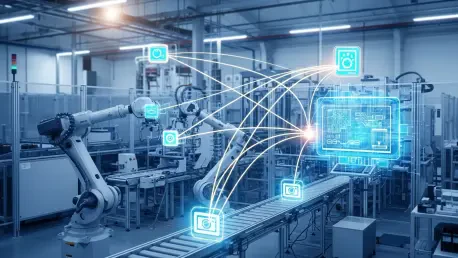

The deployment of high-performance silicon chips directly into robotic components has revolutionized how industrial facilities manage the massive influx of sensory data, effectively eliminating the latency associated with remote cloud processing. As manufacturing environments transition into hyper-connected ecosystems, the sheer volume of information generated by millions of vibration sensors, high-resolution thermal cameras, and laser scanners has reached a tipping point that traditional network architectures can no longer support. This shift toward localized intelligence is not merely a technical upgrade but a fundamental survival strategy for facilities aiming to maintain peak efficiency in an increasingly competitive global market. By moving machine learning models from centralized servers to the network edge, operators have granted their machines a form of digital autonomy that allows for reflexive, split-second decision-making. This evolution ensures that production lines can adapt to micro-fluctuations in power, material quality, or environmental conditions without the risk of communication delays that frequently plague cloud-dependent infrastructures.
Economic Drivers: The Financial Catalyst for Modernization
The financial incentives fueling the transition to localized intelligence are immense, with the market for these specialized systems projected to soar from approximately $6 billion to more than $40 billion between 2026 and 2033. This exponential growth is primarily driven by the rapid proliferation of industrial robots, which now operate in record densities across major manufacturing hubs such as East Asia and North America. As these robotic units generate a constant stream of high-fidelity data, the cost of transmitting that information to the cloud for analysis has become a significant drain on corporate resources. By processing data at the point of origin, companies have managed to drastically reduce their bandwidth consumption and cloud storage expenses, redirecting those savings into further research and development or plant expansions. Furthermore, the ability to maintain continuous operations during network outages provides a safety net that protects against the massive financial losses typically associated with unplanned downtime.
Building on these cost-saving measures, the competitive pressure to optimize equipment utilization has pushed facilities toward more sophisticated edge solutions. In modern high-output environments, even a few minutes of idling can represent thousands of dollars in lost revenue, making the real-time coordination of machine interactions a top priority for facility managers. Localized processing allows for a level of granularity in data filtering that was previously impossible, as smart sensors can now identify and discard irrelevant background noise while prioritizing critical performance metrics for immediate action. This selective processing ensures that only the most valuable insights are archived, streamlining the digital footprint of the entire organization. Consequently, the adoption of these technologies has become a benchmark for operational excellence, signaling to investors and stakeholders that a company is prepared for the rigorous demands of a data-saturated industrial landscape.
Architectural Shifts: From Observation to Responsive Action
The traditional digitalization model often focused on simple connectivity and the long-term observation of equipment health, but the current paradigm shift toward localized intelligence facilitates a transition toward truly responsive factories. Instead of merely collecting data to generate post-production reports that highlight past errors, modern systems use real-time inputs to take corrective actions as events occur on the factory floor. This architectural change decentralizes the control logic of the entire facility, moving away from a rigid model of central visibility toward a dynamic model of localized, distributed action. By distributing the “brain power” across various smart cameras and industrial PCs, the factory becomes a resilient network of independent actors that can collaborate without a single point of failure. This flexibility is essential for handling the complexity of modern manufacturing, where production requirements can change daily based on fluctuating consumer demand.
Moreover, the reduction in latency provided by this architectural shift is a critical factor for systems requiring millisecond-level precision, such as high-speed laser cutting or automated assembly of delicate electronics. When data must travel to a distant server and back, the resulting delay can be the difference between a perfect product and a defective one that requires expensive rework. Localized intelligence provides the necessary reflexes to manage these high-speed lines, allowing for instantaneous adjustments to motor torque or tool positioning. This operational resilience also extends to cybersecurity, as keeping sensitive data within the local network minimizes the surface area available for external attacks. By ensuring that critical processes continue to function safely even if the primary internet connection is interrupted, manufacturers have created a more stable and predictable environment for their workers and their automated assets.
Key Industrial Use Cases: Enhancing Reliability and Safety
Predictive maintenance has emerged as one of the most impactful applications of localized intelligence, successfully moving facilities away from inefficient reactive or rigid scheduled maintenance models. Research indicates that manufacturers leveraging these decentralized strategies have experienced significantly less unplanned downtime and a notable reduction in component defects, effectively saving billions of dollars across the broader manufacturing sector. By detecting subtle anomalies in machine vibration, heat dissipation, or acoustic signatures directly at the source, edge systems can identify the earliest signs of wear and tear before a total mechanical failure occurs. This proactive approach allows maintenance teams to schedule repairs during natural breaks in production, ensuring that the supply chain remains uninterrupted while simultaneously extending the operational lifespan of expensive capital equipment.
Beyond the realm of maintenance, localized vision systems have redefined the standards for real-time quality assurance by catching microscopic flaws on the assembly line as they happen. These advanced sensors use high-speed image processing to compare every manufactured item against a digital twin, instantly flagging deviations that might be invisible to the human eye. This capability reduces material waste and minimizes the need for manual inspection, which directly boosts the profitability of high-volume production runs. Additionally, the technology plays a vital role in workplace safety by monitoring restricted zones and equipment operating limits with unerring accuracy. If a worker accidentally enters a hazardous area or if a machine exceeds its safe operating parameters, the edge system can trigger an immediate emergency shutdown. This localized oversight provides a level of protection that central systems cannot match, as the reaction time is dictated by the speed of the hardware rather than the speed of the network.
Strategic Implementation: Navigating Industry-Specific Adoption
While the automotive sector currently leads the way in adopting localized intelligence due to its historical reliance on high-precision robotics, the chemical and process industries are catching up rapidly as they deal with sprawling physical sites and inconsistent connectivity. Highly regulated sectors, including pharmaceuticals and food production, have prioritized edge computing for its ability to keep sensitive production data secure while maintaining a complete, auditable record of quality. Processing data locally ensures that proprietary chemical formulas and manufacturing processes remain protected within the physical confines of the plant, satisfying both internal security protocols and external regulatory requirements. This industry-specific tailoring of AI implementation reflects a growing understanding that localized intelligence is not a one-size-fits-all solution but a versatile tool that can be adapted to the unique challenges of different manufacturing environments.
For leadership teams, the decision to implement these systems depended on a careful evaluation of specific operational needs, such as data sovereignty and the requirement for near-zero latency. Successful deployment often involved integrating new AI models with existing legacy hardware, such as programmable logic controllers that have been the backbone of industrial control for decades. Bridging the gap between traditional hardware and modern software required a strategic approach to lifecycle management, as AI models are not static assets but dynamic entities that require constant monitoring and retraining to remain effective over time. Leaders had to ensure that their technical staff possessed the skills necessary to manage these localized networks, blending the worlds of information technology and operational technology. This integration of human expertise and machine intelligence has become the hallmark of a modern, efficient manufacturing strategy that prioritizes long-term sustainability over short-term gains.
Governance and Platforms: Scaling the Intelligent Network
As localized intelligence moved into core production roles, it faced increased regulatory oversight, particularly from landmark legislation like the European Union’s AI Act. Manufacturers were required to implement robust governance frameworks to ensure that their machine learning models remained transparent, secure from cyber threats, and subject to consistent human supervision. Addressing these regulatory requirements was essential to avoid significant legal liabilities and operational risks, especially as AI became more integrated into high-risk machinery that interacts directly with human workers. Governance also involved ensuring that the data used to train these models was free from bias and that the decision-making processes of the machines could be audited in the event of an incident. This focus on ethical and transparent AI has fostered greater trust between human operators and their robotic counterparts, leading to more harmonious factory environments.
The industry also transitioned toward integrated platform ecosystems, where major hardware and software providers offered unified solutions for the large-scale deployment of intelligence. These platforms allowed manufacturers to manage, update, and monitor AI models across thousands of localized devices from a single, centralized interface, greatly simplifying the management of complex digital networks. This platform-based approach made it much easier for companies to scale their digital transformations from a single pilot machine to a global network of smart factories, ensuring consistency in performance and quality across different geographic regions. By leveraging these ecosystems, organizations could rapidly deploy security patches and performance optimizations, keeping their entire infrastructure at the cutting edge of technological capability. This ability to scale intelligence rapidly has become a key differentiator for companies looking to dominate their respective markets.
Future Considerations: Moving Toward Autonomous Optimization
The transition toward autonomous production focused on the democratization of intelligence, where every individual sensor on the factory floor possessed the cognitive capabilities necessary to interpret its own environment. Operational leaders successfully integrated these capabilities into decentralized models, allowing systems to experiment with process variables in real-time to find the most efficient operating parameters. This evolution moved the industry beyond simple automation toward a state of self-optimizing production, where machines learned from their own experiences to reduce energy consumption and material waste. Companies that prioritized the integration of these localized models early on gained a significant competitive advantage, as they were able to pivot their production strategies faster than those relying on traditional, centralized control structures. The focus eventually shifted toward the long-term sustainability of these systems, ensuring that the increase in processing power did not lead to an unsustainable rise in energy usage.
To maintain this momentum, future strategies should involve the continuous refinement of edge-native algorithms and the adoption of open-source standards to prevent vendor lock-in. Investing in the ongoing education of the workforce was a vital step, as the role of the industrial engineer evolved to include the management of distributed digital intelligences. Organizations that fostered a culture of experimentation and data-driven decision-making were the ones that most effectively harnessed the power of localized AI to transform their operations. The key takeaway for the industry was that while the technology provided the tools for transformation, the human element remained essential for defining the goals and ethical boundaries of autonomous systems. Moving forward, the industry must continue to balance the pursuit of efficiency with the need for safety and transparency, ensuring that the benefits of localized intelligence are shared across the entire value chain.