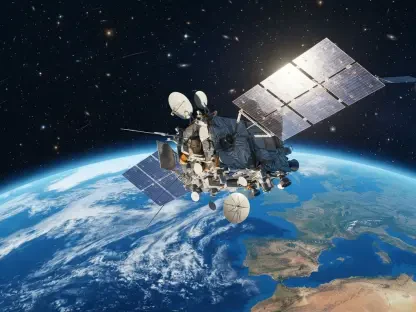

The traditional boundaries of terrestrial telecommunications are rapidly dissolving as the global push for sixth-generation (6G) networks accelerates toward its 2030 commercialization target. By integrating artificial intelligence directly into the fabric of communication protocols, engineers are attempting to solve the problem of “ubiquitous connectivity”—a state where high-speed data and intelligent processing are available even in the most remote corners of the planet. While current 5G systems rely heavily on localized ground-based towers, the next evolution requires a radical departure from stationary infrastructure. The International Telecommunication Union (ITU) has recently emphasized that the success of 6G hinges on the seamless convergence of space-to-ground networks and distributed AI. This shift is not merely about faster speeds; it is about creating a global intelligence ecosystem where data processing moves as freely as the signals themselves, bridging the gap between urban centers and the digital wilderness.
Architectural Innovations in Space-Ground Integration
Mechanics of Fluid Learning Schemes
A significant hurdle in deploying 6G intelligence involves the inherent difficulty of training complex AI models across vast, moving distances where permanent connections are non-existent. The proposed Fluid AI framework addresses this by introducing a “model-dispersal” federated learning scheme that turns the high mobility of satellites into a strategic advantage for data synchronization. Rather than requiring constant, power-hungry inter-satellite links, the system leverages the orbital trajectories of low-Earth orbit (LEO) constellations to naturally mix model parameters as they pass over different geographical regions. This decentralized approach allows the network to function without a massive central ground station, significantly reducing the overhead costs usually associated with space-bound computing. By treating the movement of hardware as a facilitator for data distribution, the framework achieves a level of flexibility that traditional static models simply cannot match, leading to faster convergence times and higher overall accuracy in diverse environments.
Furthermore, this fluid learning methodology utilizes a collaborative environment where each satellite acts as both a communication node and a specialized computing server. As these satellites orbit the Earth, they collect local data and update portions of an AI model, which are then “passed” to the next satellite in the sequence through opportunistic links. This creates a continuous flow of intelligence that mimics the natural movement of water, allowing the system to adapt to changing network densities and regional demands in real-time. Because the training process is distributed across the entire constellation, the risk of a single point of failure is mitigated, ensuring that the global AI remains operational even if specific ground stations are offline or if certain satellites experience temporary interference. This robustness is essential for maintaining the integrity of 6G services during large-scale deployments, where environmental factors and orbital mechanics introduce constant variables that would otherwise cripple a more rigid infrastructure.
Optimizing Real-Time Task Execution
In the realm of edge intelligence, the latency involved in sending data to a central cloud for processing is often the primary bottleneck for time-sensitive applications like autonomous navigation or remote disaster response. Fluid AI mitigates this by implementing a cascading neural network partition strategy, where complex AI tasks are broken down into smaller sub-models distributed across available space and ground nodes. By employing “early exiting” techniques, the system can provide a “good enough” answer quickly if the link capacity is low, or continue processing for higher accuracy if the connection remains stable. This dynamic balancing act ensures that the flow of inference is never fully interrupted by the shifting positions of satellites. As a satellite moves out of range of a specific user, the next node in the orbital chain seamlessly picks up the processing task, maintaining a state of “fluid inference” that keeps latency within the strict sub-millisecond requirements expected of 6G technology.
This layered processing approach also allows for a more efficient use of onboard satellite resources, which are often limited by strict size, weight, and power constraints. Instead of attempting to run a full, heavy AI model on a single satellite, the workload is spread across the network, utilizing the collective power of the constellation. This collaborative execution means that even smaller, less capable satellites can contribute to high-level cognitive tasks, effectively democratizing AI capabilities across the entire orbital fleet. The result is a highly responsive intelligence layer that sits just above the atmosphere, capable of providing immediate insights to ground-based users regardless of their proximity to traditional data centers. This paradigm shift ensures that 6G is not just a faster pipe for data, but a thinking network that processes information at the edge, where the speed of response can quite literally be a matter of life and death in critical mission scenarios.
Overcoming Environmental and Operational Hurdles
Maximizing Resource Efficiency and Delivery
The distribution of AI models to end-users on the ground presents a unique logistical challenge, particularly when thousands of devices may require simultaneous updates to their local intelligence. Fluid AI solves this through a sophisticated model-downloading scheme that prioritizes caching specific parameter blocks on satellites based on regional usage patterns. By using multicasting techniques, the framework can broadcast reusable model fragments to multiple ground-based devices at once, significantly improving spectrum efficiency and reducing the time a device must wait to receive a functional update. This method maximizes the “cache hit ratio,” ensuring that the most relevant and frequently used parts of an AI model are always available for quick retrieval. This is particularly effective for large-scale Internet of Things (IoT) deployments where thousands of low-power sensors need to synchronize their operational logic with the global network without draining their internal batteries.
Building on this efficiency, the integration of energy-aware scheduling becomes vital to ensure the long-term sustainability of space-based intelligence. Since satellites rely on solar power and have limited battery storage, the Fluid AI framework must intelligently time its most computationally intensive tasks for when the satellite is in direct sunlight or has excess energy reserves. This requires a deep coordination between the AI training algorithms and the satellite’s power management system, creating a symbiotic relationship where the network’s cognitive load is dictated by its physical energy state. By optimizing the delivery of models and the timing of their updates, the system avoids unnecessary transmissions and redundant processing, which in turn extends the operational lifespan of the satellite constellation. This focus on resource management ensures that the 6G edge intelligence layer remains reliable and cost-effective over years of continuous operation, even as the demand for AI-driven services grows.
Resilience Against Spacebound Extremes
The vacuum of space is an unforgiving environment characterized by intense solar radiation and extreme temperature fluctuations, both of which can cause bit-flips and hardware degradation in unshielded electronics. To protect the integrity of the Fluid AI framework, developers are shifting toward the use of radiation-hardened components and sophisticated fault-tolerant computing architectures. These systems are designed to detect and correct errors in AI model parameters in real-time, preventing the “corruption” of the global intelligence flow. Furthermore, the intermittent nature of satellite power supplies necessitates the use of non-volatile memory and checkpointing strategies, allowing the AI training process to pause and resume without losing progress during periods of low energy or orbital occultation. This level of hardware-level resilience is the foundation upon which the software-defined Fluid AI rests, ensuring that the “flow” of intelligence is not interrupted by the harsh physical realities of the orbital environment.
Beyond physical durability, the next frontier for Fluid AI involves securing the network against evolving cyber threats that seek to intercept or manipulate the distributed model updates. As 6G becomes the backbone of critical global infrastructure, the security of its integrated AI must be absolute, requiring advanced encryption and decentralized verification methods to ensure that every “drop” of data in the fluid network is authentic. Future research is already pivoting toward low-latency security protocols that do not sacrifice the speed advantages of the fluid architecture. This holistic approach—combining radiation-hardened hardware, energy-efficient scheduling, and robust cyber-defenses—transforms the Space-Ground Integrated Network from a simple communication tool into a hardened, global platform for edge intelligence. The transition to this model represents a major leap forward, providing a blueprint for how AI will eventually permeate every aspect of our connected world, from the depths of the oceans to the furthest reaches of the atmosphere.
Strategic Path Toward Global Implementation
The transition toward 6G Fluid AI demands a immediate shift in how telecommunications providers and satellite operators approach collaborative infrastructure. To move from theoretical frameworks to practical application, industry leaders should prioritize the development of standardized communication protocols that allow heterogeneous satellite constellations to share data and processing tasks seamlessly. This standardization will prevent the creation of “digital silos” in space, ensuring that intelligence can flow across hardware owned by different nations or private entities. Furthermore, investment must be directed toward low-power neural network architectures that are specifically optimized for the unique constraints of space-based edge computing. By focusing on modularity and cross-platform compatibility, the global community can build a resilient intelligence layer that is capable of supporting the next generation of autonomous systems and hyper-connected services.
Moving forward, the primary focus for researchers and engineers must be the integration of real-world environmental feedback loops into the Fluid AI training process. This involves creating “digital twins” of the orbital and terrestrial network environments to simulate and predict potential disruptions before they occur. By using these simulations to refine the fluid learning and inference algorithms, the network can become self-healing and proactive, anticipating shifts in demand or signal degradation. Stakeholders should also consider the ethical and regulatory implications of a truly global, ubiquitous AI, ensuring that data privacy and sovereignty are maintained across international borders. As the 2030 commercialization window approaches, the emphasis should remain on building a system that is not only technically superior but also fundamentally secure and energy-conscious. The successful implementation of Fluid AI will mark the beginning of an era where intelligence is a shared, global resource, accessible to all regardless of geography.