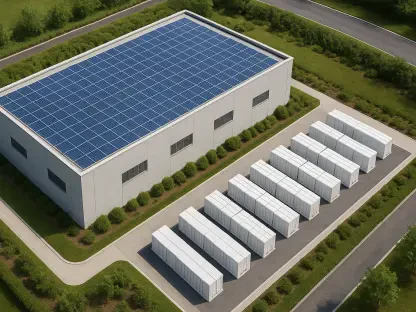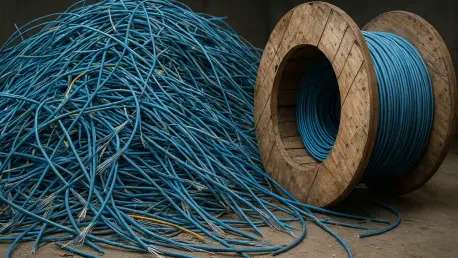

Blue Owl Capital and major construction firms like Turner are managing the industrial-scale buildout of the 4-million-square-foot Hyperion facility in Louisiana. This project represents the tangible shift from the ethereal cloud to a massive physical reality where silicon meets industrial steel and glass. The rapid expansion of Artificial Intelligence has moved beyond the digital realm and into a massive industrial buildout, sparking an unprecedented demand for physical infrastructure. As tech giants race to construct gigawatt-scale data centers, the industry has hit a significant bottleneck in the supply of optical fiber. This transition from traditional copper wiring to high-speed glass connectivity is no longer just a preference but a physical necessity driven by the extreme performance requirements of modern GPU clusters. The sheer volume of material required for these facilities is reshaping the global supply chain, turning fiber-optic production into a critical national security priority. This infrastructure is the bedrock upon which the next generation of computing is being built, requiring a scale of manufacturing that has rarely been seen in the technology sector before.
Scaling to Meet the Hyperion Standard
Meta’s Hyperion project in Louisiana serves as the primary case study for this massive surge in hardware demand across the global market. Originally conceived as a 2GW facility, the project has ballooned into a 5GW campus with a total investment commitment reaching $50 billion. Spanning 4 million square feet, this site alone is a primary driver of the current fiber crunch, necessitating nearly endless miles of connectivity. The project has necessitated complex joint ventures involving major construction firms and utility providers, all working to upgrade power grids to support the facility’s immense energy and connectivity needs. Industry experts now estimate that a state-of-the-art data center can require up to 8 million miles of optical fiber, which is enough glass to circle the Earth 320 times. This massive requirement has forced developers to secure long-term contracts with glass manufacturers well in advance of breaking ground, ensuring that the physical connectivity keeps pace with the deployment of advanced chips.
While the ambition for AI infrastructure is global, there is a widening gap between announced projects and actual construction progress. Out of nearly 4,000 data centers announced in the United States, only about 20% are currently under construction due to supply chain bottlenecks, power grid limitations, and community pushback. This discrepancy has created a highly concentrated and profitable cycle for specialized suppliers who can actually deliver the necessary components to the sites that have successfully broken ground. The complexity of these projects goes beyond mere square footage; it involves securing massive quantities of specialized cooling systems, power transformers, and, most critically, high-bandwidth optical cables. Developers who secured their supply lines early are now pulling ahead, while others face delays that could stretch for several years. This environment has transformed the data center industry from a real estate play into an industrial procurement race where the availability of physical components dictates the timeline of global AI advancement.
Market Leaders: Navigating the Global Supply Chain
Corning has emerged as a dominant force in this new landscape, securing a multi-billion dollar agreement to supply Meta’s massive requirements. To keep pace with demand from other tech titans like Google, Amazon, and Microsoft, the company is expanding its operations to create the world’s largest fiber-optic cable plant. Their enterprise sales have surged as they provide the essential tools for the AI era, transforming specialized glass into a critical strategic asset for the world’s largest companies. This expansion is not just about quantity but also about the technical sophistication of the fiber being produced. These new cables must handle higher data rates with lower latency and less signal loss than ever before. By positioning itself as the primary provider for hyperscale environments, Corning has anchored its business model to the core infrastructure of the modern economy, ensuring that every rack of GPUs is interconnected with the highest-grade glass available. The demand remains relentless as more facilities move toward full optical integration.
Other key market participants like Lumentum and Coherent are seeing similar windfalls, with revenues doubling as data center architects prioritize optical links for high-speed workloads. Both companies have received significant direct investments from NVIDIA, signaling the importance of optics to the broader semiconductor ecosystem. Meanwhile, mid-cap players like Applied Optoelectronics are struggling to keep up with orders, as demand for high-capacity optical products consistently outpaces their current manufacturing capabilities. This surge in capital infusion into optical component manufacturers highlights a fundamental shift in the AI value chain. No longer is the focus solely on the logic chips; the interconnects that allow these chips to communicate have become equally vital. The intense pressure on production lines has led to a consolidation of the market, where only the most well-funded and technically advanced manufacturers can survive the rigorous performance standards demanded by today’s leading-edge AI training clusters and large-scale data processing hubs.
The Physics of AI: Moving Toward Optical-First Design
The consensus among industry analysts is that the physics of AI has made the transition to fiber-optic technology inevitable. As compute clusters grow larger and more powerful, the heat and signal loss associated with traditional metal wiring make it obsolete for the long-range connections required within modern data centers. Copper suffers from severe signal degradation after only three meters at high speeds, a limitation that is incompatible with the sprawling architecture of massive AI campuses. To maintain performance, the industry is pivoting toward co-packaged optics and fiber-optic links to connect thousands of GPUs within a single campus. This transition is a direct response to the laws of thermodynamics and electromagnetism. As power densities increase, the electrical resistance in copper generates excessive heat, creating a cooling nightmare for operators. Fiber-optics, by contrast, utilize light to transmit data, generating significantly less heat and allowing for much longer transmission distances without losing any critical data integrity.
This has led to a fundamental move toward optical-first design, a trend that is expected to persist for several years as global manufacturing capacity struggles to catch up with the sheer scale of the AI buildout. Data center designers are no longer treating connectivity as an afterthought; instead, the entire internal architecture of the facility is being built around the optical mesh. This shift involves integrating optical transceivers directly onto chip packages to minimize the distance data travels over traditional copper traces. Such co-packaged optics represent the cutting edge of semiconductor packaging, requiring a level of precision that was previously unnecessary in standard server environments. The resulting efficiency gains are critical for scaling AI models to the next level of complexity. As the industry moves forward, the reliance on these advanced optical interlinks will only deepen, forcing a complete reimagining of how data centers are cooled, powered, and physically organized to optimize light-based communication for every single server rack.
Strategic Imperatives: Building a Resilient Digital Backbone
Ultimately, the data confirmed that while AI was a software revolution, its foundation was built on heavy industrial infrastructure. The requirement for millions of miles of fiber for individual sites underscored the transition of the technology sector into a material-heavy industry. For the manufacturers of glass, lasers, and optical switches, this capacity crunch represented a generational growth cycle, defining the physical reality of the next decade of computing. To mitigate these shortages, leading enterprises began diversifying their supply chains and investing in alternative materials that could supplement traditional silica-based glass. They also focused on vertical integration, acquiring smaller component manufacturers to ensure a steady flow of parts. This proactive approach allowed the most resilient firms to bypass the general market slowdown and continue their expansion despite global scarcity. The shift toward a more robust procurement strategy became the hallmark of successful data center operators in this highly competitive environment.
Moving forward, the industry prioritized the development of standardized optical modules to simplify manufacturing and accelerate deployment across various regions. This strategic shift ensured that infrastructure remained a facilitator rather than a barrier to innovation, setting the stage for a more resilient and scalable global digital backbone. Organizations also looked toward regionalizing their manufacturing bases to reduce the risks associated with long-distance logistics and geopolitical tensions. By establishing localized production of critical optical components, the sector increased its speed to market and reduced its environmental footprint. These steps collectively addressed the immediate crunch while creating a blueprint for sustainable growth in the era of high-density computing. The lessons learned from this period of intense demand provided a new framework for how digital and physical assets must be synchronized to support the ongoing evolution of artificial intelligence and its integration into every aspect of the modern global economy.