
Matilda Bailey has spent the better part of two decades at the intersection of networking and high-performance computing, witnessing firsthand the architectural shifts that define modern data centers. As enterprises transition from experimental AI to industrial-scale deployment, the need for integrated, rack-level solutions has never been more urgent. In this discussion, we explore the strategic launch of AMD’s Helios infrastructure, a complete system that combines the MI455X Instinct GPUs with EPYC Venice processors and Pensando networking. We delve into how this “rack-scale” philosophy challenges the current market dominance of proprietary stacks, the critical role of massive HBM4 memory in handling frontier models, and the ongoing software battle between the long-established CUDA ecosystem and the evolving ROCm platform.
How does the strategic shift from selling individual accelerators to offering a fully integrated, liquid-cooled rack-scale system like Helios change the playing field for enterprise AI?
This move represents a fundamental maturation of AMD’s strategy, signaling that they are no longer content being just a component supplier but are ready to be a full-stack architect. By integrating 72 Instinct MI455X GPUs with EPYC Venice CPUs and Pensando Vulcano networking into a single Helios rack, they are addressing the massive engineering burden that usually falls on the customer. You can feel the shift in the industry; it’s the difference between buying a box of high-end car parts and driving a finely tuned performance vehicle off the lot. This integrated approach, complete with a liquid-cooling design that utilizes quick-disconnect connections to efficiently whisk away the immense heat generated by these chips, makes it a viable alternative for sovereign computing and frontier AI. It is AMD’s most aggressive shot yet at disrupting the status quo, offering a turnkey solution that can be rolled into a data center and put to work almost immediately.
With Helios boasting 31TB of HBM4 memory and massive bandwidth, what specific advantages does this provide for developers working on long-context processing and memory-heavy frontier models?
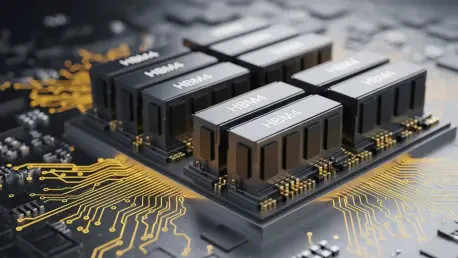
The memory specifications of the Helios rack are its true standout feature, providing about 50% more total memory than the most comparable competing systems on the market today. When you have 31TB of HBM4 memory supported by a staggering 19.6TB/s of memory bandwidth, you are essentially widening the highway for data to flow without the typical bottlenecks that stall large-scale training. For developers, this means the ability to run incredibly large AI models and handle long-context processing that would otherwise require multiple racks of hardware just to hold the data in memory. We are seeing performance metrics reach up to 2.9 EFLOPS of FP4 and 1.4 EFLOPS of FP8 compute, which provides a visceral sense of power when you are crunching through massive inference or distributed training workloads. This extra headroom is not just a luxury; it is a necessity for the next generation of AI services that require high-throughput and immense system efficiency.
AMD has leaned heavily into open standards like UALink and Ultra Ethernet for the Helios architecture; why is this choice so critical for the long-term health of the data center ecosystem?
Choosing open, industry-standard connections like the OCP Open Rack Wide (ORW), UALink, and the Ultra Ethernet Consortium (UEC) is a deliberate push back against the “walled gardens” that have dominated the AI landscape. It provides architects with a sense of freedom and flexibility, ensuring that they aren’t locked into a single vendor’s proprietary interconnect technology for the next decade. This architecture, which utilizes Pensando networking, allows for more efficient data movement across the entire data center while maintaining high levels of serviceability and power optimization. Furthermore, by building on open standards, Helios can integrate a hardware root of trust and continuous attestation at every layer, ensuring that even in complex multi-tenant environments, the data and models remain isolated and encrypted. It’s a strategic bet that transparency and interoperability will eventually be more valuable to global enterprises than the raw, isolated speed of a closed system.
Software maturity is often cited as the “weak spot” for non-Nvidia hardware; how is the expansion of the ROCm platform specifically addressing the needs of developers who are accustomed to the CUDA ecosystem?
There is no denying that the rival CUDA software has a formidable 15-to-20-year head start, and that weight of history means almost every AI tool and codebase currently defaults to it. AMD is fighting an uphill battle, but they are making significant strides by expanding the ROCm software stack to natively support the frameworks developers use every day, such as PyTorch, TensorFlow, and JAX. While ROCm is now highly usable for standard, high-throughput inference and everyday AI tasks, the challenge remains with the most specialized, cutting-edge optimizations where setup can still feel more complicated than its more mature counterpart. The goal for AMD isn’t necessarily to replicate every single niche feature of CUDA instantly, but to provide a robust, familiar workflow that allows developers to migrate their models without feeling like they are learning a completely new language. As the software matures, the hardware’s superior memory and value proposition become much more compelling for organizations looking to scale their AI infrastructure.
With major players like Microsoft already deploying Helios for Azure AI services, what practical advice do you have for CIOs who are evaluating the total cost of ownership and the complexities of a multi-vendor data center?
The deployment by a hyperscaler like Microsoft serves as a powerful validation of the hardware’s readiness for high-volume inference and support for frontier models. For a CIO, the most immediate draw is that Helios is expected to be noticeably cheaper to purchase and operate, offering lower power consumption per GPU and a more competitive price point overall. However, you have to be pragmatic about the physical reality of these systems; they use incompatible connection technologies, meaning you can’t simply plug an AMD rack and an Nvidia rack together into one combined super-machine. They must run side-by-side as separate systems handling different specific jobs, which is actually a common and effective strategy in modern data centers. My advice is to use this new option as leverage in negotiations and as a safeguard against the supply shortages that have plagued the industry, provided your engineering team verifies that your specific AI tools run smoothly on the ROCm stack.
What is your forecast for the AI infrastructure market over the next three years?
I anticipate a significant pivot toward “sovereign AI” and a diverse infrastructure landscape where the current monopoly on high-end compute begins to dissipate. As the demand for memory bandwidth continues to skyrocket, the focus will shift from raw FLOPS to how much data a system can hold and move efficiently, which plays directly into the strengths we see in the Helios design. We will likely see a hybrid approach become the standard, where organizations use specialized proprietary clusters for experimental research but shift their massive, production-grade inference workloads to more open, cost-effective, and power-efficient racks. By 2027, the ability to scale efficiently across global data centers using open standards like UALink and Ultra Ethernet will be the primary differentiator, and the current hardware gap will have closed significantly, making software ecosystem compatibility the final—and most important—frontier for total market parity.