
Lead: The Rising Tide Meets the Server Rack
Beneath flight paths and container cranes, where fiber landings lace the seabed and grid nodes hug the coast, a new class of data center is edging into view—floating, seawater-cooled, and positioned to feed AI’s hunger without squeezing the last buildable acre on shore.
In the busiest digital hubs, the math no longer works the old way. The International Energy Agency estimates data centers consumed about 415 TWh of electricity in 2024 and could reach roughly 945 TWh by 2030, with generative AI as the main accelerant. Those curves collide with a coastal paradox: the most networked places are the hardest to expand, as land competition, strained interconnections, and heat density push conventional campuses past comfortable limits.
Near the docks, a counterproposal has moved from whiteboard to quay wall. By shifting compute onto barges or platforms, developers argue, operators can tap coastal substations and submarine cables, reject heat with seawater, and sidestep the thorniest land-use fights. It is a proposition equal parts engineering, permitting, and patience—and its promise is being tested in ports from California’s delta to Southeast Asia’s shipping corridors.
Nut Graph: Why Water Beckons Now
The case begins with three interlocking constraints. First, land in core metros is scarce, expensive, and contested, with neighborhoods and logistics vying for the same footprints that data centers need. Second, power is constrained, not just in absolute megawatts but in how quickly firm, redundant capacity can be interconnected. Third, cooling for AI and HPC racks—many already transitioning to liquid loops—stresses air-cooled layouts that shaped the last decade of builds.
These pressures converge most severely along coasts. Cable landings and interties concentrate there; ports offer industrial zoning and access; yet urban density makes new campuses politically and physically fraught. Island economies and city-states add a fourth variable: sustainability mandates that demand growth without fresh-water draw or carbon creep. In such settings, moving capacity onto the water reframes the siting puzzle.
Policy is acting as a forcing function. Singapore’s staged reopening illustrated the point: about 80 MW awarded through a sustainability-focused pilot, followed by a Green Data Centre Roadmap targeting at least 300 MW and a further 200 MW tied to greener power approaches, then an additional call seeking at least 200 MW more with low-carbon conditions. The message was not permissive sprawl; it was selective capacity where efficiency and carbon performance are demonstrably better. Floating proposals align with that calculus.
Body: Experiments, Evidence, and Engineering Hurdles
Nautilus Data Technologies offered one early data point in Stockton, California, where a 6.5 MW, permanently moored facility reported a 1.15 PUE, no cooling towers, and no freshwater consumption. The project did not rewrite data center physics, but it showcased how seawater heat rejection can take pressure off both power budgets and local hydrology—two critiques frequently aimed at hyperscale growth.
Microsoft’s Project Natick approached the question from a different angle: a sealed subsea capsule, placed near the Orkney Islands for a two-year reliability and thermal study. The aim was to learn whether controlled underwater environments could enhance uptime by stabilizing temperature and reducing oxygen-driven corrosion. While not a commercial template, the results suggested nontraditional siting can meet mission-critical expectations when variables are tightly managed.
Developers of floating platforms now frame the value stack in four parts. Proximity to power and fiber reduces the need for long-lead interconnects and terrestrial rights-of-way. Seawater-assisted cooling complements the growing shift to liquid-cooled AI racks, shedding heat more efficiently than air-based systems. Siting in marine or port zones dampens land-use flashpoints while remaining within city reach for maintenance. Finally, co-location with offshore wind or other marine renewables opens a pathway—still emergent—to lower-carbon compute.
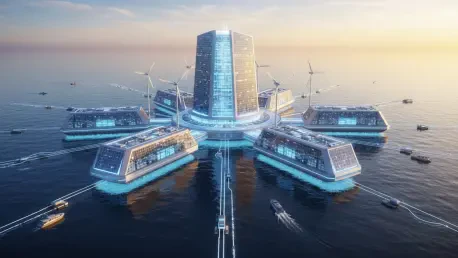
Keppel has promoted a modular, seawater-cooled concept for land-constrained urban markets, while Aikido Technologies is attempting a bolder integration: compute and power on the same floating frame. “Keeping sensitive electronics inside safe acceleration envelopes is the gating factor,” said Sam Kanner of Aikido. He pointed to low-frequency platform motions—on the order of 0.1 to 0.01 Hz—that can amplify accelerations higher above the waterline. The firm’s design tucks liquid-cooled modules into ballast tanks and pairs them with a 15–18+ MW turbine and batteries, targeting 10–12 MW of IT load per unit and aggregating across a wind farm.
The exploration is not limited to wind. Panthalassa’s Ocean-2 has probed wave energy as a prospective feed for sea-based compute, underscoring the sector’s curiosity about tight coupling between generation and load. Such hybrids remain early-stage, but they hint at a future in which some workloads sit beside bespoke power sources rather than waiting for inland interconnects that arrive years late.
Analysts and operators are parsing feasibility with healthy friction. “Floating platforms map cleanly to policy goals in constrained coastal markets,” said Mohammad Faisal Ahmad of BIS Research. “But mission-critical standards do not bend. Electrical design, redundancy, and safety must meet the same bars, with marine protections layered on.” On the other side of the ledger, JLL’s Sean Farney voiced the mainstream skepticism: “Show how to deliver and back up 100 megawatts or more, day one, on a platform that does not generate it, and the argument gets stronger. Until then, the operational complexity is tough to beat versus proven land-based modular builds.”
Behind the business case sits a battery of engineering realities. Structural dynamics top the list. Servers and storage tolerate certain vibration profiles, often tested around higher-frequency ranges, while floating platforms move slowly with waves and mooring loads. Designers are turning to hull forms, tuned mass dampers, isolation mounts, and equipment placement to keep accelerations within vendor limits, especially for gear installed far above the center of motion.
Power architecture is the next decisive layer. Nearshore platforms can rely on robust shore ties with redundant feeders, while offshore concepts need hybrid stacks—wind or other generation, batteries sized for ride-through, and possibly backup fuels—to deliver firm power. Each option influences uptime tiers, footprint, and capex. Connectivity presents parallel choices: diverse subsea paths, shore landings with maintainable joints, and wet-mateable connectors that minimize downtime during interventions.
Operations and maintenance demand a maritime toolkit. Corrosion control through coatings and cathodic protection, biofouling management, and weather windows for access all change staffing and scheduling. Spare parts may need to be staged at port depots, and procedures for tow-off, black-start, and evacuation must integrate offshore safety standards. Environmental reviews trade land-use disputes for marine scrutiny—thermal discharge limits, ecosystem impacts, and port traffic interactions shape approvals and timelines.
Where, then, does this pencil out? The consensus concentrates around coastal hubs and islands that face hard land and interconnection limits but host rich cable and grid infrastructure. There, floating capacity can serve as a pressure relief valve or as specialized AI clusters near urban demand. Inland, where land is abundant and utilities can extend capacity at lower cost, conventional campuses—evolving with direct-to-chip liquid cooling—retain the advantage.
Still, first movers have assembled a pragmatic playbook. Start with a nearshore pilot in the 5–10 MW range to verify thermal models, motion isolation, and O&M routines. Expand to multi-unit clusters within port or industrial zones, pooling interconnects and sharing marine logistics. Where policy and resource align, explore hybrid offshore generation-compute arrays, recognizing that firming, storage sizing, and lifecycle economics remain the gating steps to scale.
Conclusion: From Harbor Trials to a Working Segment
The path forward pointed toward action rather than hype. Developers finalized sites where land, power, and cooling collided; paired conservative engineering with mission-critical standards; and trained O&M teams to operate under maritime constraints. Policymakers weighed marine thermal and ecological impacts against the relief offered to urban grids and water systems. Investors demanded clarity on power guarantees and maintenance windows before underwriting multi-unit expansions.
For operators under acute coastal pressure, the next step had been targeted pilots that proved seawater cooling gains and vibration controls under live AI loads, not just in lab rigs. For markets crafting capacity roadmaps, procurement levers—priority interconnects for high-efficiency designs, credits for water stewardship, and defined review lanes for marine assets—had edged promising ideas into executable projects. And for platform designers, the hard problems had centered on power firmness, wet-mateable connectivity, and modular motion isolation kits that translated across ports.
Floating data centers did not replace the inland campus; they added a tool to the siting kit where benefits stacked and constraints bit hardest. As AI pushed power and heat past familiar thresholds, the waterline became less a boundary than a build zone, and the industry’s willingness to meet reliability bars at sea determined how much of tomorrow’s compute rode the swell rather than the sprawl.