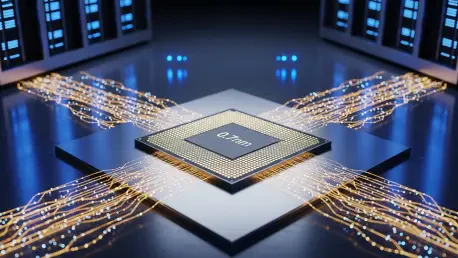

The relentless pursuit of miniaturization in the semiconductor industry has reached a pivotal juncture where traditional scaling laws no longer provide the exponential gains once taken for granted by global technology leaders. As the demand for generative artificial intelligence and complex neural networks continues to outpace existing hardware capabilities, the announcement of IBM’s 0.7nm chip technology represents a significant leap beyond the current 2nm standards that dominated the market through 2025. This advancement is not merely a reduction in physical dimensions but a fundamental reimagining of how transistors operate at the sub-atomic scale. By leveraging innovative materials and gate architectures, this breakthrough promises to redefine the boundaries of computational density, potentially offering a sustainable path forward for the energy-intensive data centers that power the modern digital economy. The shift toward sub-nanometer nodes introduces a new era of engineering where quantum tunneling and thermal management become the primary design constraints.
The Transition From Vertical Transport To Nanosheet Architecture
Achieving a 0.7nm process node requires a departure from the fin field-effect transistor designs that served as the backbone of the industry for over a decade. IBM has pioneered the use of nanosheet technology, which allows for precise control over the current flowing through the channel by wrapping the gate around all four sides of the transistor structure. This Gate-All-Around architecture significantly reduces voltage leakage, a critical hurdle that previously limited the performance of smaller nodes. Furthermore, the integration of Vertical Transport Field-Effect Transistors enables designers to stack components more densely than ever before, effectively decoupling the gate length from the physical footprint on the wafer. This transition facilitates an unprecedented increase in transistor count per square millimeter, allowing for more complex logic gates and larger on-chip cache memory. Such improvements are essential for handling the massive datasets required by contemporary machine learning models.
Beyond pure performance metrics, the move to a 0.7nm architecture addresses the escalating crisis of power consumption within the high-performance computing sector. As enterprises deploy increasingly large language models, the electricity required to maintain these systems has become a primary bottleneck for scalability and corporate sustainability goals. The enhanced efficiency of the 0.7nm node allows for a substantial reduction in operating voltage, which directly translates to lower thermal output and reduced cooling requirements for server racks. By optimizing the electron mobility within the silicon-germanium channels, engineers have successfully mitigated the resistive heating that plagued earlier 3nm and 5nm generations. Consequently, data centers can achieve higher throughput without needing to overhaul their existing power delivery infrastructure. This thermal headroom also permits higher clock speeds during peak processing loads, ensuring that time-sensitive AI inference tasks are completed with minimal latency.
Strategic Implications For Artificial Intelligence And Industry Implementation
The arrival of sub-nanometer chips arrives at a moment when the industry is transitioning from general-purpose GPUs to highly specialized AI accelerators designed for specific tensor operations. IBM’s latest architecture provides the foundational layer for these specialized circuits, offering the high bandwidth and low power necessary for real-time natural language processing and autonomous decision-making. With 0.7nm technology, the possibility of integrating billions of additional transistors onto a single die enables the inclusion of dedicated hardware blocks for transformer-based architectures. These blocks can execute matrix multiplications with far greater efficiency than current-generation hardware, shortening the training cycles for foundational models from months to weeks. As companies navigate the competitive landscape from 2026 to 2030, those who successfully integrate these advanced nodes into their product lines will likely gain a significant advantage in market share and technical leadership.
The development of 0.7nm technology was characterized by a decade of intense collaboration between material scientists and lithography engineers who overcame significant quantum interference challenges. Industry leaders prioritized the standardization of new interconnect materials, such as ruthenium or cobalt, to replace copper as the primary conductor at these minuscule scales. It was determined that organizations needed to begin auditing their hardware lifecycles immediately to prepare for the inevitable migration toward sub-nanometer infrastructure. This preparation involved a multi-phased approach, starting with the identification of high-priority workloads that benefited most from increased transistor density and energy efficiency. Additionally, it was recognized that software developers required optimized compilers and frameworks to leverage the unique architectural features of these new chips, ensuring that code was executed with maximum parallelism. Proactive planning for this hardware shift became the defining factor in maintaining operational excellence.