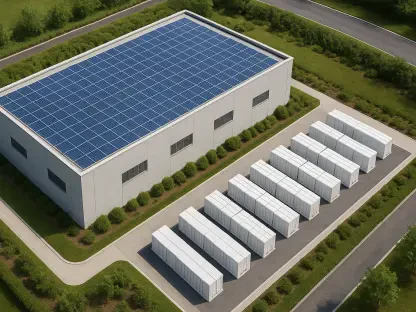

The transition from static AI models to autonomous agents is redefining the fundamental requirements of global computing infrastructure as processing demands hit unprecedented heights across every sector. Unlike previous years where large language models primarily responded to single, isolated queries, modern digital agents now navigate complex workflows by executing dozens or even hundreds of sequential tasks without human intervention. This fundamental shift in behavior has forced a complete overhaul of the underlying hardware and software layers to manage the massive surge in data processing, which recently surpassed 3.2 quadrillion tokens in a single month. To address this sevenfold increase in collective workload, Google has moved beyond incremental updates to implement a radical redesign that spans from the microscopic level of silicon architecture to the macroscopic scale of global fiber-optic networking. This new foundation is built to sustain millions of agents operating simultaneously in a persistent state.
Adopting a Philosophy of Hardware Elasticity and Persistence
The evolution toward an agent-heavy ecosystem necessitated a departure from traditional priorities such as simple raw throughput and basic low-latency response times. In the earlier stages of artificial intelligence development, the primary goal was to provide rapid answers to direct questions, but current agents perform up to 100 times more inference transactions as they work through multi-step reasoning processes and autonomous decision-making. To manage this intensive demand, the redesigned data centers emphasize a philosophy of extreme elasticity and resource persistence, allowing workloads to remain active for days or weeks rather than milliseconds. This agent-native approach ensures that computing resources are distributed widely across the fabric of the facility, allowing these digital entities to function as continuous, independent actors. By moving away from rigid, short-term processing cycles, the infrastructure now supports the long-term context storage required for complex tasks.
A central pillar of this architectural transformation is the aggressive deployment of custom silicon specifically engineered for agent-based workloads, highlighted by the debut of the TPU-8t and TPU-8i chips. The TPU-8t is designed specifically for high-performance training, offering triple the computing power of previous generations to manage the increasingly dense neural networks required for deep reasoning. In contrast, the TPU-8i focuses exclusively on inference, featuring significantly expanded memory capacity to better manage the key-value cache that is essential for an agent’s contextual reasoning over long sessions. By pairing these specialized accelerators with the power-efficient Axion CPU for general orchestration, the system minimizes the energy and time required for agents to interact with external software environments and third-party APIs. This vertical silicon integration allows for a level of performance tuning that was previously impossible with standard components.
Enhancing Software Orchestration and Global Networking
Beyond the physical layer of silicon and servers, the software stack has undergone a total retooling to manage the lifecycle and operational health of millions of active digital agents. The Google Kubernetes Engine has been specifically updated to provide a more responsive and granular environment for spinning up or shutting down agent containers as real-time demand fluctuates across the network. This level of orchestration is supported by the Pathways framework, which allows for highly distributed training sessions across a vast network of thousands of processors, effectively eliminating the traditional bottlenecks that often stalled large-scale deployments. These software improvements work in close tandem with the hardware layer to ensure that massive workloads can scale seamlessly across global infrastructure without any loss in efficiency. This synergy between software and hardware is what allows for the high availability and resilience necessary for mission-critical applications.
Connectivity remains a critical factor in maintaining consistent performance, leading to the development of networking breakthroughs such as TPUDirect and the Virgo networking architecture. TPUDirect streamlines data movement by bypassing traditional processing overhead, allowing for direct communication between accelerators that drastically reduces latency during complex multi-step reasoning tasks. Meanwhile, the Virgo technology can link up to one million TPUs into a single, cohesive cluster that operates with the unity of a single giant machine. This networking architecture is designed for maximum flexibility, supporting not only proprietary silicon but also massive configurations of third-party hardware, including the latest high-performance GPU packages from Nvidia. By creating a versatile platform that accommodates various hardware standards, the data center becomes a universal hub for the entire industry. This interconnectivity is the glue that prevents data silos.
Navigating Market Dynamics and Future Economic Models
The full-stack approach, characterized by the ownership of everything from the physical chips and networking protocols to the underlying software and models, provides a significant competitive edge in the current market. This vertical integration allows for faster optimization cycles and a more streamlined innovation process compared to competitors who remain heavily dependent on external hardware vendors for their core infrastructure. However, as the industry continues to mature from 2026 to 2028, the ultimate measure of success for these facilities will likely be the cost per token and the ability to deliver tangible business outcomes rather than just raw computing power. While the current infrastructure is incredibly powerful, it also demands a more sophisticated approach to resource management and energy consumption. Enterprises are encouraged to look beyond the hardware and focus on how these capabilities can be translated into specific workflows that enhance efficiency.
The strategic overhaul of the data center environment successfully shifted the focus from static responses to the dynamic, continuous processing required for autonomous agent operations. It became clear that the integration of specialized silicon like the TPU-8 series and the Axion CPU provided the necessary foundation for scaling intelligence across a global footprint. Moving forward, organizations were advised to prioritize infrastructure that offered the highest level of elasticity to avoid being locked into rigid, inefficient legacy systems. This transition highlighted the importance of a multi-cloud strategy to balance raw performance with the operational resilience needed to handle unpredictable agent behaviors. By optimizing the cost per token through vertical integration, the industry established a new standard for sustainable AI deployment. Stakeholders who embraced these architectural shifts early found themselves better positioned to leverage the potential of digital workers.