
The relentless expansion of artificial intelligence models has effectively shattered the traditional boundaries between computing nodes and the network switches that connect them. In the current landscape, the network is no longer just a highway for data; it is the vital nervous system that determines the speed and reliability of massive AI training clusters. As organizations push toward larger parameters and more complex generative models, the demand for bandwidth has surpassed the capabilities of older 400G and 800G standards, making 1.6T Ethernet the new benchmark for performance.
Arista Networks is meeting this challenge with the 7060XE7 Series, representing a significant move from selling individual hardware units toward delivering integrated, rack-scale solutions. This shift is critical because isolated components can no longer manage the sheer volume of data required by modern GPUs. By focusing on a unified architecture, the network becomes an extension of the compute layer, ensuring that data moves with the velocity required to prevent idle time in expensive AI infrastructure.
The Evolution: From Standalone Switching to Rack-Scale AI Infrastructure
The data center environment has transitioned from a collection of independent servers to a singular, massive computing entity. Arista’s strategy with the 7060XE7 Series recognizes that the network switch must now function as a component within a larger, integrated rack system. This development addresses the necessity of synchronized communication across thousands of processing cores, where even a millisecond of latency can derail a training cycle.
By providing a high-velocity backbone, 1.6T Ethernet serves as the glue for these expansive environments. The transition to this standard allows for a much higher density of connections within the same physical footprint, effectively doubling the throughput of previous generations. This enables enterprises to scale their AI fabrics more efficiently, ensuring that the network remains a facilitator of progress rather than a bottleneck for innovation.
The Challenge: Overcoming Thermal and Power Constraints of High-Density Workloads
Deploying generative AI at a massive scale has forced organizations to confront a physical reality where traditional power and cooling methods are becoming obsolete. High-performance GPUs consume significant energy, creating heat loads that standard air-conditioned data centers struggle to dissipate. This thermal “wall” has made energy efficiency a primary concern, as power consumption now dictates the physical limits of cluster size.
Arista’s latest networking platforms aim to bridge this gap by prioritizing thermal management alongside raw speed. As organizations migrate toward high-density clusters, the focus has shifted toward reducing the energy overhead of the networking equipment itself. Modern infrastructure must now balance the need for extreme performance with the practical limitations of the power grid and cooling capacity, making efficiency a key metric for any successful AI deployment.
The Engine: Next-Generation Silicon and Advanced Cooling Architecture
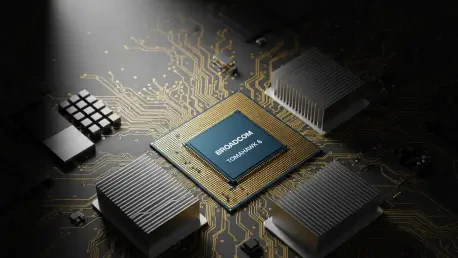
At the core of this 1.6T transition is the Broadcom Tomahawk 6 silicon, which delivers the processing power necessary for the next generation of data fabrics. To ensure this hardware works in harmony with the rest of the stack, Arista collaborated with AMD to optimize the interaction between compute nodes and Network Interface Cards. This technical synergy ensures that data flows between the network and the GPU with minimal friction, maximizing the utilization of every chip.
Managing the heat generated by such high-performance silicon requires a dual approach to cooling architecture. The current roadmap includes air-cooled models featuring integrated heat sink optics for immediate deployment, alongside specialized liquid-cooled platforms planned for the near future. These liquid-cooled designs are intended to eliminate internal fans, allowing for tighter component packing and significantly reducing the energy required to maintain optimal operating temperatures.
Technical Intelligence: Leveraging MRC Protocols for Congestion-Free Data Transport
Raw bandwidth is only one part of the equation; the intelligence of the network operating system determines how that capacity is managed. Arista’s Extensible Operating System provides the sophisticated packet buffering needed to handle microbursts of data that occur during intense AI workloads. Without this intelligence, the network would suffer from packet loss, leading to delays that significantly extend the time required to train a model.
A critical innovation in this portfolio is the support for the Multipath Reliable Connection protocol developed by the Open Compute Project. As an RDMA-based transport protocol, it allows data to be striped across multiple network paths at the same time. This capability ensures that the fabric remains highly utilized by automatically steering traffic around congested or failing links, maintaining the low-latency connections that are essential for stable AI training cycles.
The Strategy: Frameworks for Deploying 1.6T Fabrics in Large-Scale Environments
Major cloud providers such as Microsoft Azure, Meta, and Oracle validated these 1.6T platforms to establish a blueprint for large-scale enterprise adoption. These frameworks prioritized fabric utilization through automated congestion monitoring and intelligent path steering. By adopting this unified approach, operators built resilient environments that rivaled proprietary interconnects in speed while preserving the flexibility of open Ethernet standards.
Enterprises that integrated these systems realized a significant leap in operational efficiency. The transition helped them bypass the limitations of legacy hardware while maintaining the speed required for massive datasets. This transformation ultimately redefined the role of the network as the foundational layer of the global AI economy, ensuring that infrastructure could scale in tandem with the intelligence it supported.