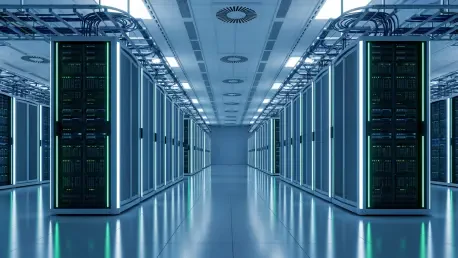

The global landscape of high-performance computing underwent a fundamental transformation when the silicon barriers of the past dissolved to make way for the integrated rack-scale supercomputing model known as Nvidia Vera Rubin. This launch signals a departure from the traditional approach of incremental hardware refreshes that once defined the semiconductor industry. Instead of simply introducing faster individual chips, the market has pivoted toward the “AI Factory,” a holistic system where the entire server rack functions as a single, cohesive supercomputer. This shift marks the end of an era where central processing units and graphics processors operated in isolated silos, replaced by a unified environment designed to handle the staggering throughput required by next-generation generative models.
The current movement suggests that specialized hardware is no longer just an accessory to the data center but is the very architecture upon which modern enterprise logic is built. This convergence of networking, memory, and compute power allows for a level of scalability that was previously unattainable. Consequently, the industry is witnessing a redefinition of performance metrics, where the efficiency of the entire rack takes precedence over the clock speed of a single component.
Moving Beyond Individual Silicon: The Era of Rack-Scale Supercomputing
The emergence of the Vera Rubin platform represents a philosophical shift in how computational power is harnessed for industrial applications. In the past, scaling a data center meant adding more servers in a linear fashion, often leading to diminishing returns due to the overhead of inter-device communication. Modern architectures have resolved this by treating the entire rack as the basic unit of compute, ensuring that data travels across the backplane with minimal resistance. This integrated approach allows for the execution of massive parallel workloads that were once restricted to elite national laboratories, now making them accessible to commercial enterprises seeking to refine their proprietary intelligence models.
Moreover, the transition to rack-scale systems has forced a rethink of how hardware components are synchronized. The Vera Rubin architecture utilizes high-speed interconnects that blur the lines between memory pools and processing cores, creating a massive, virtualized resource. This evolution means that the “AI Factory” is not just a marketing term but a literal description of a high-throughput environment where raw data enters and refined insights emerge at an unprecedented velocity. As a result, organizations are moving away from bespoke server configurations in favor of these standardized, high-density supercomputing blocks.
Why the Growing Complexity of LLMs Demands a New Architectural Foundation
The rapid evolution of large language models has exposed a critical bottleneck in legacy data center designs that were originally built for general-purpose web traffic. As models grow in parameter count, the latency introduced by moving data between storage, memory, and processors has become the primary constraint on performance. Traditional air-cooled facilities and fragmented networking setups are struggling to keep pace with the convergence of high-performance computing and commercial artificial intelligence. There is an urgent need for infrastructure that prioritizes memory bandwidth and thermal efficiency over raw clock speeds to prevent the systemic stalling of training clusters.
Furthermore, the physical limitations of traditional silicon become apparent when dealing with the petabytes of data required for modern inference. When data must travel across several inches of copper or through multiple network switches, the resulting micro-delays accumulate into significant performance losses. New architectural foundations focus on bringing memory as close to the logic gates as possible, minimizing the physical distance data must travel. This design philosophy is essential for sustaining the growth of complex models that require constant, high-speed access to vast weights and parameters.
Decoding the Vera Rubin Ecosystem: Liquid Cooling, Memory Density, and Unified Networking
The Vera Rubin architecture addresses modern bottlenecks through a tightly integrated stack of compute and networking technologies that define the modern high-density environment. By combining the Vera CPU and Rubin GPU with NVLink 6 and BlueField-4 data processing units, the platform creates an environment capable of handling every stage of the digital lifecycle. For instance, the Dell PowerEdge XE8812 showcases this shift with a fifty percent increase in memory per socket, effectively eliminating the need for data swapping. This allows massive simulations to run entirely in-memory, ensuring that the processor is never idling while waiting for information from a slow storage drive.
In contrast, Super Micro has focused on industrial-scale efficiency through its Data Center Building Block Solutions blueprint, which utilizes liquid-cooled racks capable of supporting over one thousand GPUs. This proves that facility design is now as critical as the silicon itself, as traditional fans cannot dissipate the heat generated by such intense concentrations of power. Additionally, the integration of the Groq 3 Language Processing Unit highlights a new focus on real-time inference at a scale previously thought impossible. These components work in tandem to ensure that networking does not become a hurdle, allowing the unified ecosystem to operate at peak theoretical performance without thermal throttling.
Quantifying the Shift: Global Investment Trends and Industry Sentiment
The transition to the Vera Rubin paradigm is backed by significant economic momentum and a clear consensus among enterprise leaders across the globe. According to recent projections from Gartner, the buildup of these foundations is set to inject an additional 401 billion dollars into technology spending by the end of the current cycle. Roughly eighty-seven percent of organizations now identify innovation in this sector as their top business priority, viewing high-performance infrastructure as a mandatory investment for survival. This sentiment is driving a fundamental reallocation of capital away from traditional server maintenance and toward advanced, AI-optimized clusters.
Investment in these specialized servers is expected to surge by forty-nine percent year-over-year, eventually representing nearly a fifth of all related expenditures. This financial acceleration reflects a realization that the cost of inaction is far higher than the price of upgrading to liquid-cooled, high-density systems. Furthermore, the industry-wide move toward advanced cooling solutions is no longer optional, as the extreme power density of these new systems makes air cooling obsolete for high-end deployments. Large-scale data center operators are increasingly prioritizing these systems to ensure they can meet the demands of a market that values speed and efficiency above all else.
A Strategic Roadmap for Enterprise AI Infrastructure Readiness
Adapting to the new supercomputing paradigm required more than just purchasing new servers; it demanded a comprehensive rethink of data center strategy. Organizations that sought to capitalize on this next generation of infrastructure followed a structured approach to deployment that began with a thorough audit of their physical facilities. This process ensured that floor load ratings and power distribution systems could handle the weight and intensity of liquid-cooled racks. By prioritizing memory bandwidth over raw floating-point operations, decision-makers ensured that data remained close to the processor, effectively reducing microsecond latencies that could otherwise hinder performance.
The implementation of advanced telemetry tools also played a vital role in maintaining system health and automating leak detection in these complex environments. Professionals utilized integrated rack controllers to monitor the delicate balance of power and temperature, allowing for proactive maintenance before issues escalated into downtime. Finally, the evaluation of preconfigured packages allowed enterprises to bypass the complexities of manual system integration. These strategic steps collectively ensured that the transition to next-generation infrastructure was not merely a hardware upgrade but a robust foundation for long-term computational resilience and scalable innovation.