


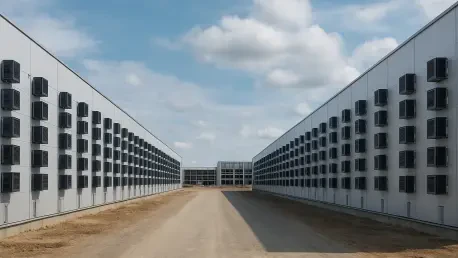

The silicon-etched dreams of the world’s most powerful technology corporations are currently crashing against the unyielding physical limits of an aging and overburdened national electrical grid. This collision represents more than just a minor hiccup in the roadmap of digital progress; it signifies a fundamental shift in how the global economy prioritizes the flow of electrons. For years, the digital revolution existed largely in a realm of weightless code and virtual interfaces, but the rise of generative artificial intelligence has brought that revolution down to earth. Now, the future of innovation depends less on the speed of a processor and more on the thickness of a copper wire and the permit for a transformer.
The significance of this infrastructure wall cannot be overstated, as it creates a direct competition for resources between the invisible algorithms of the cloud and the fundamental needs of residential communities. As tech giants move to secure massive amounts of power for their “AI factories,” local utilities are finding it increasingly difficult to balance these industrial demands with the mandate to provide affordable electricity to homeowners. This friction is sparking a new wave of political and economic debate that reaches far beyond the tech sector. It is a story about the limits of growth and the sudden, jarring realization that even the most advanced virtual intelligence requires a physical, energy-consuming footprint that the current world is not fully prepared to support.
The global technology sector is currently entangled in a historic paradox where the rapid-fire advancement of artificial intelligence has finally met an immovable object: the physical limits of the power grid. While software developers race to deploy more sophisticated models, the actual growth of these systems is no longer dictated by how fast engineers can write code, but by how quickly utilities can lay heavy-gauge wire. This friction has transformed the data center industry from a behind-the-scenes support sector into a primary front in the battle for energy security and regional stability.
The High-Stakes Collision: Silicon Ambition and Copper Reality
The transformation of the data center industry has been nothing short of staggering, moving from simple storage warehouses to the massive, power-hungry engines of the modern world. In this new landscape, the once-unlimited horizon of cloud computing is now being defined by the capacity of local substations and the health of high-voltage transmission lines. Tech executives, who once focused primarily on chip architecture and data latency, now spend their days negotiating with utility commissioners and environmental regulators. This shift highlights a critical vulnerability in the tech ecosystem: the digital world is entirely dependent on a physical infrastructure that was built for a different century.
The mismatch between digital ambition and physical reality is creating a bottleneck that threatens to slow the pace of global innovation for years to come. In regions like Northern Virginia, the heart of the global internet, the power requirements for planned facilities are so vast that they exceed the current capacity of the entire regional grid. This has led to a situation where projects are delayed not by months, but by years, as utilities struggle to build the new lines and substations needed to feed these mechanical giants. The resulting tension is palpable, as the industry realizes that its most precious commodity is no longer data, but a stable, high-capacity connection to the electrical network.
Furthermore, this collision is forcing a re-evaluation of how societies value different types of energy consumption. When a single data center project requests more power than several mid-sized cities combined, it prompts difficult questions about who should get priority in a power-constrained world. The debate is no longer confined to the boardroom; it is taking place in city council meetings and state legislatures where the “copper reality” of limited power is being weighed against the “silicon ambition” of global tech dominance. The outcome of these negotiations will determine not only the speed of AI deployment but also the future stability of the energy markets.
Energy Availability: The Ultimate Constraint for Innovation
For decades, the demand for electricity in the United States remained relatively stable, allowing the power grid to age without facing extreme pressure. The sudden “AI boom” has shattered this equilibrium, as a single high-performance data center can now require enough electricity to support millions of homes. This shift matters because it forces a zero-sum game between digital progress and residential affordability. As tech giants scramble to secure gigawatts of power, the connection between a virtual chatbot and a local utility bill has become a pressing real-world concern for both policymakers and the public.
This zero-sum dynamic is particularly evident in regions that have historically welcomed data center development as a source of tax revenue. However, the sheer scale of the energy demand is now outstripping the benefits, as the cost of upgrading the grid to accommodate these facilities often falls on the shoulders of general ratepayers. This has created a political firestorm, with residents questioning why their utility bills are rising to fund the infrastructure needed for multi-trillion-dollar corporations. The narrative of “clean tech” is being challenged by the reality of massive energy consumption and the environmental impact of the power plants required to sustain it.
The constraint on energy availability is also altering the competitive landscape among technology companies. Those with the deepest pockets and the most established relationships with energy providers are better positioned to weather the shortage, potentially leading to a market consolidation where only the largest players can afford to innovate. This creates a barrier to entry for smaller startups and research institutions that lack the capital to build their own power infrastructure or negotiate high-volume energy contracts. Consequently, the bottleneck in the power grid is effectively acting as a regulator on the entire AI sector, determining who can participate in the next wave of technological advancement.
Legislative Blocks: Navigating Gigawatt Demands and Regulations
The regulatory environment for data centers is undergoing a seismic shift, characterized by a wave of state-level moratoriums and increased scrutiny of industrial land use. New York’s recent executive order to halt new construction serves as a template for other jurisdictions concerned about resource depletion and skyrocketing utility costs. This legislative pushback coincides with a fundamental change in facility scale, where “AI factories” are evolving from modest 25-megawatt operations into massive 5-gigawatt sites. These megasites place a staggering burden on an infrastructure that was never designed to handle concentrated, high-density loads on such a massive scale.
In addition to state-level moratoriums, local zoning boards are becoming increasingly hostile toward new data center developments. Concerns about noise, water usage for cooling, and the aesthetic impact of massive windowless buildings are leading to a surge in rejected permits. The 127 jurisdictions that have implemented some form of restriction or moratorium represent a significant portion of the available land in traditional data center hubs. This forced migration is pushing developers toward more remote locations, which in turn creates new challenges related to transmission distances and the lack of existing fiber-optic and power infrastructure in rural areas.
The transition from megawatts to gigawatts is not merely a change in scale; it is a change in the very nature of industrial planning. A 5-gigawatt facility requires the same amount of power as a major metropolitan area, making it a critical infrastructure node that can impact the stability of an entire state’s grid. Regulators are responding by treating data centers more like heavy industrial utilities than office buildings. This means more stringent environmental impact studies, mandatory contributions to grid infrastructure projects, and requirements to provide “community benefits” such as lower electricity rates for local residents or investments in renewable energy.
Crisis Quantified: Economic Projections and Public Sentiment
Recent research highlights the severe economic friction caused by this infrastructure backlog, with electricity costs in high-growth regions like Virginia and Texas projected to rise as much as 57% by the end of the decade. The International Energy Agency notes that while general electricity demand is growing steadily, the energy appetite of AI-specific centers is surging by 50% annually. This imbalance is reflected in public opinion, with opposition to local data center projects jumping to 71% in just one year. For IT leaders, the bottleneck is now palpable: over 80% of decision-makers report that limited access to high-performance computing is a direct result of grid unreliability and capacity shortages.
The financial implications of these delays are equally staggering. With billions of dollars in capital waiting on the sidelines, the inability to connect to the grid is costing the industry massive amounts in lost productivity and missed opportunities. The North American vacancy rate for data center space has dropped to near zero, meaning that even if a company has the capital to deploy new AI models, they may simply have nowhere to put the servers. This shortage is driving up the cost of existing rack space, which in turn increases the price of AI services for consumers and businesses alike, creating an inflationary pressure throughout the digital economy.
The shift in public sentiment is perhaps the most difficult hurdle for the industry to overcome. In the early days of the internet, data centers were often seen as invisible, benign contributors to the local economy. Today, however, they are increasingly viewed as resource-depleting intruders. This perception is fueled by data showing that a single large facility can consume millions of gallons of water per day for cooling, often in areas already facing drought conditions. The combination of rising utility costs and perceived environmental damage has turned local communities into powerful adversaries, capable of stopping even the most well-funded projects through legal challenges and political pressure.
Engineering Autonomy: On-Site Generation and Radical Efficiency
To bypass the congested public grid, data center operators are adopting frameworks for energy self-sufficiency and modular growth. These strategies include deploying massive on-site fuel cell arrays and gas turbines to create “off-grid” primary power sources that do not compete with residential supply. Beyond power generation, the industry is transitioning to high-density liquid cooling systems—including immersion and direct-to-chip technologies—to drastically reduce the energy overhead required for climate control. By shifting toward smaller, smarter “micro-scale” facilities and investing in long-term nuclear solutions, developers are attempting to decoupling AI growth from the constraints of legacy infrastructure.
This move toward on-site generation represents a radical departure from the centralized utility model that has governed the industrial world for over a century. By becoming their own power producers, data centers can achieve a level of reliability and cost-predictability that the public grid can no longer guarantee. Companies like Oracle have already announced plans for massive on-site projects that utilize clean fuel cells, which emit fewer pollutants than traditional backup diesel generators. While these solutions require significant upfront capital, they provide a path forward for companies that cannot wait for the years-long process of traditional grid-interconnection queues.
Innovation is also happening at the rack level, where the focus has shifted from raw performance to performance-per-watt. The adoption of liquid cooling is particularly critical, as traditional air-based cooling systems can consume up to 40% of a data center’s total energy. Liquid cooling is much more efficient at removing heat from the high-density chips used for AI training, allowing for more compact and energy-efficient designs. This technological evolution demonstrated that the industry was capable of rapid adaptation when pushed to its limits.
The analysis of the infrastructure landscape clarified that the path forward for digital expansion required a complete decoupling from the fragile, traditional power systems of the past. It was observed that the most successful operators were those who integrated energy production directly into their site designs, essentially turning data centers into hybrid power-plants. The industry recognized that the era of treating electricity as an infinite, external resource had ended. Consequently, the focus shifted toward a more sustainable and independent model that prioritized regional stability and technological efficiency. These strategic pivots ensured that the next phase of innovation remained viable despite the persistent challenges of an aging physical world.







