
The journey of a single electron from a high-voltage utility substation to the logic gates of a high-performance processor is fraught with thermal leaks and architectural hurdles that drain millions of dollars in potential profit every single year. In the high-stakes environment of AI data centers, where electricity is the most critical resource, the traditional process of flipping current between alternating current (AC) and direct current (DC) is no longer a minor technicality. It has evolved into a significant financial and operational burden that threatens the very scalability of the modern digital economy.
This inefficiency acts as a silent tax on every calculation performed by a large language model. As individual racks transition from drawing a modest 10 kW to nearly 1 MW, the waste produced by legacy power paths is becoming impossible to ignore. Operators are now forced to confront a reality where power delivery is the primary bottleneck for both performance and environmental sustainability. Consequently, the industry is entering a period of radical redesign, shifting away from decades-old distribution models toward more direct and efficient electrical architectures.
The Invisible Energy Drain: Hindering AI Scalability
The fundamental challenge within modern facilities lies in the physical disconnect between how power is delivered and how it is consumed. Utility grids rely on AC for efficient long-distance transmission, but the silicon chips powering artificial intelligence require steady, low-voltage DC to function. This transition has historically been handled by a series of transformers and converters tucked away in back-of-house utility rooms, but the sheer scale of modern AI clusters has rendered these traditional methods obsolete.
When power density reaches the levels required for generative AI, the heat generated by even a tiny percentage of energy loss becomes a cooling nightmare. A conversion efficiency of 90 percent might have been acceptable in a legacy enterprise environment, but in a megawatt-scale rack, that missing 10 percent manifests as a massive amount of waste heat that must be removed by expensive liquid cooling systems. This creates a vicious cycle where more energy is spent managing the consequences of inefficient power delivery than is used for the actual computation.
Furthermore, the operational burden of maintaining complex AC-to-DC conversion hardware at such high densities increases the risk of facility downtime. Every additional component in the power path represents a potential point of failure that could take an entire cluster offline. As AI becomes integrated into critical business infrastructure, the demand for simplified, more resilient power paths is driving a total rethink of the facility-level electrical layout.
The Breaking Point: Why Legacy Infrastructure Fails
The disconnect between aging power grids and the explosive growth of artificial intelligence has reached a critical breaking point. With reports from the International Energy Agency showing a 17 percent surge in data center electricity demand over the last year, the strain on existing electrical systems is visible in nearly every major tech hub. Most current facilities were designed for traditional workloads with predictable power profiles, not the dense, erratic, and power-hungry clusters required for training massive neural networks.
This shift has transformed power conversion from a routine utility function into a primary obstacle for global sustainability and cost management. Global consumption is projected to triple by the end of the decade, yet the transmission infrastructure in many regions has not seen a significant upgrade in thirty years. The result is a widening gap between the energy the grid can provide and the energy that AI processors can actually utilize without overloading local distribution systems.
Moreover, the mismatch between the grid and the chip is forcing operators to seek unconventional solutions to keep their facilities running. Many are now experimenting with onsite generation and advanced storage, yet these additions only add more layers of conversion to an already complex stack. Without a fundamental change in how current is transformed and distributed within the rack, the industry risks hitting a ceiling where physical power constraints prevent any further advancement in AI model size or complexity.
The Conversion Tax: Quantifying Multi-Stage Power Loss
The primary culprit in energy loss is a phenomenon often described as the “ping-pong” effect of current transformation. Standard architectures typically take high-voltage AC from the grid and convert it to DC for battery storage, only to flip it back to AC for distribution across the server floor. Once the electricity reaches the IT rack, it is converted one last time back into the low-voltage DC required by the hardware. Each of these steps creates a conversion tax that bleeds energy into the surrounding environment.
These unnecessary stages represent the most direct lever that facility operators have for reducing their carbon footprint and improving their bottom line. Every time current passes through a transformer or an inverter, a portion of that energy is lost to resistance and switching inefficiencies. In an era where sustainability is a board-level priority, optimizing these paths is no longer just an engineering goal but a corporate necessity to meet strict environmental regulations and social responsibility targets.
In contrast to traditional systems, streamlined power paths minimize these transformations, thereby reducing the total thermal load on the facility. When conversion stages are removed, the demand for supplemental cooling drops proportionally, leading to a double-gain in overall efficiency. For a large-scale data center, the cumulative impact of these savings can total millions of kilowatt-hours annually, providing a competitive advantage to those who can master the complexities of direct-current distribution.
Industry Innovations: 800 VDC and Silicon Carbide Tech
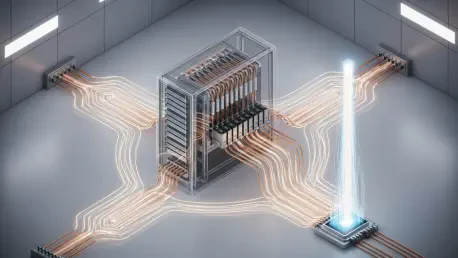
To combat these systemic losses, industry leaders like Nvidia are championing a shift toward 800 VDC power distribution. This architecture minimizes energy waste by significantly reducing the total number of conversion steps required between the utility and the processor. By distributing power at higher DC voltages, facilities can use thinner cables and reduce the amount of copper required for wiring, which simplifies rack design and improves airflow within the high-density computing environment.
Complementing this architectural shift is the rise of Silicon Carbide semiconductors. Unlike traditional silicon-based devices, Silicon Carbide components can operate at much higher temperatures and switching frequencies, allowing for the creation of more compact and efficient power modules. These advanced materials are essential for managing the extreme electrical stresses found in AI clusters, as they provide greater reliability and lower conduction losses compared to legacy semiconductor technology.
Experts from organizations like the Open Compute Project are now working to standardize these high-voltage DC technologies to ensure they become a viable reality for operators of all sizes. Standardization is the final hurdle in making these innovations scalable, as it allows for a broader ecosystem of compatible hardware and power supplies. As these protocols mature, the transition toward high-voltage DC will likely become the default standard for any facility designed to host next-generation AI hardware.
A Phased Framework: Optimizing Facility Power Delivery
Operators identified the most significant bottlenecks in their infrastructure by conducting comprehensive audits of their existing power paths. They analyzed the specific stages where the greatest energy losses occurred and mapped out the thermal impact on their cooling budgets. This data-driven approach allowed engineering teams to target specific conversion points that offered the highest return on investment for modernization. By focusing on the most inefficient nodes first, facilities began their transition toward a more streamlined electrical architecture without requiring an immediate, total overhaul of their operations.
The implementation of pilot programs for 800 VDC systems within isolated high-density AI clusters proved to be a successful strategy for demonstrating viability. These pilots allowed operators to measure real-world performance gains and refine their safety protocols before attempting a wider rollout across the entire facility. Furthermore, the decision to prioritize Silicon Carbide components during routine equipment refreshes ensured that the hardware remained capable of handling escalating power demands. This gradual integration of advanced semiconductors provided a pathway for enhancing efficiency while maintaining the high availability required for mission-critical workloads.
Staying aligned with emerging industry standards from the Open Compute Project ensured that these long-term infrastructure investments remained future-proof. Technical leads collaborated with power supply manufacturers to ensure that new server acquisitions were compatible with higher-voltage DC distribution models. This proactive alignment reduced the risk of hardware obsolescence and allowed for a more fluid transition as the industry shifted away from legacy AC designs. Ultimately, these strategic adjustments empowered operators to meet the extreme energy requirements of artificial intelligence while simultaneously driving down operational costs and meeting rigorous sustainability targets.