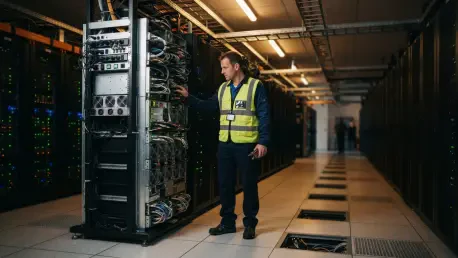

Although gaming PC enthusiasts have access to extensive independent efficiency data, the operators of industrial-scale server racks often rely solely on manufacturer-provided performance claims. This discrepancy has become increasingly critical as artificial intelligence continues to transform data centers into the fastest-growing electricity consumers on the planet. According to recent reports from the International Energy Agency, global data centers consumed approximately 415 terawatt-hours in 2024, accounting for roughly 1.5% of the total world electricity demand. Base-case projections suggest this figure will escalate to 945 terawatt-hours by 2030 and potentially reach 1,200 terawatt-hours by 2035. In the United States, current estimates from the Lawrence Berkeley National Laboratory indicate that data center usage reached 176 terawatt-hours last year, representing 4.4% of the national electricity supply. These figures are expected to climb to between 325 and 580 terawatt-hours by 2028, which would place data center consumption at 6.7% to 12% of all electricity used across the United States. Every single one of these kilowatt-hours must pass through a power supply unit before it ever reaches a processing chip, often undergoing multiple conversion stages that introduce significant cumulative losses. Despite this massive scale, oversight regarding the actual efficiency of these power supplies remains surprisingly limited, often resting on voluntary labels rather than mandatory, third-party verification.
1. Power Distribution: Tracing Energy Losses from Grid to Chip
In a standard data center environment, electricity begins its journey from the high-voltage grid and passes through several conversion stages before powering a server. It typically moves through a transformer, enters an uninterruptible power supply system, and then travels through power distribution units. Once it reaches the server rack, the server power supply unit, or a power shelf designed to feed an entire rack, converts the energy into low-voltage direct current. Finally, specialized converters on the motherboards step this voltage down even further for high-performance central processing units and graphics processing units. Every stage of this journey involves energy loss in the form of heat, but the server power supply unit is particularly significant because it is a constant presence in every server and never fully switches off. While power transformers are subject to mandatory efficiency rules within the European Union, other critical components like uninterruptible power supplies generally rely on voluntary programs. This creates a situation where the most essential link in the chain—the power supply unit—often operates without the level of independent scrutiny that consumers expect from much smaller, less critical hardware components.
The industry is currently moving toward more advanced power architectures, including high-voltage direct current systems, yet these innovations are arriving faster than the regulatory frameworks designed to oversee them. As major hardware providers transition to rack-level power shelves that can deliver massive amounts of energy to AI clusters, the lack of oversight becomes even more pronounced. In many jurisdictions, including the United States, there is no federal law requiring an independent laboratory to verify the efficiency claims made for data center power supplies. This means that a large-scale facility operator purchasing thousands of server modules might have less verified data than an individual consumer buying a single power supply for a home computer. This regulatory gap is particularly concerning given the trend toward high-voltage direct current applications, where mandatory rules are virtually nonexistent. While manufacturers often quote peak efficiency numbers, these figures represent the best possible performance at a specific point on the curve, which may not reflect the actual performance of the unit under the varied and persistent loads encountered in real-world artificial intelligence processing environments.
2. Regulatory Landscape: Mandatory Standards Versus Voluntary Programs
The European Union has taken some steps toward establishing minimum efficiency rules for server power supplies through Regulation 2019/424. Since the beginning of 2023, single-output server power supplies in the EU have been required to reach 90% efficiency at a 10% load, 94% at a 20% load, and 96% at a 50% load. These are technically demanding benchmarks that reflect a desire to minimize waste in the digital sector. However, a significant loophole exists in the implementation of these rules: compliance is based on self-declaration under the CE marking system. This means that no independent third-party laboratory is legally required to confirm these efficiency numbers before a product enters the market. Furthermore, these regulations exclude direct current-powered servers and exempt several specialized hardware types, such as large servers with more than four processor sockets and fully fault-tolerant systems. Although a review of this regulation was planned, the process has faced delays, leaving many of the most energy-intensive hardware systems currently powering the artificial intelligence boom outside the scope of mandatory verification.
In the United States, the federal landscape for server power supply efficiency remains largely devoid of mandatory minimums, leaving the industry to rely on voluntary frameworks. The ENERGY STAR program offers a robust specification for computer servers that includes power supply efficiency and power factor tables, and it notably requires independent certification by recognized bodies. While this represents a high standard for testing and validation, it remains a voluntary choice for manufacturers rather than a legal requirement. Earlier this year, the future of this program faced uncertainty during budget discussions, but full funding was eventually restored by Congress in January 2026. Following this legislative action, an agreement was signed in March 2026 between the Environmental Protection Agency and the Department of Energy, establishing the Department of Energy as the lead agency for the program. Beyond government programs, voluntary labels like 80 PLUS continue to categorize data center power supplies, even introducing new levels like Ruby to target high-efficiency AI systems. However, these programs often utilize testing protocols that only check a few fixed load points, which may not capture the full performance profile of a unit in a dynamic data center.
3. Critical Blind Spots: PUE Metrics and Measurement Methods
One of the most significant blind spots in data center energy management is the reliance on Power Usage Effectiveness as a primary efficiency metric. As defined in ISO/IEC 30134-2, PUE is calculated by dividing the total energy consumed by the facility by the energy used by the information technology equipment. Under this definition, any energy wasted by a server power supply unit is categorized as IT energy rather than facility waste. This creates a misleading picture where a watt lost as heat inside a power supply is treated the same as a watt used for actual computation. Consequently, a data center can achieve a very impressive PUE score while still wasting significant amounts of electricity through inefficient power conversion within its server racks. PUE is an effective measure of how efficiently a building is managed, but it is fundamentally incapable of revealing the inefficiencies of the internal power supplies. This lack of visibility prevents operators from identifying one of the largest sources of energy waste in the entire facility, effectively hiding power supply losses within the core performance metrics.
The method by which efficiency is measured also presents a major challenge to accurate energy reporting. Standard regulatory frameworks and voluntary labels typically evaluate power supplies at specific load points, such as 20%, 50%, and 100% of their rated capacity. While these benchmarks provide a baseline, they do not reflect the reality of redundant power configurations where units often share a load and spend significant periods operating at light loads below 10%. Most existing protocols fail to check performance at these lower levels, which is precisely where many data center power supplies operate for a large portion of their lives. Furthermore, the shift toward 800V direct current architectures in AI racks—championed by industry groups like the Open Compute Project—further complicates the landscape. These high-voltage DC systems are often excluded from current efficiency regulations because they do not use standard alternating current inputs. While vendors may claim peak efficiencies exceeding 97.5% for these new rack power shelves, these figures often represent an ideal scenario rather than the weighted average that facility operators actually pay for on their monthly utility bills.
4. Impact of Efficiency Gains: The Global Scale of Small Improvements
The potential for energy savings through improved power supply efficiency is immense when viewed at a global scale. If the average efficiency of the worldwide fleet of server power supplies were raised by just one percentage point—from 95% to 96%—the resulting energy savings would be staggering. Based on projections for 2030, where servers are expected to consume approximately 567 terawatt-hours, a single percentage point increase in efficiency would reduce total input power by more than 1%. This represents a saving of roughly 5.9 terawatt-hours per year, an amount comparable to the total annual electricity consumption of a country like Cyprus. These calculations illustrate that even marginal improvements in the performance of individual components can lead to massive reductions in total energy demand when multiplied across millions of servers. This order-of-magnitude illustration highlights why independent verification is not just a technical detail, but a crucial component of global energy policy in the age of artificial intelligence and large-scale digital infrastructure.
Beyond the direct reduction in electricity consumption, improving power supply efficiency has a secondary benefit related to thermal management. Every watt of energy that is lost during the power conversion process is turned into heat inside the server chassis. This heat must then be removed by the facility’s cooling systems, which themselves consume significant amounts of electricity. In modern hyperscale data centers, cooling can account for 7% to 30% of total energy usage, depending on the efficiency of the site and the climate in which it is located. Therefore, a power supply that runs more efficiently does not just save energy at the conversion stage; it also reduces the load on fans, liquid cooling pumps, and external chillers. As AI hardware pushes power densities to new heights, the ability to minimize internal heat generation becomes essential for maintaining reliable operation and extending the lifespan of expensive processors. When the cumulative savings from both direct conversion and reduced cooling requirements are considered, the argument for mandatory, high-precision efficiency testing becomes undeniable for any operator concerned with operational costs or environmental sustainability.
5. Proposed Improvement Strategies: Toward a New Standard of Validation
Addressing the lack of oversight in data center power supplies requires a multi-faceted approach that involves legislative updates, standardized testing protocols, and changes in procurement behavior. In the European Union, the current public consultation on data center standards provides a critical opportunity to demand component-level regulations. By expanding Regulation 2019/424 to include direct current and high-voltage direct current supplies, and by replacing the current self-declaration model with mandatory third-party certification, regulators could ensure that efficiency claims are backed by verifiable data. This would involve utilizing accredited laboratories to test power supplies across their entire load range rather than just a few fixed points. Additionally, publishing these results in a transparent, public database would allow data center operators to make informed decisions based on realistic performance data. This regulatory shift would align server hardware with other major electrical components that are already subject to rigorous independent testing, creating a more consistent and reliable framework for the entire industry.
In addition to legislative changes, the development of a comprehensive international testing protocol is essential for long-term progress. Current industry standards often rely on outdated or incomplete methodologies that do not fully capture the behavior of modern AI power systems. A new work item within the International Electrotechnical Commission could establish a standardized, full-range efficiency measurement for both AC and high-voltage DC power supplies. This would provide a globally recognized benchmark that regulators and facility operators could reference in their requirements. Meanwhile, large-scale buyers and government agencies can drive immediate change by prioritizing independently certified equipment in their procurement tenders. By requiring that power supplies and uninterruptible power units meet verified efficiency standards, the most significant players in the market can signal to manufacturers that transparency and performance are no longer optional. Collaborative partnerships between certification bodies and independent laboratories could further streamline this process, ensuring that a high volume of hardware can be tested and certified without creating unnecessary bottlenecks in the supply chain.
6. Immediate Action: Implementing Accountability and Transparency
The transition toward a more accountable power infrastructure requires specific and immediate actions from stakeholders across the technology sector. Participating in ongoing regulatory consultations, such as the European Commission’s current review of performance standards, is a vital first step for those advocating for independent certification. Stakeholders must push for regulations that eliminate the self-certification loophole and bring high-voltage direct current power shelves under the same level of scrutiny as standard server modules. Furthermore, initiating new standards that evaluate efficiency across the entire load spectrum—including the light-load scenarios common in redundant configurations—is necessary to reflect real-world operational conditions accurately. These standards should also incorporate factors like intake temperatures and the accuracy of internal power telemetry. By ensuring that the power data reported by the hardware itself is accurate, operators can improve their own energy reporting and optimization efforts, leading to more sustainable and cost-effective data center management.
The shift toward independent verification represented a fundamental change in how data center infrastructure was procured and audited throughout this period. Industry leaders moved beyond simple self-declared labels, establishing a rigorous ecosystem of accredited laboratories and standardized testing protocols that validated every performance claim. By integrating these practices into every stage of the supply chain, the technology sector ensured that the massive electricity demands of artificial intelligence were met with maximum efficiency and transparency. This transition not only lowered operational costs for hyperscalers and enterprise providers but also significantly reduced the environmental footprint of global computing infrastructure. The collective effort between regulators, manufacturers, and independent labs ultimately created a framework where efficiency was no longer a marketing claim but a verifiable technical standard. As a result, the data centers powering the modern world achieved a level of energy accountability that matched their growing importance in the global economy, setting a precedent for all future large-scale technological developments.