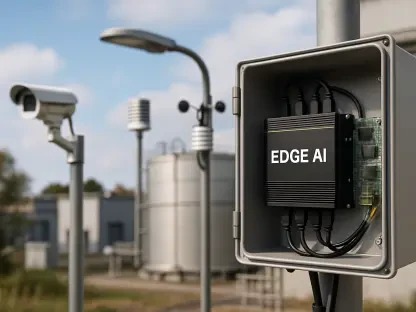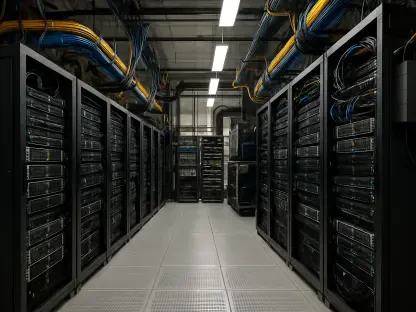

The landscape of digital intelligence has reached a definitive crossroads where the sheer volume of information generated by billions of interconnected devices can no longer be efficiently managed by centralized server farms. While artificial intelligence was once exclusively synonymous with massive, power-hungry data centers, it is now migrating directly into the microcontrollers and smart sensors found in everyday consumer and industrial products. This transition represents a critical evolution in how digital logic interacts with the physical world, prioritizing localized processing to create more responsive, autonomous, and energy-efficient systems. The traditional cloud-centric model is becoming increasingly unsustainable as AI becomes a transformative presence in wearables, autonomous vehicles, and complex industrial machinery. This shift is not merely a technical preference but a structural necessity driven by the inherent limitations of current bandwidth and the physics of data transmission.
Market Dynamics: The Economic Shift Toward Localization
The economic momentum behind localized inference is currently staggering, with industry projections suggesting a seismic shift in how computational workloads are distributed across the global network. Market analysts anticipate that by 2030, roughly half of all enterprise AI inference will occur at the edge, reflecting a market valuation that is expected to exceed one hundred and eighteen billion dollars by 2033. This growth is fueled by an unprecedented data explosion that makes transferring every byte of raw information to a central server logically and financially impossible for most modern organizations. As the cost of cloud egress and storage continues to climb, businesses have begun to realize that processing information at the source is the only viable path to maintaining profitability while scaling their digital services. This massive capital reallocation toward edge-ready hardware signifies a fundamental change in the global semiconductor procurement strategy.
This transition requires a sophisticated filtering mechanism where an intelligent edge can distinguish relevant signals from background noise before any transmission occurs. Rather than wasting precious network resources on transferring raw, unprocessed data, smart systems now process information locally, ensuring that only essential insights or anomalies are transmitted to the cloud for long-term storage or further analysis. This operational efficiency is the primary driver for industry leaders who are moving away from monolithic, centralized graphics processing units in favor of more agile and distributed computing frameworks. By reducing the reliance on a constant high-speed internet connection, companies are also insulating themselves against the risks of network outages and fluctuations in service quality. Consequently, the edge has evolved from a simple data collection point into a robust environment for real-time reasoning and autonomous action.
Technological Synergies: Silicon and Software Optimization
The shift to the edge is being powered by a new generation of semiconductors, specifically highly specialized microcontrollers and dedicated Neural Processing Units. These components are meticulously designed to strike a delicate balance between high-performance processing capabilities and minimal energy consumption, which is vital for battery-operated devices. Furthermore, cutting-edge innovations such as In-Memory Computing are effectively eliminating the energy tax associated with traditional von Neumann architectures by fusing data storage and computation within the same physical space. This allows modern devices to run complex, multi-layered neural networks on a mere fraction of the power that was previously required for similar tasks. The result is a hardware landscape that is increasingly optimized for the specific mathematical requirements of deep learning, rather than general-purpose computing.
Hardware alone is insufficient for this transition; a robust software ecosystem is essential to bridge the gap between complex AI models and small-scale silicon implementations. Advanced techniques such as quantization and pruning allow developers to shrink massive neural networks, significantly reducing their memory footprint without sacrificing an unacceptable amount of accuracy. Automated toolkits provided by major semiconductor manufacturers now enable the seamless translation of these optimized models into machine code tailored for specific hardware targets, making embedded AI more accessible to general software engineers. This synergy between silicon and software ensures that even the most modest devices can perform sophisticated tasks like voice recognition or anomaly detection. As these tools continue to mature, the barrier to entry for deploying sophisticated machine learning at the endpoint continues to vanish.
Operational Priorities: Safety and Data Integrity
Localized artificial intelligence directly addresses a triple mandate that traditional cloud computing struggles to satisfy: real-time responsiveness, data security, and environmental responsibility. For safety-critical applications like autonomous driving or industrial robotics, the millisecond delays caused by cloud communication can be catastrophic, making the low latency of edge AI a non-negotiable requirement for modern engineering. By performing inference on-device, these systems can react to environmental changes instantaneously, ensuring a level of safety that remote processing simply cannot guarantee. This immediate feedback loop is essential for the next generation of collaborative robots and automated safety systems in manufacturing environments. The ability to operate independently of a central server ensures that critical functions remain active even in the most remote or shielded locations.
Simultaneously, processing data locally ensures that sensitive information, such as personal health metrics from a wearable or security feeds from a private residence, never leaves the device. This approach provides users with a significantly higher level of privacy and empowers them with greater control over their digital footprint in an era of increasing surveillance concerns. By minimizing the amount of data in transit, organizations also reduce the potential attack surface for cybercriminals, as there is no central repository of raw sensitive data to intercept. This decentralized approach to security is becoming a standard requirement for healthcare providers and financial institutions that must adhere to strict data sovereignty regulations. Consequently, the edge has become the preferred location for handling any data that carries a high risk of personal or corporate liability.
Strategic Integration: Future-Proofing the Intelligence Landscape
The industry recognized that the previous reliance on cloud-only architectures was a bottleneck for innovation and responded by pivoting toward localized silicon. Successful organizations implemented hybrid strategies where the edge handled immediate actions while the cloud remained reserved for long-term model training and massive data aggregation. This dual-layered approach optimized both performance and cost, ensuring that systems remained scalable without becoming prohibitively expensive to operate. Developers who embraced early edge adoption found that their products offered superior reliability in environments where connectivity was intermittent or nonexistent. The transition facilitated a more sustainable digital infrastructure by reducing the carbon footprint associated with massive data transfers and hyperscale cooling requirements. These strategic moves laid the groundwork for the persistent and pervasive intelligence found in modern urban and industrial settings.
To maintain a competitive advantage in this evolving landscape, stakeholders focused on integrating multimodal sensors that provided contextual awareness to their edge devices. By combining thermal, acoustic, and visual data, these systems achieved a level of environmental understanding that far exceeded the capabilities of single-source sensors. Engineers prioritized the use of automated deployment pipelines to ensure that models could be updated over-the-air as new data became available, creating a cycle of continuous improvement. The shift toward the edge was ultimately validated by the increased efficiency and safety of autonomous systems across all sectors. Moving forward, the focus shifted toward making these localized systems even more autonomous, reducing the need for human intervention in routine monitoring and maintenance tasks. This trajectory ensured that the AI revolution remained a beneficial force that respected both physical constraints and the privacy of the end-user.