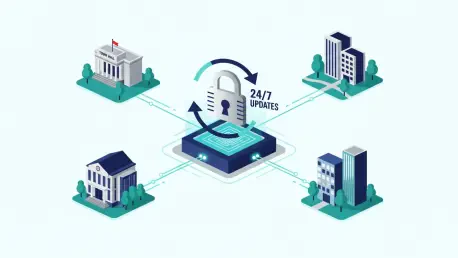

The quiet corridors of local government offices often mask the relentless digital bombardment occurring behind the scenes where municipal infrastructures face hundreds of thousands of unauthorized access attempts every single day. Hart District Council recently recognized that the traditional model of cybersecurity, which largely relied on business-hour monitoring and static firewall rules, no longer provided sufficient protection against an adversary that never sleeps. As cybercriminals increasingly leverage automated scripts and artificial intelligence to probe for weaknesses in regional networks, the risk to sensitive citizen data and essential public services has escalated to a critical level. This shift toward a continuous, twenty-four-seven surveillance model represents a fundamental change in how public sector organizations perceive their digital boundaries. By transitioning to a more proactive stance, the council aims to mitigate the catastrophic impact of ransomware attacks that have previously crippled similar administrative bodies. This decision reflects a broader trend among local authorities who must balance tightening budgets with the absolute necessity of maintaining a resilient and secure digital environment for their constituents.
The Modern Crisis: Evolution of the Threat Environment
Modern cyber threats have evolved far beyond the simple phishing emails and rudimentary viruses that defined the landscape only a few years ago, moving instead toward sophisticated, multi-stage campaigns. Organized criminal groups now operate with the precision of corporate entities, often launching their most damaging maneuvers during the middle of the night or on public holidays when internal IT teams are least likely to be active. For Hart District Council, the realization that an attacker could gain a foothold at two in the morning and move laterally through the network for hours before detection was a primary driver for this strategic pivot. Automated vulnerability scanners constantly crawl the internet searching for unpatched software or misconfigured cloud storage, making the speed of response a decisive factor in whether an incident remains a minor glitch or becomes a full-scale data breach. Consequently, the reliance on manual logs has been replaced by real-time telemetry and behavioral analysis.
Furthermore, the specific nature of municipal data makes local councils a high-value target for actors seeking to exploit personal identifiable information or disrupt the continuity of vital social services. From electoral registers and financial records to planning applications and social care files, the diversity of data stored by Hart District Council necessitates a defense strategy that covers every possible entry point simultaneously. The integration of Internet of Things devices in smart city initiatives further expands the attack surface, introducing new vulnerabilities that traditional security frameworks are often ill-equipped to handle without constant oversight. By adopting a twenty-four-seven security posture, the council ensures that anomalies in traffic patterns or unauthorized attempts to access restricted databases are identified and quarantined within minutes rather than days. This persistent vigilance is no longer a luxury but a baseline requirement for any organization in an interconnected world.
Strategic Resilience: Operational Efficiency and Managed Response
Implementing a comprehensive round-the-clock security operation requires a level of specialized expertise and financial investment that is often beyond the reach of a single local authority operating in isolation. To bridge this gap, Hart District Council has turned toward a Managed Detection and Response model, leveraging the capabilities of a dedicated Security Operations Center to provide the necessary scale and depth of coverage. This approach allows the council to benefit from the collective intelligence of a global security provider, which sees emerging threats across multiple industries and can apply those insights to the local government context. Instead of burdening their internal IT staff with the exhausting task of monitoring alerts overnight, the council can reallocate these human resources to focus on digital transformation projects and the improvement of front-line citizen services. This partnership provides a sophisticated layer of defense that includes threat hunting and automated response protocols.
The transition to a twenty-four-seven cybersecurity posture at Hart District Council established a robust framework that addressed both immediate vulnerabilities and long-term strategic goals. Leaders prioritized the deployment of advanced endpoint detection and response tools that integrated seamlessly with existing cloud-based ecosystems, ensuring that no device remained unmonitored. This proactive strategy shifted the focus from reactive damage control to a model of continuous improvement where every blocked attempt provided valuable data to strengthen the overall perimeter. The council recognized that true resilience required more than just technological upgrades; it demanded a cultural shift toward security awareness across all departments. By investing in these robust systems, the administration successfully insulated its core functions from the rising tide of global cybercrime. For other authorities, the next logical step involved conducting audits of third-party vendors and establishing clear communication chains.