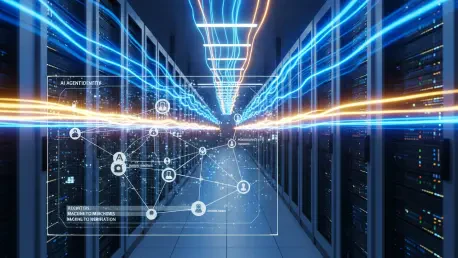

The digital perimeter has effectively evaporated as autonomous AI agents begin to navigate enterprise networks with the speed of light and the authority of a seasoned administrator. The shift from human-prompted AI to autonomous agents marks a turning point where traditional, manually governed security measures are no longer viable. As AI agents begin to call APIs, move sensitive data, and trigger complex workflows without human intervention, the window for manual threat detection effectively closes.
This new era of agentic AI demands a security model that functions at the same velocity as the software it protects, moving beyond simple user-based permissions to a system rooted in machine-to-machine verification. The fundamental premise is that security must now evolve to handle millions of independent agents that operate far faster than human users. Without this evolution, the productivity gains offered by autonomous systems could be outweighed by the risks of unmonitored machine activity.
How Can Security Teams Defend Against an Adversary That Operates at Machine Speed?
The transition toward autonomous agents represents a fundamental change in how software interacts with corporate resources. In a world where AI agents can initiate their own tasks, the time available for a security operations center to respond to an anomaly shrinks from hours to milliseconds. Traditional security protocols, which often rely on a human to verify a login or approve a sensitive data export, act as a bottleneck that autonomous agents will naturally bypass or break.
Moreover, the complexity of these interactions makes it nearly impossible for human administrators to map every possible outcome of an agentic workflow. When an AI agent autonomously communicates with a third-party API to process internal data, it creates a chain of custody that is difficult to track using legacy logs. This environment requires a shift from reactive monitoring to a proactive, identity-based architecture where every machine action is scrutinized before it occurs.
The Widening Gap Between Autonomous Innovation and Legacy Security
The enterprise landscape is rapidly moving toward a reality where millions of independent AI agents operate across global networks. Current security frameworks, designed for human users logging into systems, are ill-equipped to handle the volume and speed of agent-to-agent interactions. This disconnect creates a massive surface area for lateral movement, where a single compromised agent could potentially navigate an entire corporate network undetected.
With the AI security market projected to reach $8 billion by 2030, starting from 2026, organizations face an urgent need to redefine trust in a landscape populated by autonomous machines. The speed at which businesses are adopting these tools often outpaces the development of accompanying safety standards. This widening gap leaves many companies vulnerable to automated exploits that can drain data or disrupt services before a human can even identify that a breach has started.
Architectural Pillars of the Zscaler Zero Trust AI Exchange
Zscaler has expanded its platform to address the unique vulnerabilities of agentic systems through several primary technological innovations. The AI Broker secures communication via the Model Context Protocol, ensuring that interactions between agents and data sources are verified and encrypted. Alongside this, the Endpoint AI Security tool monitors local AI components and browser extensions that often evade traditional protection, creating a safeguard for the very edge of the network.
Complementing these tools, the AI Access Graph provides deep visibility into data lineage, mapping the complex relationships between identities and applications. This visibility allows security teams to see exactly how data moves through various AI channels and to enforce policies that reduce unnecessary access. Finally, the AI Protect suite introduces intent-based guardrails that interpret the context of multi-turn conversations, preventing sensitive data leakage by identifying malicious patterns in machine communication.
Market Dynamics and Expert Perspectives on AI Autonomy
Industry analysts emphasize that autonomous agents cannot simply inherit the security credentials of the human who initiated them. Experts from firms like Dell’Oro Group and ABI Research argue that every agent must possess a distinct identity and a strictly defined scope of action. The consensus is that without proactive, automated security, the autonomy of these systems could lead to catastrophic outcomes if misconfigured or if they fall under the control of a threat actor.
The integration of technology from acquisitions like Symmetry Systems highlights a strategic move toward understanding data flow rather than just applying allow or block rules. This is essential for maintaining corporate integrity in a machine-led environment where context is everything. By focusing on the intent and the identity of the agent, organizations can allow for high-speed innovation without sacrificing the granular control required for modern regulatory compliance.
Proactive Defense Measures for the Autonomous Enterprise
Securing an agentic ecosystem required a shift toward active stress-testing and nuanced governance. Organizations adopted AI red teaming and prompt hardening services to simulate attacks and identify vulnerabilities in their AI models before they were exploited. This proactive stance allowed businesses to verify the resilience of their autonomous systems against evolving threats such as prompt injection and unauthorized API calls.
The implementation of compliance heat maps allowed security teams to align their AI usage with rapidly changing global regulations automatically. By moving toward intent-based guardrails and continuous monitoring of data lineage, enterprises ensured that the productivity gains provided by autonomous AI agents did not introduce unmanageable risk to the corporate infrastructure. These steps ultimately created a foundation for a future where machine autonomy and enterprise safety existed in a balanced, high-velocity state.