
Matilda Bailey is a seasoned networking specialist who has spent her career watching the industry move from manual command-line interfaces to the cutting edge of AI-driven operations. Today, she joins us to discuss the seismic shift in enterprise connectivity as networks transition from being merely informative to becoming truly autonomous entities. With extensive experience in cellular and next-gen wireless solutions, Matilda provides a deep look at how platforms like HPE Mist and Aruba Central are redefining the modern administrative workload by taking action on behalf of the business rather than just reporting data.
How does the shift from informational networking systems to autonomous “self-driving” platforms change daily operations, and what specific tasks are now being offloaded from human teams to AI-driven microservices?
The shift is massive because it turns the network from a static map into an active partner that takes action on behalf of the business. We are seeing microservices offload the heavy lifting of real-time diagnosis, which allows human teams to step away from the grueling “firefighting” of routine maintenance. For example, instead of manually adjusting frequency bands or investigating signal drops, the system uses telemetry to resolve issues in real-time without anyone opening a support ticket. This transition means that instead of spending their day buried in operations, engineers can finally pivot toward high-level architectural innovation and strategic growth. Rami Rahim has pointed out that this fundamentally changes the role of networking, moving it away from a system that merely informs to one that acts independently to ensure uptime.
When managing wireless capacity, how do systems dynamically adjust RF parameters like channel bandwidth and power beyond standard ranges, and how can visual roaming journey reconstructions help identify specific coverage gaps or handoff failures?
Modern systems handle capacity by using learned utilization patterns to push RF parameters like channel bandwidth and power levels way beyond their usual predefined ranges. When a user moves through a building, the platform creates a visual recreation of that client’s roaming journey across a digital floor plan to simulate access point handoffs. If a handoff fails, the system can pinpoint exactly where the signal dropped or where a delay occurred, which is a lifesaver for traditionally difficult-to-solve coverage gaps. To troubleshoot, you would watch the virtual path, identify the specific access point where the transition stalled, and let the AI-driven resource management adjust the radio frequencies to ensure the next handoff is seamless. This proactive approach helps mitigate wireless client disruptions before the user even notices a dip in their connection quality.
Measuring Wi-Fi performance at the “first connect” stage provides unique visibility into the link between the device and the access point; how does this metric bridge the gap in client-to-cloud visibility, and what are the practical implications for diagnosing root causes of user-perceived latency?
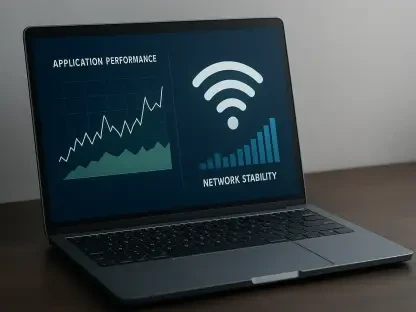
Measuring performance at the “first connect” stage is a game-changer because it allows us to see the user experience over the RF link itself, which is historically a major blind spot for administrators. This metric bridges the gap in client-to-cloud visibility by providing a clear picture of what is happening the moment a device tries to join the network. By capturing this data, we can distinguish between a slow cloud application and a bottleneck at the physical access point layer. Seelan Manavalan has noted that this delivers insight that is largely unique in the industry, accelerating root-cause identification by measuring the experience directly over the air. It ensures that “connected but not working” scenarios are solved with precision, providing the end-to-end visibility needed to diagnose user-perceived latency across the entire journey.
Rogue DHCP servers and missing VLANs often lead to significant connectivity disruptions; how does AI-driven detection isolate these anomalies down to the specific switch port, and what is the process for automatically remediating these configuration errors to prevent traffic blackholing and security risks?
A rogue DHCP server—which often pops up unintentionally when someone plugs in a personal BYOD device—can be a total nightmare, but AI now traces these anomalies down to the exact switch port. Once identified, the system can automatically contain the rogue device to reduce the “blast radius” and keep the rest of the network safe and functional. Similarly, when a missing VLAN causes a connectivity blackout during a day-0 or day-2 change, the platform correlates client telemetry and configuration states to find the mismatch. It then either remediates the error automatically or gives the operator a single-click action to fix the configuration, preventing traffic from being blackholed. As Selena Mosley highlights, the outcome is always the same: fewer escalations, faster resolution, and a consistent experience for the end user.
What is your forecast for autonomous networking?
The era of the “self-driving” network is no longer a distant aspiration; it is officially operational and will soon become the standard requirement for any enterprise. I expect to see these systems move deeper into predictive territory, where they anticipate capacity spikes before they happen and reconfigure entire campus topologies in seconds. We are moving toward a future where the network infrastructure is essentially invisible, providing a consistent application experience that requires zero human intervention for its upkeep. As these microservices continue to evolve, the traditional role of the network administrator will transform entirely into that of a high-level digital architect and strategist. Within the next few years, the manual configuration of individual ports and radios will likely feel as outdated as manually dialing into a modem.