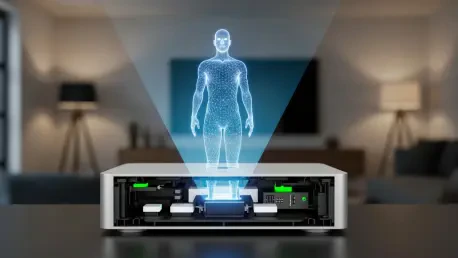

The evolution of ambient sensing technology has reached a pivotal threshold where standard household hardware can now serve as sophisticated biometric scanners without requiring physical contact or visual line-of-sight. Recent advancements in signal processing have revealed that the electromagnetic waves emitted by ordinary WiFi routers interact with the human body in ways that are as unique as a fingerprint or a retinal pattern. By measuring the minute fluctuations in signal strength and phase, known technically as Channel State Information, researchers have developed systems capable of identifying specific people with nearly absolute certainty. This capability stems from the fact that every individual possesses a distinct physical profile, including height, bone density, and mass distribution, which creates a specific interference pattern as they move through a wireless field. Because these signals penetrate walls and operate in total darkness, the potential for non-intrusive monitoring has expanded far beyond the limitations of traditional camera-based security systems.
The Algorithmic Engine: Decoding Human Presence Through Deep Learning
Transforming raw signal data into a reliable identification tool requires the integration of advanced deep learning architectures that can filter out environmental noise from the relevant human data. The breakthrough lies in the use of specialized neural networks that are trained to recognize the gait signature and morphological characteristics of a person as they disrupt the multipath propagation of radio waves. These models analyze the temporal and spatial variations of the signal, effectively creating a high-definition silhouette based purely on radio frequency reflections. In controlled environments, these systems achieved a 99.5% accuracy rate, proving that the subtle ways a person walks or even stands can be mapped to their identity. This high level of precision is maintained even when multiple people occupy the same space, as the algorithms can now deconvolve overlapping signals to isolate individual profiles. Unlike facial recognition, this method remains effective regardless of clothing choices, lighting conditions, or facial coverings, making it a robust alternative for secure authentication and healthcare monitoring.
Data Sovereignty: Implementing Privacy Standards for Ambient Sensing
The realization that ubiquitous networking equipment could double as a surveillance apparatus necessitated a rapid shift in how digital privacy was approached by both manufacturers and consumers. Stakeholders recognized that while the medical benefits for elderly care and fall detection were immense, the potential for unauthorized tracking required the immediate implementation of signal obfuscation protocols at the firmware level. Engineers prioritized the development of privacy-preserving hardware that could toggle sensing capabilities or encrypt the raw data before it reached local processors. Regulatory bodies evaluated new frameworks to ensure that biometric data harvested from ambient waves received the same legal protections as traditional biometric markers. Moving forward, the focus shifted toward decentralized processing, where identification tasks occurred locally on the router rather than in the cloud, thereby mitigating the risk of large-scale data breaches. This transition ensured that the power of wireless sensing was harnessed for safety and convenience while maintaining the sanctity of personal space within the home environment.