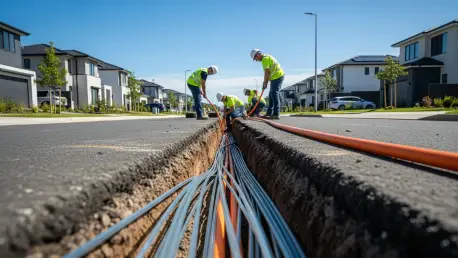

Heavy machinery and neon utility markings have transformed the once-quiet streets of Boulder County into a sprawling construction site as the region races to modernize its digital foundation for the current era. This physical disruption signals a high-stakes competition among internet service providers to capture a market that no longer views high-speed connectivity as a luxury but as a fundamental necessity for survival. As crews lay thousands of miles of glass strands beneath sidewalks from Broomfield to Boulder, residents are navigating a complex landscape where the quality of their home connection depends almost entirely on which block they live on. While some neighborhoods enjoy the cutting edge of digital speed, others remain tethered to aging infrastructure, creating a fragmented reality that complicates local governance and economic planning. This massive overhaul represents more than just a technological upgrade; it is a fundamental shift in how the county operates, works, and communicates in an increasingly data-reliant society.
The Technical Evolution of Regional Connectivity
The fundamental driver of this infrastructure boom is the obsolescence of legacy copper-wire systems that once defined the American digital experience for decades. Traditional Digital Subscriber Line and coaxial cable technologies served well in a world where consumption was the primary activity, but they often faltered when faced with the demands of a modern, upload-intensive economy. Fiber-optic technology, which transmits data via rapid light pulses through microscopic strands of glass, has effectively replaced these aging conduits by providing symmetrical speeds that handle massive data transfers with ease. This transition proved essential for a workforce that relies on seamless video conferencing and real-time cloud collaboration where lag is not just a nuisance but a barrier to productivity. While the core technology has existed for some time, the recent aggressive deployment reflects a realization that direct-to-home fiber is the only way to meet current bandwidth demands.
Major internet providers have adopted diverse business strategies to maintain relevance and dominate the evolving local market during this period of rapid expansion. Legacy companies like Comcast have defended their market share by investing billions of dollars into hybrid networks that integrate fiber deeper into existing cable infrastructure. This approach allows them to offer enhanced performance without the astronomical costs of a total ground-up rebuild in every neighborhood. In contrast, mobile-first providers like T-Mobile have utilized a partnership model, allowing infrastructure-focused firms like Intrepid Fiber to handle the physical construction and maintenance. By separating the hardware installation from the customer-facing brand, these companies have accelerated their rollout schedules, effectively bypassing the slower traditional construction cycles. This competition has forced a faster pace of development, ensuring that the technology reaches residential corridors much faster than previous upgrades.
Corporate consolidation has also played a pivotal role in determining which specific fiber assets reach local residents and how quickly those systems become operational. Telecommunications giants like AT&T have expanded their footprint in the region by acquiring established fiber assets from other providers, such as those formerly managed under the CenturyLink and Lumen brands. This strategy allowed larger corporations to bypass many of the logistical hurdles associated with obtaining new municipal permits and digging new trenches in established areas. By absorbing existing regional infrastructure, these major players have established an immediate and powerful presence in competitive residential neighborhoods that were previously underserved. This trend of consolidation suggests that while the physical cables may be new, the providers managing the data are often the same established entities, leveraging their massive capital reserves to secure long-term control over the county’s digital pathways.
Local Service Variation and Public Management
The availability of high-capacity fiber-optic internet remains surprisingly uneven across the region, largely dictated by private investment patterns and localized construction schedules. In municipalities like Erie and Lafayette, local officials have noted that it is frequently difficult to track which specific neighborhoods have access to fiber versus legacy cable. This lack of transparency is often exacerbated by the complex web of resellers and third-party contractors who manage the actual service delivery on a day-to-day basis. Some areas have become intense battlegrounds where multiple providers, including Google Fiber and Ripple Fiber, compete for every single household, leading to a surplus of options for those residents. However, just a few miles away, other communities may only have access to a single provider, highlighting a digital divide that is based on geography rather than income or need, complicating the county’s unified growth.
The City of Boulder has distinguished itself by taking a more proactive stance toward infrastructure management by developing its own public network assets. Rather than leaving the rollout entirely to the whims of the private market, the city constructed its own backbone of dark fiber, which it now leases to private providers like ALLO Communications. This public-private partnership was specifically designed to give the municipality more oversight regarding the quality, reach, and longevity of the local network compared to a purely private rollout. By maintaining ownership of the underlying physical assets, the city has ensured that the infrastructure remains a long-term community benefit rather than a temporary corporate asset. This model serves as a middle ground between total private reliance and a full municipal utility, offering a blueprint for other cities that want to ensure equitable access while still benefiting from the technical expertise of the private sector.
Regional Economic Sustainability and Future Strategies
A few select communities have opted for a more radical approach by treating high-speed internet access as a public utility, similar to the management of water or electricity. Longmont’s NextLight and Loveland’s Pulse have become the regional benchmarks for this municipal broadband model, proving that local governments can successfully manage complex digital networks. By operating these networks through municipal departments, these cities have ensured that all revenues are reinvested directly back into the local community rather than being distributed to distant corporate shareholders. These programs have successfully attracted a new wave of tech-savvy businesses and remote professionals who prioritize stable and affordable gigabit connectivity above almost all other amenities. While these municipal programs required significant initial taxpayer investment, they have consistently delivered some of the highest satisfaction ratings and most reliable service speeds in the entire state.
The transition to a fiber-centric economy required significant sacrifices from local residents and immense capital from the providers who sought to dominate the region. Moving forward, the primary challenge shifted from basic installation to ensuring that the existing infrastructure could evolve with future technological breakthroughs. Local governments discovered that the most effective strategy involved standardized permitting processes and the creation of comprehensive digital maps to help residents navigate the patchwork of available services. The county successfully moved away from its copper-wire past, but the lesson learned was that infrastructure must be managed as a continuous public concern rather than a one-time project. Future planning should focus on integrating these fiber networks with 5G and satellite technologies to create a resilient, multi-layered communication grid that can withstand both environmental challenges and the inevitable growth in global data consumption.