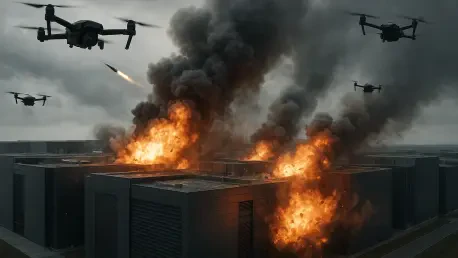

The precision with which physical drones dismantled the digital nervous system of Russia’s largest technology firm reveals a fundamental shift in how modern infrastructure can be neutralized in the current year. International sanctions on high-end semiconductors mean that Yandex faces a prolonged recovery period for its destroyed supercomputing modules, which relied on restricted Western hardware. This disruption began in the second week of October 2026, targeting data centers in Sasovo, Kaluga, and Vladimir. These locations were not chosen at random; they were the physical anchors for the nation’s “sovereign internet.” The destruction of the Sasovo facility alone, which housed two of Yandex’s three supercomputers, represented a decapitation of high-performance computing capabilities essential for training advanced artificial intelligence models. As the fire spread through tens of thousands of servers, the redundancy that Yandex had carefully cultivated over years of expansion proved insufficient against a multi-day kinetic offensive. This collapse marks a transition where the digital economy is no longer just vulnerable to cyberattacks but can be physically erased by relatively inexpensive unmanned aerial vehicles, forcing a total reassessment of national security priorities for the domestic tech sector.
The Technical Fallout: Infrastructure and Service Collapse
The destruction of physical server modules immediately triggered a collapse across the various layers of the Yandex digital stack, revealing how deeply integrated these systems had become. Yandex Cloud, which provides essential business-to-business services to thousands of Russian companies, saw over eighty distinct services go offline or become severely unstable within hours of the first strike. This disruption hit database management systems and storage arrays particularly hard, leaving corporate clients without the data access necessary to conduct daily operations. Because modern cloud architecture relies on automated load balancing and physical redundancy, the loss of three major hubs simultaneously created a cascade of errors that the remaining infrastructure could not absorb. Companies that had outsourced their entire digital presence to Yandex found themselves in a state of operational paralysis, unable to process payments, manage inventories, or communicate with their own internal systems. This ripple effect demonstrated that in a centralized digital economy, the failure of a physical hardware layer can render the entire software stack useless across multiple unrelated industries.
Cascading Failures: The Digital Cloud Crisis
The most significant technical blow to the corporate sector involved the failure of the YandexGPT API, an artificial intelligence interface used by thousands of third-party developers. Because many independent Russian firms had integrated this language model into their own proprietary software for customer support, data analysis, and internal automation, the outage caused a systemic “ripple effect” that neutralized tools across the broader economy. This highlighted how a physical strike on a single provider could simultaneously disable the technological capabilities of hundreds of unrelated businesses. The loss of high-performance computing power at the Sasovo site meant that even when some basic services returned, the advanced machine learning features remained offline. Developers found that their applications, which were designed to lean on Yandex’s centralized intelligence, were suddenly hollowed out and non-functional.
This technical debt, created by a heavy reliance on a single conglomerate’s API, has forced many firms to reconsider the risks of deep integration within a monopolistic technology ecosystem. The inability to switch to Western alternatives due to ongoing sanctions further compounded the issue, leaving these firms with no immediate fallback or secondary provider. As the cloud backbone wavered, the logic of “sovereign” technology proved to be a liability, as there were no diverse infrastructure paths available to reroute critical traffic. The result was a total standstill for any business that had traded local hardware for the convenience of Yandex’s centralized cloud.
Consumer Disruption: The Silent Smart Home
On the consumer side, the attacks rendered essential services like Yandex Music, video conferencing via Telemist, and the voice assistant Alisa largely non-functional for millions of users. The psychological and practical impact was most visible in the “smart home” sector, where automated environments became unresponsive or entered error states. Residents who had automated their lighting, security systems, and climate controls through the Yandex Home ecosystem found themselves unable to manage their own living spaces through voice or mobile applications. This sudden loss of functionality served as a stark reminder to the public of their total dependence on a centralized, vulnerable cloud architecture for even the most basic domestic tasks. When the servers in Vladimir and Kaluga stopped responding, the “intelligence” of these homes vanished, leaving behind expensive but useless hardware.
The instability extended to navigation and entertainment, where the loss of localized data caching caused maps to fail and streaming services to buffer indefinitely. For an urban population that had fully embraced the “super-app” lifestyle, the disruption was not just a technical glitch but a fundamental break in the rhythm of daily life. The voice assistant Alisa, once a ubiquitous presence in Russian households, was silenced by the physical destruction of the server racks that processed her natural language algorithms. This underscored a growing reality in 2026: the more sophisticated a consumer technology becomes, the more it relies on a physical infrastructure that is increasingly susceptible to external disruption. The crisis revealed that the convenience of a unified digital life comes with the high price of a single point of failure that can be targeted with devastating precision.
Economic Paralysis: The Single Point of Failure
The current economic architecture of the region relies on Yandex not just as a service provider but as a foundational utility, making its physical health a matter of national economic stability. When the navigation and mapping services faltered following the strikes, the gig economy faced immediate turmoil as hundreds of thousands of drivers and delivery workers lost their ability to route efficiently. In a market where logistics are optimized through real-time data, the absence of functional GPS overlays meant that delivery times skyrocketed and taxi services became nearly impossible to book. Major state-linked entities, such as the national railway operator RZD and the mobile giant MegaFon, also reported significant service interruptions, proving that Yandex’s infrastructure is inseparable from the state’s most critical corporate operations. The integration of logistics and transportation into a single digital platform turned a physical attack into a nationwide logistical bottleneck.
Logistics and Corporate Dependency: A Fragile Backbone
Major corporate entities found themselves unable to maintain standard operating procedures without the underlying mapping and geolocation data provided by Yandex. For the national railway operator, this meant delays in tracking freight and coordinating complex shipping schedules across multiple time zones. Mobile providers like MegaFon, which utilize Yandex’s infrastructure for various back-end processes and customer-facing apps, saw their own service ratings plummet as their internal tools failed to connect to the cloud. This demonstrated that the “super-app” model, while efficient for the consumer, creates a dangerous bottleneck for the state’s strategic assets. The dependency is so deep that the corporate landscape has essentially lost the ability to function in an “offline” or decentralized mode, making any physical threat to Yandex a threat to the entire gross domestic product.
The loss of these services also had a direct impact on the livelihoods of those at the bottom of the economic ladder. Independent contractors in the food delivery and ride-sharing sectors saw their income vanish as the apps they rely on for work became unusable. Without a secondary mapping provider capable of handling the same volume of localized Russian data, these workers were left with no way to navigate the complex urban environments they serve. The economic paralysis extended beyond the digital realm, as the lack of efficient transport and logistics began to affect the supply chains of physical goods. This situation has sparked a debate among economic planners about the dangers of allowing a single private entity to control the primary digital gateways of a modern industrial nation.
Market Stagnation: The Crisis for Small Business
Small and medium-sized enterprises were particularly hard-hit during this period of instability, as they generally lack the financial or technical resources to build independent digital infrastructures. These businesses rely heavily on Yandex’s advertising and analytics tools to reach their customer base and manage their marketing budgets. With these platforms stalled or destroyed, the primary growth engines for the private sector were effectively turned off, leading to a period of total operational paralysis for firms that had spent the last decade building their presence within the Yandex ecosystem. The loss of data analytics meant that businesses were essentially operating in the dark, unable to track customer behavior or optimize their spending during an already volatile economic period.
For many of these smaller firms, the switching costs to move to another provider like VK Cloud are prohibitive, requiring specialized staff and significant time that they do not have. Furthermore, the lack of viable international alternatives like Google, which has been marginalized in the local market, means there is nowhere else for these businesses to go. The destruction of the Yandex data centers has therefore resulted in a stagnant market where growth is capped by the speed of physical repairs. As marketing campaigns remain frozen and customer acquisition tools stay offline, the long-term viability of many SMEs is being questioned. This highlights the hidden risk of a digital monoculture where the prosperity of thousands of independent businesses is tied to the physical security of a handful of server rooms.
Barriers to Technological Recovery: The Sanctions Gap
Restoring the destroyed data centers is not a simple matter of construction; it is a complex technological puzzle that is currently missing its most vital pieces. The modern server environment, particularly for high-performance computing and AI, requires specialized components that are almost exclusively manufactured by Western firms. Because the Sasovo facility housed the core of Yandex’s supercomputing power, its loss is a permanent blow to the nation’s ability to compete in the global technology race. The restricted hardware required to power these modules is exactly what international sanctions were designed to target, creating a situation where the physical destruction of the hardware cannot be easily rectified through domestic production or open-market purchases. This hardware gap is the single greatest obstacle to returning the digital economy to its pre-strike status.
Sanctions and Hardware: The Semiconductor Barrier
The loss of supercomputing modules in Sasovo is particularly devastating because modern artificial intelligence training requires high-performance Graphics Processing Units and specialized accelerators produced by companies like NVIDIA. Due to the stringent export restrictions and sanctions maintained through 2026, there is no legal way for Yandex to replace these components with equivalent technology. While domestic alternatives exist in a nascent stage, they do not offer the floating-point performance or the energy efficiency required to maintain a massive cloud network. This has effectively stalled Russia’s progress in the development of proprietary large language models and other AI-driven services. The hardware that was physically incinerated in the drone strikes represented years of accumulated technological capital that is now impossible to replenish through standard supply chains.
The broader impact on the semiconductor industry within the region is also severe. Without access to high-end chips, the local tech sector is forced to repurpose older, less efficient hardware, which increases the operational costs of running a data center. This “technological regression” means that even if Yandex manages to get its services back online, they will likely be slower, less reliable, and more expensive to maintain than their predecessors. The destruction of the data centers has essentially acted as a force multiplier for existing sanctions, turning a trade restriction into a physical reality that can be seen in the charred remains of the server racks. For the engineering teams tasked with recovery, the challenge is not just rebuilding the walls, but finding a way to power the future with the technology of the past.
Parallel Imports: The Myth of Reliable Supply
While there have been extensive efforts to bypass hardware restrictions through “parallel import” schemes, these methods are proving to be costly, slow, and ultimately insufficient for the scale of the current crisis. Smuggling enough high-end GPUs to replace a destroyed supercomputer is a logistical impossibility, as these components are closely tracked by manufacturers and international regulators. The convoluted supply chains required to move restricted hardware through neutral third-party countries add significant markups to the price, often doubling or tripling the cost of the equipment. For a company like Yandex, which is already facing the financial strain of the attacks, these inflated costs make a full-scale recovery financially unsustainable in the short term.
The unreliability of these unofficial channels also means that the hardware that does arrive often lacks the necessary warranties, support, or firmware updates required for secure and efficient operation. This creates a fragmented and unstable infrastructure where different generations of smuggled hardware are patched together in a desperate attempt to maintain basic functionality. The physical destruction of the Sasovo and Vladimir sites represents a permanent setback because it removed the “seed” hardware that allowed the network to function at a high level. Without the ability to acquire the necessary components quickly and in bulk, the technological advancement of the entire region is likely to remain frozen in a pre-2026 state. This scenario serves as a cautionary tale about the limits of parallel imports when facing the wholesale destruction of critical infrastructure.
The Illusion of the Sovereign Internet: Resilience Versus Control
For years, the political narrative focused on the “Sovereign Internet” as a means of ensuring national security and total independence from external digital influence. However, the events of October 2026 have revealed that this project was fundamentally designed for censorship and domestic control rather than physical or structural resilience. While the state successfully implemented the Technical Means of Countering Threats to filter content and block dissenting voices, it failed to address the physical vulnerability of the hardware that hosts these tools. By forcing the nation’s digital traffic through a few state-aligned silos like Yandex and VK, the government inadvertently created a series of high-value targets that could be neutralized through kinetic intervention. The current crisis has exposed the paradox of a sovereign network that is easier to dismantle than a decentralized one.
Control Versus Resilience: The RuNet Contradiction
The implementation of the 2019 Sovereign Internet Law focused heavily on the ability to disconnect the local network from the global web, a goal that required the centralization of traffic through specific exchange points. This centralization, while effective for monitoring and blocking traffic, created a catastrophic “single point of failure” for the entire country. The Technical Means of Countering Threats boxes installed by regulators were designed to monitor packets of data, not to protect the data centers themselves from physical damage. When the drones struck the facilities in Ryazan and Kaluga, the sophisticated censorship tools became irrelevant because there was no traffic left to filter. The state’s obsession with controlling the flow of information led to a neglect of the physical security and geographic diversification of the hardware itself.
This lack of resilience has proven that “sovereignty” in the digital age is an empty concept if it is not backed by physical security and hardware independence. The government’s push to keep all data within national borders backfired when those borders proved insufficient to protect the data centers from modern drone technology. Now, the state is faced with a digital landscape that is both heavily censored and physically broken, a combination that provides neither security for the government nor service for the citizens. The RuNet project was a success in terms of political control, but a total failure in terms of infrastructure stability. The current silence of the Yandex servers is a testament to the fact that you cannot filter a network that no longer has the power to operate.
Digital Centralization: The Risk of High-Value Targets
The consolidation of the digital economy into a handful of “trusted” entities was a strategic choice that has now become a liability. By encouraging or forcing businesses to migrate their operations to Yandex and VK, the state made it remarkably easy for an adversary to cause widespread economic damage by hitting just a few geographic locations. Instead of a resilient, decentralized network of thousands of small data centers scattered across the country, the digital wealth of the nation was concentrated in a few massive complexes. These facilities became high-value targets that offered an incredible return on investment for any kinetic strike, as a few million dollars’ worth of drones could cause billions of dollars in economic disruption.
This centralization also meant that the expertise required to manage the network was concentrated in the same locations. When the facilities were hit, not only was the hardware lost, but the operational rhythm of the technical teams was shattered. The current crisis demonstrates that true network sovereignty requires a level of diversification that the current political strategy specifically sought to avoid. To maintain control, the state sacrificed the very decentralization that makes the internet inherently difficult to destroy. As the smoke clears from the Sasovo and Vladimir sites, the strategic error of putting all of the nation’s digital eggs in one or two baskets has become undeniable. The path to a truly resilient network would require the very global integration and hardware diversity that the “sovereign” model was designed to eliminate.
Global Repercussions: The Bot Traffic Collapse
One of the most striking findings from the period following the attacks was the dramatic drop in automated traffic originating from Yandex’s network. Data from global monitoring services indicated that bot traffic plummeted to nearly zero point four percent of its previous peak immediately following the strikes. This revealed a hidden side of the domestic digital infrastructure: its role as a primary staging ground for international disinformation operations. The infrastructure housed in these data centers was clearly being utilized by “troll farms” and automated botnets to influence foreign political discourse. The physical destruction of the servers, therefore, had the unintended consequence of temporarily silencing a major source of global political manipulation, demonstrating the inextricable link between domestic cloud services and international hybrid warfare.
Disinformation Collapse: The Silence of the Botnets
The infrastructure provided by Yandex Cloud was not just used for taxis and food delivery; it also powered the complex automated systems used to generate and spread disinformation across Western social media platforms. These botnets required the high-performance computing power and the stable IP ranges provided by a major domestic conglomerate to maintain their activities. When the servers in Sasovo and Kaluga went offline, the automated accounts they supported suddenly went silent, leading to a measurable decrease in polarizing content on platforms like X and Facebook. This suggests that the “troll farms” were not operating from independent, hidden bunkers, but were integrated into the same corporate cloud used by legitimate businesses.
The collapse of this bot traffic provided a rare window into the scale and reach of these influence operations. Researchers noted that the timing of the server failures perfectly correlated with a drop in specific types of political messaging in Europe and North America. This reveals that the physical security of a data center in a Russian province can have direct implications for the digital health of a political debate thousands of miles away. The silence of the botnets has served as a practical demonstration of how much of the “noise” on the global internet is generated by a few centralized hubs of computing power. By striking the physical heart of the network, the drones inadvertently performed a massive cleanup of the international information environment.
International Stability: The End of Hybrid Influence
Prior to the strikes, these botnets were actively fueling social and political friction in several key regions, including Germany and the United States. In Europe, they were used to amplify the messaging of fringe political movements, focusing on divisive topics such as migration and the cessation of aid to neighboring conflicts. The sudden disappearance of this automated support has led to a more stable, if still contentious, political discourse in these countries. Without the constant artificial amplification of extreme views, the natural voices of the electorate have become more clearly audible. This highlights the role of infrastructure as a dual-use asset that can be used for both domestic convenience and international aggression.
In the United States, the disruption of the Yandex servers coincided with a noticeable decrease in the spread of fabricated news stories and inflammatory social media posts regarding immigration and domestic policy. This has allowed for a temporary “cooling off” period in the digital space, as the automated engines of polarization were physically disabled. The impact on regional tensions, particularly between Poland and Ukraine, was also significant, as the botnets had been leveraging historical grievances to weaken European unity. The destruction of the hardware has shown that hybrid warfare is not an ethereal concept but one that relies on physical cooling systems, power grids, and server racks. The temporary peace in the digital information war is a direct result of the kinetic reality that even the most sophisticated disinformation campaign cannot survive the loss of its physical foundation.
Future Resilience: Lessons from the Infrastructure Collapse
The technological landscape after the October strikes necessitated a radical shift in how both the government and the private sector approached digital security. It was realized that the era of massive, centralized data centers serving as the sole backbone for a nation’s economy had passed, as these facilities proved to be far too vulnerable to modern kinetic threats. In the weeks following the attacks, businesses that had survived began to pivot toward localized, edge-computing solutions, seeking to reduce their total reliance on any single cloud provider. This movement toward decentralization was not a matter of choice but of survival, as firms recognized that a unified “super-app” ecosystem was a liability in a landscape where physical hardware could be erased overnight. The government, too, was forced to acknowledge that its “Sovereign Internet” strategy had failed to protect the very infrastructure it was meant to secure, leading to a quiet reassessment of the 2019 legislation.
Strategic planners eventually moved to encourage a more fragmented and diverse digital infrastructure, acknowledging that resilience required the very redundancy they had previously discouraged in favor of centralized control. Corporate entities started investing in their own on-premise server solutions, even if they were less efficient than the cloud, simply to ensure that they could maintain basic operations during a network collapse. The lessons learned from the Sasovo, Kaluga, and Vladimir strikes reached far beyond the borders of the region, serving as a global case study for the fragility of the modern digital state. International observers took note of how quickly a major economy could be paralyzed by targeting a few specific points of failure, leading to a worldwide trend of “de-risking” digital assets. Ultimately, the destruction of the Yandex data centers marked the end of the dream of digital isolation and the beginning of a more cautious, decentralized, and physically aware approach to technological development.