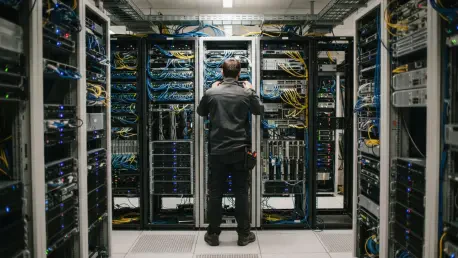

The seamless orchestration of millions of individual processing units into a singular, hyper-efficient computational brain has become the absolute benchmark for modern data center engineering. In the current environment of 2026, the success of massive AI initiatives depends entirely on the underlying fabric that binds these resources together. As datasets expand and model complexity increases, the network has evolved from a simple conduit for information into a strategic asset that dictates the limits of computational throughput. This shift represents a fundamental restructuring of how data moves across various layers of infrastructure.
The Modern Landscape of AI Data Center Fabrics
Modern data center fabrics are structured around a layered architecture that addresses the varying demands of data movement. The scale-up layer is responsible for the intense, high-speed communication between GPUs within a single rack, creating the low-latency environment necessary for real-time inference and training. Moving outward, the scale-out layer connects these racks into vast clusters, facilitating the parallel processing required to train the next generation of large language models. Finally, the scale-across layer enables geographic distribution, allowing separate facilities to function as a unified virtual supercomputer.
Each layer presents unique engineering challenges, ranging from the physical constraints of electrical signaling to the complexities of global traffic management. While scale-up operations require near-instantaneous memory access, scale-out networks must prioritize robust congestion control across thousands of nodes. This tiered approach ensures that the networking architecture remains modular, allowing hyperscalers to expand their capacity without redesigning the entire system from the ground up.
Technological Shifts and Dominant Market Drivers
Emerging Standards and the Move Toward Open Architectures
One of the most notable shifts in the industry is the transition toward open architectures and away from proprietary silos. For several years, specialized interconnects like NVLink and InfiniBand provided the performance edge needed for high-end AI. However, the rise of the Ultra Ethernet Consortium (UEC) and the UALink Consortium has introduced a new era of standardized connectivity. These initiatives focus on enhancing Ethernet performance to meet the rigorous demands of AI workloads without the burden of vendor lock-in.
By fostering interoperability across various hardware providers, these open standards are driving down costs and accelerating the adoption of high-performance networking across the entire enterprise sector. The move toward Ethernet allows organizations to leverage a broad ecosystem of vendors, ensuring that they can customize their fabrics to meet specific workload requirements. This diversification is essential for maintaining a competitive edge in a market where hardware availability can fluctuate rapidly.
Performance Indicators and Long-Term Market Forecasts
Market indicators suggest that financial commitment to these infrastructures is reaching unprecedented levels. Spending on data center switches for AI back-end networks is projected to hit nearly $1 trillion for the period between 2026 and 2030. As 800 Gb/s ports are superseded by 1.6 Tb/s and 3.2 Tb/s speeds, the scale-up segment is expected to capture over half of the market share. This reflects a growing prioritization of intra-rack connectivity, where the highest bandwidth is required to prevent the network from becoming a bottleneck for expensive AI accelerators.
The demand for speed is complemented by the need for enhanced telemetry and predictive analytics within the switch fabric. Operators are increasingly looking for systems that can provide real-time visibility into packet loss and latency spikes. As bandwidth requirements continue to double every few years, the ability to manage these high-speed links with automated software tools is becoming a primary differentiator for networking vendors.
Overcoming Bottlenecks in Next-Generation AI Infrastructure
To maximize GPU utilization, network architects are focusing on overcoming the persistent challenges of latency and congestion. Strategies such as the refinement of RDMA over Converged Ethernet (RoCEv2) have become standard for achieving lossless communication in high-traffic environments. Additionally, the development of specialized Scale-Up Ethernet (SUE) solutions has helped bridge the performance gap that previously favored proprietary systems. These advancements ensure that data moves through the fabric with minimal friction, allowing clusters to maintain peak performance even as they scale to include hundreds of thousands of processors.
Effective congestion management is particularly critical as AI models become more distributed. Without sophisticated load balancing, certain links in the fabric can become overwhelmed while others remain underutilized, leading to significant delays in model training. Modern networking solutions address this by implementing dynamic routing protocols that can reroute traffic in microseconds, ensuring that the total available bandwidth is used as efficiently as possible.
The Regulatory Landscape and Industry Compliance
The regulatory landscape is also evolving, with international bodies like the Open Compute Project and the IEEE setting new benchmarks for compliance. As AI networking becomes a critical component of national infrastructure, adherence to security protocols and data protection standards is mandatory. Organizations must ensure that their networking fabrics are resilient against external threats and internal failures, particularly as they handle increasingly sensitive datasets.
Moreover, energy efficiency has become a primary regulatory concern across major markets. New deployment standards require that networking hardware minimize power consumption per terabit of data moved, forcing vendors to innovate in thermal management and silicon design. Compliance with these energy standards is no longer just an environmental goal but a prerequisite for obtaining the power permits necessary for new data center expansions.
Future Horizons for Distributed AI Networks
Future developments in the field are likely to be driven by innovations in silicon photonics and advanced telemetry. By integrating optical components directly onto the silicon, manufacturers can significantly reduce the energy and latency costs associated with traditional electrical signaling. This breakthrough will be essential for the next generation of scale-across deployments, where millions of GPUs can be managed with unprecedented efficiency.
Furthermore, the rise of edge AI is pushing networking capabilities closer to the source of data generation. This requires a seamless integration between central data center fabrics and the distributed edge, creating a continuous network that can handle both heavy training tasks and lightweight inference. As these technologies mature, the distinction between local and remote computing will continue to blur, enabling a truly global AI infrastructure.
Strategic Summary and Investment Outlook
The strategic landscape of AI networking necessitated a pivot toward modular systems that prioritized interoperability and vendor diversity. Organizations that successfully navigated this transition recognized that the network was a fundamental driver of AI performance rather than just a passive utility. They adopted standardized Ethernet architectures that allowed for seamless scaling from individual racks to global clusters. By focusing on high utilization rates and proactive energy management, these pioneers ensured that their infrastructure remained resilient against shifting market demands. This move toward open fabrics established a foundation for a more sustainable and collaborative technological ecosystem, ultimately providing a clear path for continuous innovation in distributed intelligence.