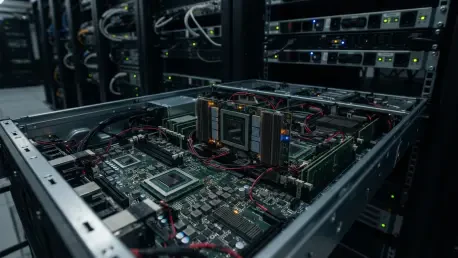

Enterprise-grade storage solutions are integrating piezoMEMS chips to maintain optimal operating temperatures in high-density data center racks and server environments. This pivot toward solid-state thermal management addresses the critical bottleneck of heat dissipation in increasingly compact silicon architectures. As generative AI models migrate from massive cloud clusters to localized edge devices, the physical space required for traditional cooling fans has become a prohibitive luxury. The silicon-based µCooling technology from xMEMS Labs utilizes microscopic diaphragms that move air via piezoelectric actuation, effectively eliminating the mechanical friction associated with standard rotors. These chips are capable of generating substantial back pressure, which is essential for forcing air through the dense internal layouts of modern smartphones and wearable electronics. By replacing rotating components with static silicon, manufacturers have started to overcome the vibration and noise issues that previously limited the deployment of active cooling.
The Mechanics of Silicon Cooling: Achieving Thermal Efficiency in Edge AI Devices
The current generation of solid-state cooling is defined by the XMC-2400 and XMC-4800 micro-cooling chips, which provide a scalable solution for varying thermal envelopes. The smaller XMC-2400 measures a mere 7.42 by 9.48 millimeters, making it suitable for integration into the ultra-thin frames of augmented reality glasses or compact solid-state drives. Consuming only 150 milliwatts of power, this chip allows for active heat management without significantly draining the battery life of portable hardware. In contrast, the larger XMC-4800 is designed for more demanding applications, such as high-end AI smartphones and enterprise-grade networking equipment. This variant consumes approximately 240 milliwatts but offers higher airflow volume to handle the intense heat generated by modern NPUs and GPUs. Both models utilize a side-vented or top-vented architecture, allowing engineers to direct airflow with surgical precision toward the hottest components, a feat that is nearly impossible with traditional centrifugal fans.
Beyond the reduction in physical dimensions, the move to all-silicon cooling eliminates the pervasive mechanical noise and vibration that haunt traditional fan designs. In the context of AI-enabled wearables, such as smart glasses featuring high-resolution displays and integrated microphones, the hum of a mechanical fan would interfere with both the user experience and the sensitive on-board sensors. Solid-state chips operate at ultrasonic frequencies, making them completely silent to the human ear while providing the necessary active cooling to prevent thermal throttling during intensive processing tasks. This silent operation is complemented by an inherent resistance to dust and moisture, as the lack of rotating bearings means there are fewer points of mechanical failure. For hardware designers, this durability translates to a longer product lifespan and lower maintenance costs, particularly in environments where cooling systems are expected to run continuously for years without intervention or replacement.
Engineers and hardware architects successfully identified the transition from passive to active solid-state cooling as a vital step for the next generation of computing. The recorded temperature reductions, ranging from 10 to 25 degrees Celsius, proved that micro-scale airflow could achieve thermal parity with much larger mechanical systems. To prepare for the widespread adoption scheduled for 2027, manufacturers focused on redesigning internal airflow pathways to take full advantage of the high-pressure output provided by these silicon chips. They prioritized the integration of these modules into devices where thermal constraints previously forced a compromise in processing speed. By moving away from rotating parts, the industry embraced a more reliable and silent infrastructure that supported the continuous growth of edge AI capabilities. This technological shift highlighted the importance of viewing thermal management not as an afterthought, but as a fundamental component of semiconductor design.