
Financial institutions are struggling to dismantle organized crime rings because traditional relational databases cannot efficiently trace the subtle infrastructure links between synthetic identities. These criminal organizations have evolved significantly in 2026, utilizing sophisticated automation to create webs of disposable accounts that appear unrelated on the surface. While legacy monitoring systems excel at verifying individual transactions, they often fail to perceive the connective tissue between seemingly isolated events. The integration of Neo4j’s graph intelligence with Microsoft Fabric has emerged as a transformative solution, moving the industry toward a proactive defensive posture. By treating data as a network of relationships rather than a collection of independent tables, banks can now identify the patterns of collusion that define modern peer-to-peer fraud. This shift from reactive oversight to relationship-based intelligence allows investigators to visualize the broader strategy behind criminal activity, effectively unmasking the hidden architecture used to launder funds and exploit digital vulnerabilities across the global financial landscape.
The Technical Barriers of Legacy SQL Architectures
The fundamental struggle for modern fraud departments often stems from an over-reliance on SQL-based relational databases that were never designed for complex network analysis. These systems organize data into rigid, flat tables that require intensive computational resources to link together through “join” operations. In 2026, when a fraud investigator attempts to trace an account’s connections across five or six degrees of separation—such as shared device IDs, physical addresses, and secondary contact numbers—relational systems frequently hit an architectural wall. The exponential growth in processing requirements for these multi-hop queries leads to significant latency, often resulting in system timeouts precisely when speed is most critical. Consequently, the very tools intended to protect financial assets become bottlenecks that allow agile criminal networks to stay several steps ahead of detection efforts, draining accounts before an alert can even be processed by a human reviewer.
This performance degradation is not merely a technical inconvenience; it represents a significant security gap that organized crime rings exploit with increasing frequency. When a relational database fails to provide a real-time view of a suspect network, analysts are forced to work with fragmented snapshots of data, missing the “big picture” of a coordinated attack. For instance, a single suspicious transaction might be flagged, but the dozen associated accounts that share a common, hidden infrastructure remain undetected. This inability to perform deep-link analysis at scale means that financial institutions are often playing a game of “whack-a-mole,” shutting down individual accounts while leaving the underlying criminal hive intact. To overcome this, the industry has begun to recognize that the value of data lies not in the individual records themselves, but in the strength and nature of the connections that bind them together in a complex, shifting financial ecosystem.
Eliminating False Positives with Contextual Graphs
A pervasive challenge in the current landscape of automated monitoring is the high volume of false positives generated by shared public infrastructure, a phenomenon often described as the “coffee shop Wi-Fi” problem. Traditional AI models grounded in flat data often struggle to distinguish between a group of innocent strangers using a public airport gateway and a criminal syndicate sharing a private, high-security credential. Because relational models treat every shared attribute with equal weight, a single IP address can link thousands of legitimate users to a known fraudster, triggering an avalanche of irrelevant alerts. This lack of context-aware reasoning burdens investigative teams with “noise,” making it nearly impossible to prioritize genuine threats. Without the ability to differentiate between coincidental proximity and high-risk collusion, banks risk alienating their customers with unnecessary account freezes while simultaneously missing the subtle signals of actual theft.
By integrating Neo4j’s graph intelligence into the Microsoft Fabric “OneLake” environment, financial institutions can finally apply a layer of sophisticated reasoning to these data points. In this connected property graph model, the system can automatically weight the significance of different types of relationships. While sharing a public IP address might be assigned a low risk score, sharing a unique device fingerprint or a specific mobile carrier gateway in a rapid-fire sequence of transfers triggers an immediate high-priority escalation. This nuance allows the AI to filter out the background noise of everyday digital life, focusing exclusively on the “high-confidence identifiers” that characterize professional fraud rings. The result is a dramatic reduction in false alarms, enabling security teams to dedicate their limited time and resources to the most credible threats. This precision is essential for maintaining customer trust in an era where digital banking speed is a primary competitive advantage for modern financial firms.
Real-Time Detection through Advanced Community Algorithms
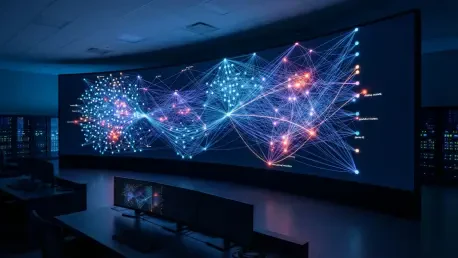
The true power of modern graph intelligence is realized through the application of specialized Graph Data Science algorithms that operate directly on the connected data structures within Microsoft Fabric. Algorithms such as “Weakly Connected Components” allow systems to analyze the entire topology of a bank’s data in milliseconds, identifying clusters of accounts that are bound together by shared illicit infrastructure. When a single node in the network is flagged for suspicious behavior, the graph engine can instantly reveal every other account in that specific “community,” regardless of how many steps removed they appear to be. This capability transforms fraud detection from a transaction-based model into a network-based defense. Instead of investigating one account at a time, banks can now identify and neutralize entire crime rings simultaneously. This systemic approach is the only way to effectively combat synthetic identity theft, where criminals create hundreds of fake personas to overwhelm traditional systems.
Furthermore, the transition to a graph-grounded Copilot within the Fabric ecosystem provides investigators with a level of actionable intelligence that was previously unattainable. When a standard SQL-based AI agent generates a report, it often produces a disorganized list of raw data that requires hours of manual interpretation to find relevant patterns. In contrast, a graph-powered agent delivers a concise, prioritized summary that explicitly details why a group of accounts is considered a threat, highlighting the specific shared devices or transfer paths that link them. This “explainable AI” is crucial for regulatory compliance and internal auditing, as it provides a clear logic trail for every action taken by the fraud department. By providing both the “who” and the “how” of a criminal operation, graph intelligence empowers financial institutions to move beyond simple detection and into the realm of strategic prevention, disrupting the economic incentives that drive organized financial crime.
Strategic Implementation within the Microsoft Ecosystem
Adopting graph-based intelligence does not necessitate a complete reconstruction of a bank’s existing data architecture, as Neo4j integrates natively as a workload within the Microsoft Fabric platform. This synergy allows data scientists to work within the familiar environment of Fabric notebooks, utilizing the Cypher query language alongside Python to calculate risk scores directly on the data residing in the lakehouse. There is no longer a need to export massive datasets to external silos, which significantly reduces the risk of data leakage and simplifies the management of complex data pipelines. This streamlined workflow ensures that the transition from traditional monitoring to graph-grounded intelligence is both rapid and cost-effective. Organizations can leverage their existing investments in Microsoft’s cloud infrastructure while gaining the cutting-edge capabilities required to defend against the most advanced financial threats of the current year.
Beyond technical efficiency, this integrated approach addresses the stringent security and governance requirements that define the financial services industry. Because the system operates within the tenant-isolated environment of Microsoft Fabric, it maintains full compatibility with native security features such as Single Sign-On and Microsoft Purview for data lineage and governance. This ensures that even as the fraud detection system performs aggressive, wide-reaching analysis of network patterns, it remains fully compliant with global privacy regulations and internal data handling policies. The ability to perform high-speed graph analytics without compromising on security standards provides a significant competitive advantage. Financial institutions can now pursue organized crime rings with the confidence that their investigative processes are both legally sound and technically superior, creating a robust shield for their customers’ assets and the integrity of the broader financial system.
Future Proofing Financial Security Through Connectivity
The transition to graph-grounded AI in 2026 proved that treating data as a network was the most effective way to dismantle the sophisticated crime rings that once plagued the banking sector. By moving away from the limitations of relational tables, financial institutions gained the ability to see the “connective tissue” of criminal infrastructure that was previously invisible. This shift allowed for the rapid identification of synthetic identities and coordinated P2P fraud networks, transforming the speed at which security teams could respond to emerging threats. The integration of Neo4j with Microsoft Fabric didn’t just improve existing processes; it fundamentally changed the logic of fraud detection by prioritizing relationship-level context over isolated data points. Investigators found that they could finally resolve the “coffee shop Wi-Fi” problem, reducing false positives and focusing their expertise on legitimate threats that posed the greatest risk to their organizations and their valued clients.
Moving forward, the primary recommendation for financial institutions is to prioritize the consolidation of disparate data silos into a unified graph-ready lakehouse to maximize the effectiveness of these AI agents. Organizations should actively transition their transaction monitoring workflows toward community detection models that can isolate entire fraudulent networks in real-time. Additionally, investment in “explainable” graph intelligence will be essential for satisfying evolving regulatory requirements regarding AI-driven decision-making. By grounding AI Copilots in the structural reality of a connected graph, banks can ensure that their defensive strategies remain both transparent and formidable. The success of this approach highlights a broader industry truth: in a world of interconnected digital finance, security is only as strong as one’s ability to understand and navigate the complex web of relationships that define the modern economic landscape. Those who embrace this connectivity will lead the way in creating a more secure financial future.