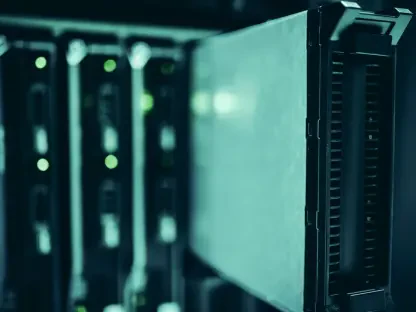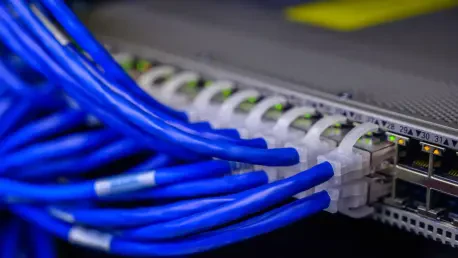

Cisco announced the N9348C8D-H2 last week, a top-of-rack switch that connects servers within a rack to the wider network, as server consolidation puts more computing power behind fewer connections. At Cisco Live in Melbourne this week, Cisco linked the move to faster server processors and the traffic those machines can generate. Cisco also expects AI agents, software that carries out tasks for users, to add pressure across internal networks and cloud connections.
Server Consolidation Puts More Traffic Into Each Rack
Kevin Wollenweber, senior veep for datacenter and internet infrastructure at Cisco, said part of the thinking behind the switch was that servers now often have two high-speed network interface cards, which connect the machines to a network.
Those connections serve machines running sixth-gen Intel and AMD processors, which can have dozens or even hundreds of cores, so each server has more computing work to do and more traffic going through its connections. Chip and server vendors have been encouraging customers to use fewer machines built on sixth-gen chips that use power more efficiently, and those machines would take the place of groups of older Xeons and Epycs.
According to media reports, it is not unusual for customers to reach consolidation ratios of 6:1 when swapping out Xeons or Epycs from the third or fourth generation for current machines, which means fewer servers are needed to take on the work. That change can bring electricity bills down, while the move also packs extra cores into every rack and pushes up the volume of data coming out of it. According to Wollenweber, Cisco already had plenty of switches with 25G ports. What Cisco saw missing was a product for higher traffic volumes from uses outside AI, including consolidated servers. Its new switch brings 100G server connections alongside faster links into the wider network.
| N9348C8D-H2 feature | Specification |
|---|---|
| Rack space | 1U |
| Server-facing connections | 48 ports, 100G SFP-DD |
| Uplinks | Eight ports, 400G QSFP-DD |
Wollenweber acknowledged that a small group of new servers might not need all the capacity 100G provides today, while Wollenweber argued that customers expect to use the spare capacity before long. Wollenweber gave agentic AI applications as one possible reason for that growth, which could lead customers to use more of the capacity available to them.
AI Agents Could Bring More Traffic Inside and Outside Networks
Cisco expects agents to add north-south traffic, which is data moving between an organization and cloud services, while agents would also add east-west traffic moving between systems within the organization’s network. Cisco executives at the event said network upgrades would be needed to handle that growth, and presented those upgrades as something customers would not be able to avoid.
That argument depends on agents becoming much more numerous than human users and producing traffic all the time, while people using chatbots or generative AI tend to produce traffic in bursts. Wollenweber acknowledged that some 100G capacity could be spare for now, which leaves the question of how soon each customer will actually need to use that capacity.
Cisco Says More Agents Will Mean More Network Automation
In Cisco’s view, networks serving large numbers of agents will need heavy automation, and network data volumes have already grown beyond what people can readily make sense of. According to Cisco, the Canvas platform for agentic operations is meant to find faults and point those faults out to an administrator. Canvas can also offer to make the repairs. Joe Vaccaro, who is senior vice president and general manager for Network Platform and Assurance at Cisco, said administrators are comfortable with suggestions from agents when the work is familiar and carries little risk. Vaccaro expects that confidence to build over time, and expects administrators to become more comfortable with agents taking on tasks that are more complicated than the familiar, low-risk work.