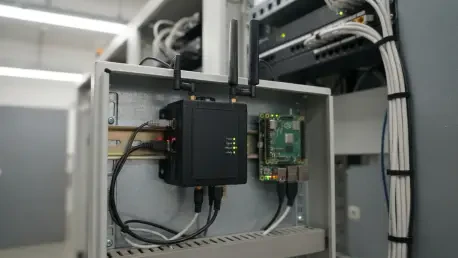

The adoption of the Lightweight Machine-to-Machine protocol addresses the specific management needs of ultra-low-power IoT devices operating in bandwidth-constrained environments. This strategic inclusion in the RutOS 7.26 firmware update marks a significant shift for Teltonika Networks as it moves beyond traditional connectivity toward a more nuanced, edge-centric architecture. By integrating AWS IoT Greengrass V2 into the RUTX series and other compatible industrial routers, the developer has effectively bridged the gap between raw data collection and high-level cloud analytics. This development became essential as the industry officially completed the transition away from Greengrass V1 in early 2025, forcing a widespread move toward more modular, component-based architectures. The latest firmware provides the necessary infrastructure for organizations to maintain local intelligence, allowing devices to continue processing information and executing commands even when primary internet connections are severed in remote or high-stakes industrial locations.
Resilience at the Edge: Localized Intelligence and Data Integrity
Local Execution: Utilizing AWS Lambda and Enhanced Authentication
The deployment and execution of AWS Lambda components directly on the router hardware represents a fundamental shift in how industrial data is managed. By enabling localized processing at the source, industrial operators can drastically reduce latency and lower cumulative bandwidth costs, as only refined and relevant datasets are transmitted to the cloud once a stable connection is established. This localized intelligence is further supported by an enhanced authentication mechanism that allows the router to verify device credentials against a local Greengrass core during an internet outage. Such a feature ensures that safety protocols and automated routines remain active without needing to wait for a handshake from a distant central server. Furthermore, the firmware allows for a more efficient use of hardware resources, as localized computing tasks can be scaled according to the specific needs of the local network environment, ensuring that the router remains responsive even under heavy computational loads.
Data Reliability: Persistent Disk Spooling and Message Priority
To ensure absolute data integrity during network failures, RutOS 7.26 introduces a sophisticated persistent disk spooling system for MQTT messages. Unlike older, memory-based spooling methods that often lost data due to power cycles or filled volatile RAM, this new approach utilizes the router’s physical storage to cache outbound messages securely. The system is designed to respect various Quality of Service levels, meaning that mission-critical data marked as high priority is given precedence for retention and eventual transmission. Once the connection to the Wide Area Network is restored, the router automatically synchronizes the cached data with the cloud, ensuring no gaps in the historical record of the industrial site. This robust handling of data streams is vital for compliance and auditing in sectors like pharmaceutical manufacturing or energy production, where every single data point can have significant legal and operational implications for the business.
Seamless Integration: Bridging Modern Logic with Legacy Hardware
Protocol Translation: The Role of the AWS Modbus RTU Adapter
A recurring challenge in the industrial landscape is the presence of brownfield equipment that relies on legacy communication protocols rather than modern cloud-native languages. The integration addresses this by including an AWS Modbus RTU adapter, which allows Teltonika routers to act as a sophisticated bridge between traditional serial-based machinery and the AWS cloud environment. By utilizing the physical serial ports or external USB adapters on the RUTX series, Greengrass applications can read from and write to industrial registers on the factory floor. This capability essentially transforms isolated, aging machines into smart, connected assets that can participate in complex automation workflows. This bridge does not merely forward data; it allows for the implementation of local control logic that can respond to machine states in real time, providing a layer of protection and efficiency that was previously impossible without expensive hardware overhauls.
Operational Success: Next Steps for Network Infrastructure
As organizations analyzed the results of these technical upgrades, it became clear that the move toward edge autonomy was the only viable path for sustainable growth in the industrial sector. The integration of AWS IoT Greengrass V2 into RutOS 7.26 demonstrated that industrial networking hardware could perform roles once reserved for dedicated onsite servers. Operators who successfully migrated their workflows reported a marked decrease in unplanned downtime and a substantial improvement in data management efficiency across their remote sites. Moving forward, stakeholders prioritized the auditing of their existing legacy equipment to identify which assets could be immediately bridged using the Modbus adapter. Additionally, engineering teams were encouraged to experiment with custom Greengrass components to tailor the router’s logic to specific site-specific safety requirements. This proactive stance ensured that the infrastructure remained resilient against the evolving demands of the global digital economy.