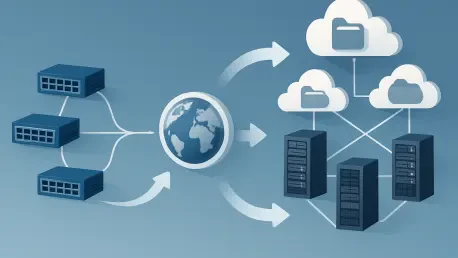

While Multiprotocol Label Switching once provided the predictable performance required by the finance industry, its control mechanisms remained firmly in the hands of service providers. This historical dynamic forced enterprises into a passive role, where they were essentially renters of connectivity rather than architects of their own digital environments. For decades, the Wide Area Network functioned as a static utility, dictated by the rigid Service Level Agreements of telecommunications carriers who owned the physical infrastructure. However, the modern enterprise landscape demands a radical departure from this legacy model. Today, connectivity is being reimagined as a dynamic, programmable resource that must align instantaneously with high-performance application requirements. As data-intensive workloads like artificial intelligence become the standard, the balance of power is shifting away from the traditional carrier toward a more sophisticated, application-centric architecture that prioritizes deterministic performance over mere connectivity.
Historical Power Dynamics: The Quest for Control
The trajectory of networking history reveals a persistent tension between cost, performance, and institutional control. In the earliest iterations of corporate connectivity, leased lines offered the high performance required for critical operations, yet the astronomical costs associated with these private circuits prevented widespread scalability. During this period, the telecommunications carriers held absolute power, leaving organizations to write checks for infrastructure they could neither see nor influence. Even as the 1990s introduced shared infrastructures like Frame Relay and Asynchronous Transfer Mode, the fundamental power dynamic remained largely static. Enterprises were essentially tenants on carrier-owned property, subject to the specific routing decisions and performance constraints of the provider. This era of carrier-led networking established a baseline of reliability, but it simultaneously stifled innovation by forcing organizations to adapt their digital strategies to the limitations of the transport layer.
The emergence of Multiprotocol Label Switching offered a technical compromise that improved performance but deepened the dependency on external providers. While MPLS enabled sophisticated traffic engineering and prioritized critical data streams, it did little to democratize the underlying control of the network. Technical teams remained reliant on the service provider to manage the label-switched paths, creating a bottleneck that slowed the pace of business transformation. This era was defined by a manual approach to network management, where changes to the architecture required long lead times and extensive coordination with external technicians. The predictability of the network was a significant asset for industries like finance, yet the lack of agility eventually became a liability. As the pace of global business accelerated, the rigid nature of carrier-managed networks began to clash with the need for rapid deployment and flexible resource allocation, setting the stage for a shift toward software-defined solutions.
The Decoupling Revolution: From Hardware to Policy
The turning point in the evolution of enterprise connectivity arrived with the rise of Software-Defined WAN, which effectively decoupled the control plane from the underlying physical transport. This innovation marked a massive departure from the past, as it allowed organizations to steer traffic based on business policies and application requirements rather than being locked into the predetermined paths of a carrier. For the first time in the history of networking, enterprises were able to “take back the wheel,” managing multiple transport types including broadband and cellular alongside their legacy circuits. This move toward transport independence was not merely a cost-saving measure but a strategic realignment that placed the enterprise in direct control of its digital traffic. By virtualizing the network edge, organizations gained the ability to prioritize critical applications in real-time, ensuring that high-value workloads received the necessary bandwidth without being hindered by less important background traffic.
This shift toward software-centric control was further refined by the development of Secure Access Service Edge, which integrated routing flexibility with cloud-native security. Before this integration, organizations were often forced into an inefficient practice known as “hairpinning,” where all remote traffic was funneled through a centralized data center for security scrubbing before reaching its destination. This approach added significant latency and degraded the user experience, particularly as applications began to migrate out of private data centers and into the cloud. SASE eliminated these bottlenecks by moving security functions directly to the network edge, allowing for secure, direct-to-cloud connectivity. This architectural shift allowed enterprises to achieve unprecedented oversight of both their routing logic and their security posture. However, this period of enterprise-centric control was relatively brief, as the massive gravity of cloud hyperscalers began to redefine the path of least resistance for modern digital traffic.
Hyperscaler Influence: The Best-Effort Bottleneck
As enterprise applications migrated to public cloud environments, the heavy infrastructure supporting them moved to a handful of global hyperscalers like Amazon Web Services, Microsoft Azure, and Google Cloud. These entities invested billions of dollars into building private, high-capacity fiber-optic networks that rival the reach of traditional global carriers. In the current landscape, much of the corporate traffic travels over the public internet only until it reaches the nearest cloud on-ramp, after which it rides the hyperscaler’s dedicated backbone. This transition has rendered traditional Multiprotocol Label Switching optional for many organizations, as the reliability of cloud backbones often exceeds what was previously available through public peering. However, while this shift solved many accessibility issues, it also introduced a new form of gatekeeping. The cloud providers now dictate the performance characteristics of the global network, meaning the enterprise has traded carrier dependency for a reliance on the specialized ecosystems of the hyperscalers.
Despite the sophistication of these cloud-connected networks, the majority of modern Wide Area Network architectures still rely on a “best effort” delivery model at the transport layer. While this model is generally sufficient for standard web browsing or basic communication tools, it is proving to be a critical bottleneck for the high-performance demands of artificial intelligence and real-time data replication. High-performance workloads require absolute predictability and zero-tolerance for latency spikes or jitter. Software overlays, no matter how advanced, cannot fully compensate for inconsistencies in the physical transport layer. When a network is operating on a best-effort basis, it remains susceptible to congestion that can disrupt the synchronization of massive GPU clusters or slow the throughput of intensive data pipelines. This limitation has highlighted the urgent need for a new class of deterministic networking that can provide the guaranteed performance levels required by the next generation of data-driven business applications.
Photonics: The Future of Deterministic Networking
The next major evolution in networking is moving control directly into the hands of the application through the implementation of technologies like the All-Photonics Network. This represents a fundamental upgrade to the physical transport layer, designed to eliminate the latency-inducing conversions between optical and electrical signals that have historically hampered network speeds. By making the underlying network programmable at the light level, the infrastructure can finally adapt to the specific needs of the application rather than forcing the software to work around network limitations. This means a high-priority artificial intelligence workload can communicate its exact requirements for bandwidth and latency, and the network can reconfigure its physical resources in real-time to meet those demands. This shift marks the end of the best-effort era for high-performance environments, replacing it with a model of guaranteed performance that ensures critical data reaches its destination with perfect consistency and zero lag.
To address these evolving challenges, forward-thinking organizations focused on four strategic pillars: modernizing the physical transport layer, avoiding vendor lock-in, eliminating architectural debt, and adopting agentic infrastructure. Decision-makers recognized that software overlays alone were insufficient for the demands of the current era, leading to a prioritized investment in deterministic transport systems. They also worked to balance the simplicity of integrated security frameworks with the need for long-term architectural flexibility. By planning for the predictability required by high-performance intelligence workloads, these leaders avoided the high costs of future retrofitting. Furthermore, as the volume of network telemetry data grew beyond human capacity, the implementation of autonomous, AI-driven management systems became a necessity for maintaining optimal performance and security. These actions ensured that the network finally functioned as a seamless extension of the applications it supported, enabling a new level of operational agility.