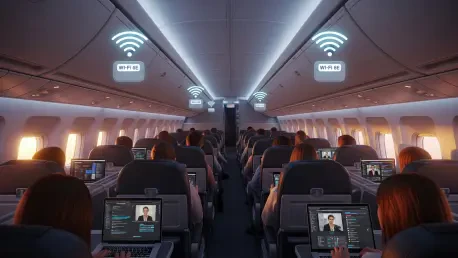

The landscape of international aviation witnessed a significant and unprecedented transformation as the traditional frustrations of sluggish in-flight connectivity finally gave way to a new era of seamless and high-speed digital performance across the global skies. United Airlines recently secured the top position in global speed rankings, marking a pivotal moment for travelers who increasingly view high-speed internet as a non-negotiable utility rather than a luxury upgrade. This achievement stemmed from a multi-year initiative aimed at eliminating the dead zones and high-latency issues that have historically plagued transcontinental and transoceanic flights. By prioritizing bandwidth capacity and reliability, the carrier successfully redefined the expectations for mobile productivity at thirty thousand feet. Data analysts noted that the gap between United and its closest competitors widened significantly, reflecting a deliberate shift toward advanced satellite constellations that provide a ground-like experience. This evolution fundamentally changed the relationship between the passenger and the cabin.
Strategic Deployment of Advanced Satellite Architecture
The primary driver behind this surge in connectivity performance involved the aggressive adoption of Low Earth Orbit (LEO) satellite networks, which operate much closer to the planet than traditional geostationary systems. By utilizing constellations such as those operated by SpaceX’s Starlink, United provided passengers with significantly reduced latency and higher throughput, addressing the fundamental physical limitations of older technology. These LEO satellites allowed for a more consistent signal even while crossing polar regions or mid-ocean corridors where coverage was previously sparse or nonexistent. Furthermore, the integration of these systems ensured that bandwidth remained robust even when every seat in a wide-body aircraft attempted to access the network simultaneously. This technological pivot effectively removed the bottleneck that often occurred during peak usage times on long-haul routes. The decision to move away from legacy hardware in favor of these high-capacity networks demonstrated a commitment to long-term digital infrastructure.
Complementing the satellite upgrades was a comprehensive fleet-wide hardware overhaul that replaced aging antennas with multi-link electronically steered arrays capable of maintaining stable connections during high-speed flight. These new hardware configurations allowed for faster handoffs between satellite beams, ensuring that passengers did not experience the frequent disconnections typical of older switching mechanisms. The internal cabin distribution also received a major upgrade, with the installation of the latest Wi-Fi 6E access points to manage the increased data flow efficiently across dozens of devices. By optimizing the local network within the aircraft, United ensured that the massive influx of data from the satellites reached individual smartphones, tablets, and laptops without internal interference. This end-to-end optimization was critical because even the fastest satellite link can be throttled by outdated onboard routers or poor signal distribution. The result was a cohesive ecosystem where the hardware and software worked in tandem.
Future Considerations for Integrated Digital Standards
The emergence of such high-speed capabilities necessitated a broader discussion regarding the implementation of standardized security protocols across the global aviation sector to protect sensitive user data. As United set the pace for the industry, the next logical step involved the integration of biometric authentication and encrypted tunnels to ensure that public Wi-Fi on aircraft remained as secure as a private office network. Carriers recognized that maintaining speed was only half the battle; the long-term solution required a collaborative approach to cybersecurity and data privacy. Furthermore, the industry looked toward the potential for software-defined networking to automatically allocate bandwidth based on the specific needs of different applications, ensuring that critical tasks received priority. Stakeholders also evaluated the environmental impact of these massive satellite constellations, seeking ways to balance technological progress with sustainable space management practices. This move toward standardized protection benefited all passengers.
Ultimately, the success of this high-speed rollout provided a clear roadmap for the aviation industry to prioritize connectivity as a fundamental component of the travel experience rather than a secondary perk. Airline executives and technology partners shifted their focus toward creating a unified digital identity that allowed passengers to transition seamlessly from airport terminals to the aircraft cabin. This integrated approach addressed the fragmentation that previously characterized travel technology, making the journey more intuitive and less stressful. The industry as a whole moved toward adopting these high-capacity standards, ensuring that every passenger had access to the necessary tools for both professional and personal digital life. Moving forward, the emphasis remained on refining these systems to support even more data-intensive applications like virtual reality and real-time remote collaboration. The precedent established by these speed rankings underscored the necessity of continuous investment in digital infrastructure to meet the evolving demands of a hyper-connected global population.