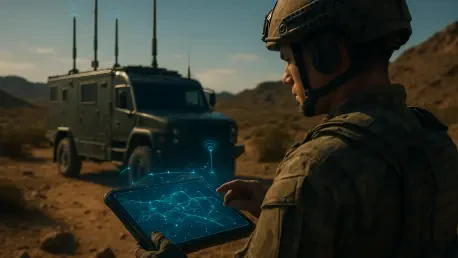

Military operations in the current landscape of 2026 have moved far beyond the traditional reliance on voice-centric communications toward a complex web of interconnected sensors, drones, and high-bandwidth data streams. This shift creates a massive influx of information that can easily overwhelm human operators, making the integration of artificial intelligence within 5G architectures a necessity rather than a luxury. Tactical networks now face the dual challenge of maintaining low-latency connectivity in hostile environments while simultaneously filtering out noise to deliver actionable intelligence. The convergence of these technologies offers a path toward a self-healing and self-optimizing network infrastructure that adapts to the shifting priorities of a mission in real-time. By leveraging the high throughput of 5G, combined with the analytical power of AI, commanders can now expect situational awareness that was previously unattainable, effectively turning the network into a strategic asset that anticipates threats.
Intelligent Orchestration of the Electromagnetic Spectrum
Cognitive Networking: Autonomous Bandwidth Slicing
Traditional methods of static spectrum management often fail when deployed in contested environments where electronic jamming and physical obstructions are constant variables. The implementation of AI-driven 5G slicing allows the network to prioritize mission-critical data, such as telemetry from an autonomous reconnaissance drone, over less urgent administrative traffic automatically. This cognitive approach ensures that the most vital communications channels remain open even when bandwidth is severely restricted or under heavy load. Algorithms continuously analyze signal strength and latency across the entire tactical grid, adjusting the allocation of resources in milliseconds to maintain a stable link between the command center and the front lines. This level of automation reduces the burden on signals officers, who no longer need to manually reconfigure hardware to compensate for environmental changes. Instead, the network functions as a living organism, constantly reshaping its virtual architecture to provide the best performance.
Electronic Warfare: Intelligent Signal Resilience
Beyond simple allocation, the integration of deep learning models within the radio access network enables sophisticated electronic counter-countermeasures that were impossible with legacy systems. When an adversary attempts to disrupt communications through narrow-band jamming, the AI detects the specific signature of the interference and instantly shifts the 5G waveform to a cleaner portion of the spectrum. This frequency-hopping happens so rapidly that the end-user experiences no loss in connectivity, maintaining the flow of vital information during the most critical moments of an engagement. Furthermore, the AI can distinguish between intentional jamming and natural interference caused by terrain or weather, allowing it to apply the most effective mitigation strategy without wasting power or bandwidth. By utilizing massive MIMO and beamforming directed by intelligent controllers, the network can create highly directional links that are harder for enemies to intercept. These advancements ensure that the tactical edge remains connected even in hostile theaters.
Transforming the Tactical Edge Through Distributed Processing
Edge Computing: Distributed Battlefield Intelligence
One of the most significant advantages of pairing 5G with artificial intelligence is the ability to perform high-level data processing directly at the network edge rather than relying on a centralized cloud. In a tactical environment, the delay caused by sending massive amounts of sensor data back to a distant server for analysis can be the difference between mission success and failure. Multi-access edge computing enabled by 5G allows for the deployment of AI nodes within mobile vehicles themselves, processing video feeds and sensor data on-site. This localized intelligence enables immediate threat detection and identification, such as spotting a concealed target and alerting nearby units in a matter of milliseconds. As tactical networks continue to evolve from 2026 through 2028, the reliance on these intelligent, self-organizing systems will only deepen. By reducing the volume of data that must travel across the core network, this distributed model also preserves precious bandwidth for other tasks.
Strategic Sustainability: Integrated Tactical Logistics
Organizations that successfully integrated these AI-driven 5G capabilities into their tactical frameworks realized that the true value lay in the seamless fusion of connectivity and intelligence. It was not enough to simply have faster data transmission; the network had to be smart enough to understand the context of the information it was carrying. Moving forward, defense planners should prioritize the development of open-architecture systems that allow for the rapid integration of new AI models as they emerge. Investment in hardened edge computing hardware proved to be a critical factor in maintaining operational resilience in contested environments. Leaders focused on training personnel to trust and interact with these autonomous systems, ensuring that human decision-making remained central even as the machine handled technical complexity. By treating the tactical network as a dynamic entity, military forces secured a decisive advantage in the cognitive domain, transitioning from merely connecting devices to creating an intelligent ecosystem.