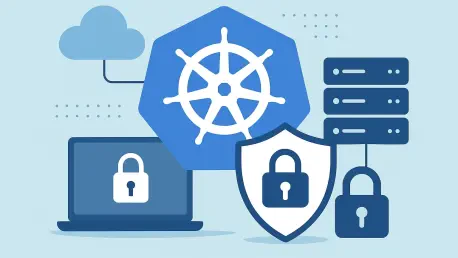

The timeframe between the spinning up of a new cloud environment and its discovery by malicious automated scripts has shrunk to a point where traditional security perimeters are effectively obsolete. Telemetry from recent infrastructure audits indicates that a fresh Kubernetes cluster can be identified and probed by external bots in less than ten minutes, creating a critical window where misconfigurations are exploited before an administrator can even apply basic hardening policies. This immediate exposure negates the luxury of the grace period that many organizations historically relied upon when moving from development to production phases in their digital transformation journeys. The reality of modern computing dictates that security cannot be an afterthought or a secondary process that follows deployment; instead, it must be an integrated, living component of the infrastructure itself. Relying on periodic audits or manual oversight invites disaster in an environment where automated threats operate at machine speeds, scanning entire IP ranges for the smallest opening or over-privileged service account.
The Reality of Automated Cloud Exploitation
The Mechanics: Understanding the Speed of Automated Threats
The velocity of modern cyberattacks is driven by sophisticated global automation frameworks that operate without human rest or error, scanning for exposed endpoints around the clock. These botnets are not seeking specific high-value targets initially; rather, they are programmed to find any accessible Kubernetes API server or unsecured dashboard that offers an entry point into the underlying infrastructure. Once a vulnerability is identified, the exploitation process is triggered instantaneously, often resulting in the deployment of cryptojackers, backdoors, or credential-stealing scripts before the security team receives a single alert from a standard monitoring tool. This level of efficiency means that the battle for cluster security is lost the moment a permissive default setting is pushed to a public-facing environment without active mitigation. Because the interval between exposure and compromise has become so narrow, the industry has reached a consensus that pre-deployment checks, while necessary, are no longer a sufficient defense against the relentless tide of automated discovery.
Security architectures that focus exclusively on the perimeter or the build phase fail to account for the dynamic nature of containerized workloads that can be modified or compromised after they are running. Attackers frequently bypass static defenses by using living-off-the-land techniques, where they utilize legitimate binaries and system tools already present within the container image to carry out malicious activities. This strategy allows them to remain undetected by traditional signature-based scanners that only look for known malware files rather than suspicious behavior. Consequently, the emphasis has shifted toward maintaining a constant, high-fidelity observation of the cluster’s internal state to catch these subtle deviations from expected operational patterns. Without continuous runtime visibility, an organization remains blind to the most dangerous phase of an attack: the period after initial entry where lateral movement and data exfiltration occur. Addressing this gap requires a move away from reactive security models toward a proactive stance that treats every running process as a potential vector.
Identifying the Source: Addressing Blind Spots in Static Scanning
While static analysis and container image scanning remain essential components of a secure development lifecycle, they are increasingly bypassed by attackers who exploit the discrepancy between build-time state and runtime reality. A container image might pass every security check during the CI/CD process, but once it is deployed, it can be modified through a shell injection or a compromised dependency that downloads malicious payloads directly into memory. Static tools are incapable of detecting these changes because they only examine the static files within the image, leaving a massive blind spot for any activity that occurs after the container starts. This gap is where runtime detection becomes indispensable, as it monitors the actual behavior of the application as it interacts with the operating system and the network. By watching for unusual outbound connections or unexpected file system modifications, runtime sensors can alert administrators to a breach that was initiated through a zero-day vulnerability or a sophisticated supply chain attack that bypassed inspections.
Advanced adversaries often leverage legitimate administrative tools like kubectl or package managers like apt and yum to perform reconnaissance and move laterally within a cluster, activities that static scanners cannot flag as inherently malicious. These living-off-the-land attacks are particularly dangerous because they blend in with standard administrative operations, making them difficult to distinguish without a deep understanding of the normal behavioral baseline for a specific workload. Runtime detection powered by eBPF allows for the creation of sophisticated profiles that define exactly what a container should and should not be doing during its lifecycle. If a web server container suddenly attempts to run a network scanner or access a sensitive configuration file that is not part of its standard operations, the system can trigger an immediate alert or even terminate the suspicious process. This capability ensures that the security posture remains dynamic and responsive to the actual threats present in the environment, rather than relying on a static set of rules.
Advanced Strategies for Real-Time Monitoring
Deep Visibility: Comparing Methodologies and eBPF Integration
The technical evolution of cloud security has sparked a debate between agentless and agent-based methodologies, yet the most resilient frameworks now integrate both to achieve comprehensive situational awareness. Agentless scanning offers a valuable outside-in perspective by using cloud-native APIs to assess configurations and disk images without impacting the performance of the workload itself. However, this method lacks the granularity required to observe transient events or in-memory execution paths that never touch the persistent storage layer. To solve this, the integration of extended Berkeley Packet Filter technology has revolutionized how defenders monitor their environments from the inside-out. By executing sandboxed programs directly within the Linux kernel, eBPF provides deep visibility into system calls, network sockets, and process lifecycles with significantly lower overhead than traditional kernel modules or sidecar proxies. This allows security teams to monitor every interaction at the lowest level of the operating system.
The power of eBPF lies in its ability to intercept and analyze system requests without modifying the application code or the underlying kernel source, making it an ideal tool for high-performance Kubernetes environments. Because it operates at the kernel level, it can correlate network traffic with specific processes and users, providing a detailed map of how data flows through a cluster and which entities are responsible for those movements. This granular data enables the identification of unauthorized scripts that may be masquerading as legitimate system services or background tasks, which are often missed by higher-level monitoring tools. Furthermore, eBPF-based sensors can distinguish between a vulnerability that is merely present in a library on disk and one that is actually being exploited by a running process. This distinction is vital for modern security teams who are often overwhelmed by a deluge of alerts; it allows them to prioritize remediation efforts on active threats that pose an immediate risk to the business.
Operational Success: Metrics for Modern Detection Solutions
The effectiveness of a runtime detection solution is measured not just by its ability to identify a threat, but by the speed and context with which it delivers that information to the responders. In an era where automated exploits can achieve their objectives within a matter of minutes, an alert that takes thirty minutes to generate and another hour to investigate is essentially a post-mortem report rather than a preventative measure. Effective tools must provide near-instantaneous notification of anomalies, coupled with rich contextual data that includes the identity of the user, the specific pod involved, and the potential impact on surrounding services. This level of detail allows security analysts to quickly determine the blast radius of an incident and make informed decisions about whether to isolate a node or terminate a compromised process. The primary goal is to reduce the mean time to detect to seconds, ensuring that defenders can react before the attacker has a chance to establish persistence or exfiltrate data.
The shift toward kernel-level observability through eBPF and native system APIs provided a decisive advantage in the ongoing struggle against automated cloud exploitation. By integrating real-time monitoring directly into the fabric of the Kubernetes infrastructure, organizations finally bridged the gap between static vulnerability scanning and the dynamic reality of modern cyber threats. This transition necessitated a move away from siloed security tools toward unified platforms capable of correlating events across diverse operating systems and cluster configurations. To maintain this momentum, stakeholders prioritized the automation of response actions, ensuring that high-confidence alerts triggered immediate isolation of compromised resources without requiring manual intervention. Moving forward, it became essential to invest in continuous training for security teams to interpret complex telemetry and to refine behavioral baselines as applications evolved. These strategies ensured the defense matched the speed of the adversary, turning the cluster into a resilient environment.