


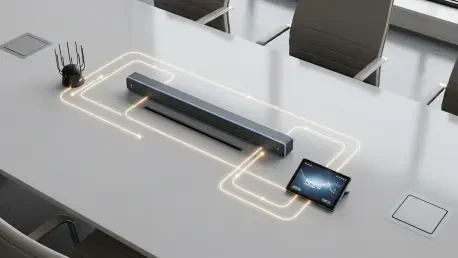

The modern corporate boardroom has evolved into a high-performance computing environment where even a millisecond of delay can disrupt the rhythm of a global executive summit. This fundamental transformation is driven by a shift away from purely centralized cloud processing toward a more resilient model known as hybrid edge intelligence. While the cloud once seemed like the ultimate destination for all video and audio processing, the reality of maintaining seamless communication in diverse network environments has forced a rethink. Today, the focus has pivoted toward placing significant computational power directly within the meeting space. By decentralizing these tasks, organizations ensure that their collaboration tools remain responsive, high-fidelity, and reliable, regardless of external internet conditions or data center fluctuations. This change represents a significant maturation of the professional audiovisual industry, moving from simple signal distribution to complex, intelligent data management that prioritizes the user experience above all else. As meeting spaces become more technologically dense, the need for localized processing becomes a matter of practical necessity rather than just a luxury for high-end installations.
Navigating the Technical Threshold of Hybrid Infrastructure
The Latency Barrier: Why Real-Time Communication Requires Local Logic
In the early stages of digital transformation, the cloud was hailed as the definitive solution for reducing hardware costs and simplifying enterprise management. However, as professional audiovisual systems have grown more sophisticated, the limitations of relying solely on distant servers have become glaringly apparent. Modern features such as automatic camera tracking, multi-speaker framing, and AI-driven noise suppression require decision-making speeds that are simply incompatible with the inherent delays of a long-distance internet hop. When a system must identify a new speaker, adjust a 4K camera lens, and filter out a background siren, the round-trip time to a data center can create a jarring disconnect between the audio and the visual presentation. Much like a self-driving vehicle must process its immediate surroundings locally to ensure safety, a smart conference room must make split-second adjustments to maintain the natural flow of human conversation. If every minor adjustment is forced to wait for a handshake from an external server, the resulting lag ruins the sense of presence that is vital for effective remote collaboration.
Efficiency and Reliability: Mitigating the Risks of External Connectivity
Beyond the immediate frustrations of latency, the financial and operational costs of high-bandwidth cloud reliance have prompted a strategic migration toward the edge. Streaming multiple high-definition video feeds to a centralized processor consumes massive amounts of data, often straining corporate networks and leading to unpredictable service quality during peak hours. This dependency has given rise to the term “fog-ware,” describing systems that promise advanced artificial intelligence features but fail to deliver them consistently because they are throttled by network congestion. By shifting the computational heavy lifting to local hardware, organizations can significantly reduce their external bandwidth requirements while ensuring that core functions remain operational even during a total internet outage. This localized approach provides a layer of redundancy that is essential for mission-critical environments, such as command centers or executive suites, where a dropped connection could have severe consequences. The move to the edge is not about replacing the cloud entirely but about optimizing where each task is performed to maximize both performance and reliability across the entire corporate infrastructure.
Architecture of the Intelligence Array
Distributed Ecosystems: Integrating Smart Devices into a Local Nervous System
The current landscape of professional audiovisual technology has moved beyond the era of isolated hardware components toward a cohesive intelligence array. In this new model, the “edge” is no longer represented by a single, monolithic computer hidden in a rack, but rather by an interconnected network of smart devices that function as a localized nervous system. Modern cameras, beamforming microphones, and environmental sensors are now equipped with their own onboard processors, allowing them to communicate and share metadata in real time. For instance, a microphone array can detect the precise coordinates of a speaker and instantly relay that information to a nearby camera without needing to consult a central controller. This lateral communication between devices allows the room to function as a unified, self-optimizing entity. This distributed logic ensures that the audiovisual environment can adapt to changes in the room—such as a participant moving to a whiteboard or a sudden increase in ambient noise—with a level of fluidity that was previously impossible. By spreading intelligence across the hardware stack, manufacturers have created systems that are more responsive and easier to scale than traditional centralized designs.
Functional Hierarchy: Defining Roles for Cloud and Edge
The evolution toward hybrid intelligence has established a clear division of labor between localized hardware and centralized cloud platforms, creating a more efficient operational hierarchy. In this balanced framework, the cloud is utilized for its primary strengths: high-level management, global scheduling, and long-term data analytics. It serves as the administrative brain that pushes firmware updates, monitors device health across a global campus, and provides insights into how meeting spaces are being utilized over months or years. Conversely, the edge functions as the tactical executor, handling the immediate, resource-intensive tasks that define the actual meeting experience. This includes real-time video stitching, acoustic echo cancellation, and biometric authentication. By separating these duties, manufacturers prevent the bottlenecks that occur when a system is too dependent on a single point of failure. This hybrid model allows for a “best-of-both-worlds” scenario where the system remains agile and fast at the room level while remaining easy to manage and update from a central IT department. This strategic alignment ensures that the most critical functions are always available to the user, regardless of the broader network’s status.
Data Sovereignty and Architectural Flexibility
Regulatory Compliance: The Shift Toward Data Repatriation and Privacy
Security and data privacy have become primary drivers for the adoption of edge intelligence, particularly in highly regulated industries such as healthcare, legal services, and finance. As organizations face increasing pressure from strict data protection laws, there is a growing trend of data repatriation, where sensitive information is moved from third-party cloud servers back to localized, company-owned infrastructure. In the context of a high-stakes meeting, the audio and video feeds can contain proprietary trade secrets or protected patient information that an organization may not want traversing the public internet. By processing this data locally at the edge, companies can ensure that sensitive streams never leave their secure internal network. Modern edge processors are designed to handle complex AI tasks—such as live transcription or facial recognition for room occupancy—entirely within the local environment. This approach allows businesses to leverage the benefits of artificial intelligence without the privacy risks associated with sending raw biometric or acoustic data to a remote cloud provider. Consequently, the edge has become a critical component of a modern security strategy, providing a localized “DMZ” where data can be analyzed and then discarded without creating a permanent digital footprint in an external data center.
Modular Ecosystems: Simplifying Integration via Standardized Interfaces
The transition toward distributed intelligence has also fostered a more modular approach to system design, allowing organizations to build flexible environments that can evolve alongside their business needs. Unlike the rigid, proprietary setups of the past, today’s intelligent audiovisual components are increasingly built on open standards and single-cable network architectures. Power over Ethernet (PoE) and standardized protocols have made it possible for various components—such as specialized audio blocks, smart camera hubs, and touch controllers—to integrate seamlessly into a common local “brain.” This modularity allows a company to deploy the same intelligent features across a variety of room sizes, from small huddle spaces to massive multipurpose auditoriums, by simply adding or removing components as needed. It also reduces the complexity for IT teams, who can now manage a diverse fleet of devices through a unified software interface. This shift toward interoperability ensures that hardware from different vendors can work together as part of a localized intelligence array, preventing vendor lock-in and allowing for more creative and effective room designs. As these ecosystems continue to mature, the focus remains on creating a friction-less experience for both the end-user and the technician.
The New Logic of Audiovisual Strategy
Selecting the Core Processor: Determining the Room Quarterback
As the intelligence of individual devices continues to increase, the primary challenge for audiovisual designers has shifted toward identifying which piece of hardware will serve as the primary “quarterback” for the room. In any given setup, there is now a choice between using the intelligence built into a video bar, a dedicated room PC, or a networked audio processor to lead the local decision-making process. Identifying where the primary logic resides is now just as important as evaluating the resolution of a camera or the frequency response of a speaker. Professionals must look beyond the marketing checklists of cloud-based features and instead interrogate the local computational capacity of their hardware. A system that relies too heavily on the cloud for basic functions will inevitably feel slower and less reliable than one designed with a robust local processor. Buyers are increasingly prioritizing hardware that offers significant onboard AI capabilities, ensuring that their investment will remain relevant even as new software features are introduced. This strategic focus on the local “brain” ensures that the meeting environment remains snappy and intuitive, providing a high-quality experience that encourages collaboration rather than hindering it with technical friction.
Implementing Robust Frameworks for Localized Logic
The shift toward hybrid edge intelligence provided a clear pathway for organizations looking to optimize their collaboration environments and secure their data. Successful implementations showed that by prioritizing local processing, companies significantly reduced their bandwidth overhead while improving the overall responsiveness of their conference systems. Professionals in the field discovered that the most effective strategy involved a thorough audit of their existing network infrastructure to ensure it could support the lateral communication required by an intelligence array. Moving forward, the industry adopted a more critical view of “cloud-only” solutions, favoring hardware that maintained a high level of autonomy. This transition ensured that the most critical tasks—such as audio clarity and visual framing—remained within the four walls of the meeting room, where they could be managed with surgical precision. Organizations that embraced this model found themselves better equipped to handle the demands of a global workforce, providing a seamless and secure platform for communication that was no longer at the mercy of external internet fluctuations. This proactive adoption of edge-centric design represented a permanent change in the professional audiovisual landscape, setting a new standard for performance and reliability in the modern workplace.







