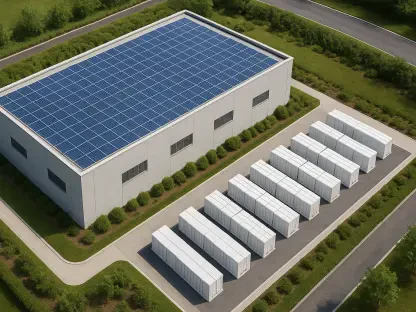

The rapid expansion of generative AI models has fundamentally altered the traditional topology of global data centers by shifting massive computational workloads from centralized cloud facilities directly to the network edge. This transition is not merely a matter of convenience but a critical necessity for maintaining the low latency required by real-time applications such as autonomous vehicular networks and augmented reality interfaces. As organizations scramble to process data where it is generated, the demand for localized high-performance computing has surged, leading to a proliferation of micro-data centers. These installations are becoming the backbone of a distributed intelligence framework that mitigates the bandwidth bottlenecks previously caused by backhauling every byte of data to a distant core. By 2026, the reliance on these edge nodes has grown to encompass every sector from healthcare to logistics, ensuring that artificial intelligence is no longer a remote service but a pervasive utility that provides immediate results for consumers.
Physical Infrastructure: Shifting to the Network Periphery
Hardware Evolution: Deploying High-Density Computing
To support the intense demands of modern AI training and inference, hardware manufacturers have pivoted toward creating specialized silicon that thrives in constrained edge environments. Unlike the sprawling server halls of the past, contemporary edge nodes utilize high-density liquid-cooled racks that can pack enterprise-level processing power into small, modular containers. This shift has enabled telecommunications companies to transform former switching hubs into micro-data centers equipped with specialized AI accelerators. Building on this foundation, localized clusters are now designed to handle complex neural network tasks without the luxury of massive climate-controlled environments found in hyper-scale facilities. Consequently, the industry is seeing a massive uptick in the adoption of ruggedized hardware capable of operating in diverse urban and industrial settings. This physical transformation ensures that the computational muscle required for real-time natural language processing is available exactly where the user interacts with the system.
Network Architecture: Optimization for Zero-Latency Cycles
This approach naturally leads to a complete overhaul of network architecture to accommodate the bidirectional flow of heavy data streams between users and local nodes. Traditional hierarchical networks were designed for content delivery where data flowed primarily from the center to the periphery, but AI requires a collaborative environment where data is constantly exchanged for inference and fine-tuning. To solve this, network providers are implementing sophisticated software-defined networking protocols that intelligently route traffic to the nearest available computational resource based on current load and latency. This dynamic routing is essential for applications like remote robotic surgery or autonomous drone fleets, where even a millisecond of delay can have catastrophic consequences. By integrating AI-driven management layers directly into the fiber backbone, these networks can predict congestion and reroute data packets before a bottleneck occurs, ensuring that the localized processing power is utilized to its maximum potential.
Strategic Implementation: Enhancing Operational Sustainability
The successful integration of AI at the edge required a holistic approach that combined hardware innovation with smart energy management. Industry leaders discovered that the most effective strategy involved deploying AI-driven power management software to adjust processor speeds in real-time based on the available energy and workload priority. This past year, organizations focused on implementing standardized protocols for edge-to-cloud synchronization to ensure that while processing happened locally, global models could still be updated with new insights derived from local data. Consequently, it became essential for enterprises to conduct a comprehensive audit of their existing network infrastructure to identify critical latency-sensitive applications that benefited from edge migration. Investing in modular, liquid-cooled edge units proved to be the most viable path for scaling operations without a massive increase in carbon emissions. These developments eventually prioritized interoperability and security across diverse hardware platforms and geographic regions.