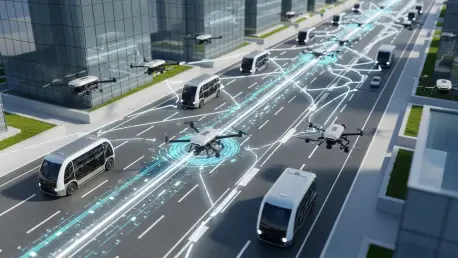

A fleet of thousands of autonomous delivery drones navigating a dense urban landscape requires a level of connectivity that traditional, static network architectures simply cannot provide in their current configuration. These mobile assets are constantly entering and exiting different cell coverage zones, demanding instantaneous handovers and fluctuating bandwidth that would overwhelm manual management protocols. The shift toward an Internet of Moving Things (IoMT) represents a fundamental departure from the era of fixed sensors and stationary workstations, necessitating a system that thinks and reacts at the speed of the assets it supports. As these devices become more sophisticated, the underlying infrastructure must evolve into a fluid, autonomous ecosystem capable of reconfiguring itself in real time to prevent latency spikes or total service disruptions. Without this evolution, the promise of a truly mobile, automated economy remains a theoretical concept rather than a functional reality for modern industries that depend on precision.
Legacy Infrastructure: The Challenge of Static Networks
Legacy telecommunications networks were designed for a world where humans moved with smartphones, not for a reality where high-velocity robots operate with millisecond precision. These traditional systems rely on pre-defined, rigid configurations that require manual intervention whenever a major change in demand occurs across the grid. In a landscape filled with autonomous trucks and aerial delivery vehicles, the location of demand is never constant, creating a management nightmare for service providers trying to maintain quality of service. When hundreds of devices converge in a single area, the resulting congestion can degrade performance to the point of failure, highlighting the fragility of older infrastructure models. To address these challenges, operators must move away from hardware-centric perspectives and embrace software-defined environments that treat connectivity as a dynamic resource rather than a static pipe that is either open or closed for a specific location at a given time.
Environmental Impact: Balancing Connectivity and Sustainability
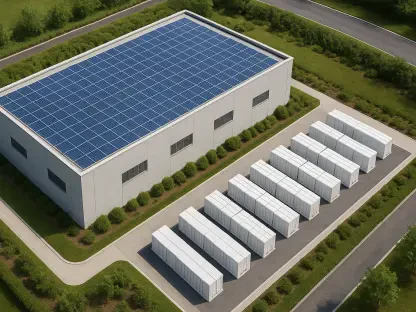
Furthermore, the rapid expansion of these mobile fleets carries a significant environmental risk if the supporting infrastructure continues to operate under inefficient, always-on power models. Traditional network nodes often run at high capacity regardless of actual traffic demand, leading to excessive energy waste and a ballooning carbon footprint that contradicts global sustainability mandates. As the density of the Internet of Moving Things increases, the energy required to power the necessary compute and transmission layers could scale exponentially if left unchecked. This creates a direct conflict between the drive for technological innovation and the urgent need for environmental stewardship in the corporate sector. Balancing these two priorities requires a departure from manual oversight toward intelligent automation that can power down inactive segments or reroute traffic based on energy efficiency metrics. Bridging this gap is no longer just a technical necessity but a moral and regulatory obligation for the industry.
Predictive Orchestration: The Logic of Following the Thing
Solving the logistical complexities of mobile assets requires a revolutionary “follow the thing” logic, which positions network resources in direct response to the movement of the device. This approach utilizes an event-streaming fabric that acts as a continuous nervous system, gathering real-time telemetry from every connected asset and every active cell site simultaneously. An AI-driven orchestration engine then processes this data to predict where an asset will be in the next few seconds, preemptively preparing the necessary network path. Instead of the device seeking a signal, the network actively reaches out to meet the device, ensuring that high-bandwidth tasks like 4K video streaming or remote sensory feedback remain uninterrupted. By shifting the focus from static coverage zones to mobile user-centric slices, the infrastructure becomes a proactive partner in the movement of the asset. This level of synchronization is essential for safety-critical applications where even a momentary loss of data could lead to failures.
Edge Integration: Optimizing Bandwidth for Moving Assets
Consider the scenario of a long-range survey drone transitioning from a low-power standby mode into an intensive high-definition data capture mission while traversing multiple jurisdictions. The AI orchestration platform identifies the shift in the drone’s operational state and automatically initiates a dedicated 5G network slice specifically tailored to its throughput requirements. Simultaneously, the system moves the heavy data processing workloads to the nearest edge computing node to minimize the distance information must travel, thereby slashing latency to nearly zero. This automated choreography happens without any human operator needing to toggle a switch or adjust a bandwidth quota, allowing the network to scale its response based on the urgency of the task. Such responsiveness ensures that command-and-control functions remain rock-solid regardless of the asset’s velocity or the complexity of the environment. By localizing compute power and bandwidth in this manner, the network effectively optimizes itself for every individual moving part.
Economic Transformation: Monetizing High-Precision Connectivity
The transition to an intelligent, moving network framework also presents a massive commercial opportunity for communication service providers to move beyond being simple commodity vendors. By offering programmable, on-demand network slicing, operators can provide specialized service level agreements that guarantee performance for specific industrial tasks like autonomous mining or remote surgery. Businesses are increasingly willing to pay a premium for connectivity that is not just fast, but also reliable and tailored to their specific operational workflows via standardized APIs. This allows for the implementation of performance-based charging models, where companies pay for the successful completion of a task rather than just the volume of data consumed. This shift transforms the relationship between the provider and the enterprise from a utility-based interaction into a strategic partnership focused on shared outcomes. The ability to offer “connectivity-as-a-service” enables a more flexible economy where resources are only allocated when they provide value.
Unified Standards: Building a Cohesive Global Framework
The implementation of a standardized, AI-driven orchestration layer served as the bridge between theoretical connectivity and the practical demands of an autonomous world. Stakeholders across the telecommunications and industrial sectors recognized that manual processes were no longer sufficient for managing the complexities of real-time mobile assets. By adopting a “follow the thing” logic and prioritizing carbon-aware operations, organizations successfully balanced the need for high performance with the necessity of environmental preservation. This transition proved that modular, API-driven architectures allowed for a level of flexibility that transformed the network into a truly dynamic foundation for global commerce. Moving forward, technical teams prioritized the expansion of these capabilities to include even more diverse asset classes, from autonomous maritime vessels to orbital satellite clusters. Ultimately, the integration of intelligent automation and standardized protocols ensured that the expansion of moving things remained both profitable and sustainable for all participants.