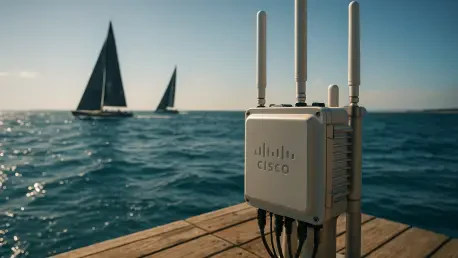

By deploying a high-gain antenna on the school roof and a movement-resistant patch antenna on a floating dock, engineers conquered the problem of signal reflections off the ocean surface. This technical achievement allowed a prestigious coastal regatta to broadcast its events with unprecedented clarity and reliability. In previous years, traditional wireless setups struggled with multipath interference caused by shifting tides and the constant movement of the water. This phenomenon often led to dropped frames and pixelated feeds just as the racing reached its most exciting moments. By integrating advanced Cisco Ultra-Reliable Wireless Backhaul (CURWB) technology, the production team established a robust data link that maintained high bandwidth despite the harsh maritime environment. The implementation demonstrated that high-definition video streaming is no longer tethered to static, land-based fiber connections. Instead, modular and flexible wireless architectures now provide the backbone for complex sporting events where geography presents a significant barrier to conventional infrastructure.
Engineering the Maritime Network
Overcoming Signal Interference: Managing Multipath Reflections
The primary challenge in outdoor maritime broadcasting involves managing the behavior of radio waves over a highly reflective and non-stationary surface. Standard Wi-Fi protocols often fail in these environments because reflected signals arrive at the receiver at slightly different times, creating a destructive interference pattern known as multipath fading. To mitigate this, the engineering team utilized specialized antenna arrays designed to focus the signal beam precisely while filtering out secondary reflections from the sea. The deployment of Cisco Catalyst industrial wireless equipment ensured that the data stream remained steady even as the floating dock swayed with the ocean swell. This stability was crucial for maintaining the 4K resolution required for professional broadcast, as any jitter in the connection would immediately degrade the viewer experience. By leveraging hardware capable of sub-millisecond handoffs, the network effectively neutralized the physical unpredictability of the open water, setting a new standard for aquatic event coverage.
Ensuring Hardware Resilience: Operating in Harsh Environments
Reliability on the water also demands hardware that can withstand the corrosive effects of salt spray and high humidity over extended periods. The chosen Cisco access points and backhaul radios featured IP67-rated enclosures, providing necessary protection against the elements without compromising the integrity of radio frequency performance. Engineers strategically positioned these nodes to create mesh-like reliability, ensuring that even if one path was temporarily obscured by a passing vessel, the system would instantly reroute traffic through an alternate link. This self-healing capability was tested frequently during the regatta as dozens of support boats moved through the line of sight between the dock and the shore. Because the CURWB technology operates independently of traditional Wi-Fi contention mechanisms, it provided a dedicated wireless lane for video traffic. This architectural choice eliminated the risk of congestion from the thousands of mobile devices used by spectators on the beach, keeping the production feed completely secure.
Enhancing the Viewer Experience
Real-Time Data Integration: Enhancing the Digital Broadcast
Beyond simply transmitting video, the wireless infrastructure supported a complex ecosystem of telemetry sensors and real-time data overlays. Each participating yacht was equipped with lightweight sensors that tracked speed, heading, and wind conditions, feeding this information back to the central production hub via the Cisco network. This integration allowed broadcasters to present viewers with sophisticated graphics that explained the tactical nuances of the race in real time. The low-latency nature of the wireless backhaul was essential here; if the data lagged even by a few seconds, the on-screen graphics would have fallen out of sync with the live video feed, ruining the immersive effect for the audience. By maintaining a consistent latency of under ten milliseconds, the network enabled a seamless blend of physical action and digital information. This capability transformed the regatta from a distant spectacle into an interactive educational experience for viewers watching from across the globe.
Future Strategic Implementations: Expanding Wireless Infrastructure
Organizers and technical partners concluded that the deployment of standardized wireless frameworks prioritizing mobility and high-capacity throughput was the only viable path forward for modern sporting events. The project proved that the integration of industrial-grade wireless backhaul with cloud-based production tools could significantly reduce the overhead costs associated with live sports broadcasting. Future strategies involved implementing similar architectures for broader applications, such as remote port monitoring and autonomous vessel operations, where consistent connectivity remained a safety requirement. Technicians recommended conducting comprehensive site surveys using 3D modeling to predict signal behavior before hardware installation began. They also emphasized the importance of using multi-band radios to provide redundancy across different frequency ranges, ensuring that localized interference did not disrupt critical data flows. This strategic shift redefined how remote locations connected to the digital landscape.