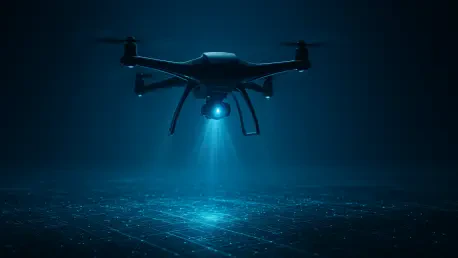

Input-output interference acts as a significant bottleneck in virtualized systems when several virtual machines attempt to access disk or network channels at once. This challenge is magnified when trying to migrate complex computing tasks from stable ground-based facilities to the dynamic, resource-constrained environment of unmanned aerial vehicles. Researchers at Changsha University of Science and Technology have addressed this by developing the VDDM strategy, an innovative framework designed to transform drones into agile, flying data centers. By positioning computational power directly at the network’s edge, these drones bypass the traditional reliance on fixed towers, which are often overtaxed or geographically unavailable during high-demand events. The VDDM model moves beyond simple remote-controlled flight, integrating advanced resource management to handle real-time data offloading with minimal latency. This evolution ensures that mobile edge computing becomes a resilient and adaptable asset in modern wireless communications.
Orchestrating Resources Through Joint Optimization
The Shift Toward Holistic Network Control
The VDDM strategy represents a departure from traditional, single-faceted optimization methods by embracing a comprehensive joint optimization approach. In the current landscape of mobile edge computing, performance gains are often lost when researchers focus exclusively on either the communication link or the server’s processing speed. To solve this, the framework utilizes Mixed-Integer Nonlinear Programming to manage a vast array of variables simultaneously. This mathematical model considers continuous factors, such as the exact three-dimensional coordinates of a drone in flight, alongside discrete choices like which specific drone should serve a particular user. By looking at the system as a whole, the framework ensures that every part of the network operates in harmony. This method accounts for the complex interplay between signal strength and power consumption, providing a sophisticated blueprint for how aerial resources should be allocated to maximize the overall efficiency of the network.
Breaking Down Complex Real-Time Problems
Because these sophisticated mathematical problems are computationally intensive and difficult to solve during active flight, the researchers decomposed the system into three interactive components. This modular structure allows the drone to process information in a unified pipeline, managing its internal virtual machine partitions, user connection assignments, and physical trajectory as distinct yet connected tasks. This decomposition is vital for real-time operations where decisions must be made in milliseconds to maintain a stable connection. By breaking down the problem, the VDDM framework avoids the bottleneck effect where one slow process drags down the entire system’s performance. The interaction between these components ensures that a change in the drone’s position immediately informs the software configuration, creating a responsive environment that adapts to the shifting needs of users on the ground. This architectural flexibility is what truly allows a drone to function as a mobile server.
Managing Hardware and User Demand
Minimizing Internal Friction and Delays
One of the primary technical hurdles in aerial computing is managing the internal hardware limitations of a drone. When several virtual machines run on a single physical host, they often compete for the same hardware resources, leading to performance degradation known as hardware friction. The VDDM framework addresses this by implementing a dynamic partitioning algorithm that adjusts the number of virtual instances based on the current workload. If the incoming tasks are large and resource-intensive, the system automatically reduces the number of active partitions to provide each task with more dedicated bandwidth and processing power. Conversely, when faced with many small, simple tasks, the drone can increase the number of partitions to maximize parallel processing efficiency. This level of adaptability ensures that the onboard computer remains at peak performance without the internal delays that typically plague shared hardware environments, making the data center truly efficient in its resource use.
Implementing Strategic Load Balancing Fleetwide
Beyond the internal mechanics of a single drone, the framework must also manage the distribution of users across an entire fleet of aircraft. In many high-density environments, users naturally try to connect to the closest drone, which can lead to a hotspot that overwhelms a single unit while others remain underutilized. To prevent this, the researchers integrated matching theory, a concept often used in economics to pair participants for mutual benefit. In the VDDM model, this results in a load-aware assignment process that calculates the current burden on every drone in the area. The system may pair a user with a drone that is slightly further away if that unit has the available capacity to process the data faster than a nearby, overloaded drone. This load balancing ensures that the computational weight is spread evenly across the network, smoothing out queuing delays and preventing any single aerial node from becoming a point of failure during periods of peak demand across the system.
Artificial Intelligence in the Sky
Deploying Autonomous Pilots for Data Signal
The flight control layer serves as the most dynamic element of this framework, using artificial intelligence to bridge the gap between physical location and digital performance. The researchers employed a Deep Reinforcement Learning algorithm known as Soft Actor-Critic to serve as the drone’s autonomous brain. Through a continuous process of trial and error, the AI learns which flight paths result in the highest signal quality and the lowest task latency. The drone receives positive rewards whenever it makes a move that improves the user experience, allowing it to refine its behavior over time. This approach is particularly effective because it allows the drone to adapt to environments that are too complex for pre-programmed instructions. As users move through a space or as their data needs fluctuate, the AI-driven pilot adjusts its altitude and position to maintain a line-of-sight communication link, which is essential for achieving the high speeds required for modern mobile edge computing in 2026.
Promoting Continuous Learning Through Entropy
A standout feature of the Soft Actor-Critic algorithm is its focus on entropy, which encourages the drone to explore its surroundings rather than settling for the first good solution it finds. This prevents the system from getting stuck in local optima, ensuring that the drones are always searching for the most efficient possible flight path. In comparative tests, this AI-driven approach demonstrated a high convergence speed, meaning the drones could learn the optimal policy and stabilize their performance much faster than traditional models. This speed is a critical requirement for real-world deployment, especially as networks become more volatile and demand for instant data processing grows. A system that takes hours to calibrate would be ineffective in a rapidly changing scenario, but the VDDM framework’s ability to rapidly adapt makes it a viable solution for moving targets. The result is a more resilient network that can maintain high performance even as the physical environment shifts.
Future Applications of Aerial Infrastructure
Enhancing Critical Connectivity in Disasters
The practical implications of turning drones into flying data centers are most apparent in the realm of emergency response and disaster recovery. In situations where traditional ground-based infrastructure has been damaged or destroyed by natural events, a fleet of VDDM-equipped drones can be deployed to provide an immediate communication and computing layer. These drones can process vital sensor data and high-definition video feeds directly in the air, allowing search-and-rescue teams to receive real-time updates without the lag of distant cloud servers. By operating at the edge, the drones significantly reduce the time it takes for critical information to be analyzed and returned to those on the ground. This capability could be the difference between success and failure in time-sensitive missions, as the reduced latency allows for faster decision-making. The ability to create a temporary, high-speed network out of thin air represents a significant shift in how we manage large-scale emergencies.
Supporting Temporary Networks for Global Crowds
Outside of emergency scenarios, this technology is poised to revolutionize how we manage data-heavy environments such as massive public gatherings and sporting events. At events like the Olympics or large music festivals, existing cell towers are often overwhelmed by the sheer volume of data being uploaded. A fleet of autonomous drones can act as a supplementary layer, absorbing the excess demand and ensuring that the network remains stable. In the field of precision agriculture, these flying data centers can process vast amounts of imaging data from remote fields, providing farmers with instant insights into crop health without needing a satellite link. This technology also holds promise for maritime surveillance and research stations where terrestrial infrastructure is impossible to build. By transforming the sky into an intelligent digital layer, the VDDM framework ensures that high-performance computing is accessible in every corner of the world, regardless of the terrain.
Assessing Next Steps for Integrated Networks
Reflecting on the progress made throughout 2026, the development of the VDDM framework established a clear path forward for the integration of aerial assets into global data networks. The successful mitigation of input-output interference and the implementation of load-aware matching algorithms proved that drones could indeed handle the complexities of a mobile data center. Engineers and network architects shifted their focus toward scaling these fleets, moving from small-scale simulations to city-wide deployments that supported a variety of industrial and civilian needs. The use of deep reinforcement learning provided the necessary autonomy for these systems to operate without constant human intervention, lowering the barrier to entry for many organizations. As these technologies matured, they provided actionable insights into the future of decentralized computing, suggesting that the most effective way to manage a data-heavy world was to look upward. The era of the flying data center arrived, fundamentally changing the landscape.