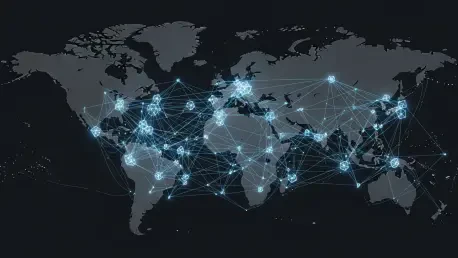

The global telecommunications industry is currently undergoing a fundamental paradigm shift in how subsea cable networks are conceptualized and deployed across the vast reaches of the ocean floor. Historically, the primary metrics for success in subsea infrastructure were raw capacity and the efficiency of the shortest path between major hubs, but the rapid emergence of Artificial Intelligence as a dominant driver of data consumption has rendered these traditional benchmarks insufficient for current needs. This transition is forcing a move toward a model that prioritizes route diversity and structural resilience over simple bandwidth expansion. As the world moves through the 2026 to 2028 window, the focus is shifting toward creating a mesh-like architecture that can withstand both physical and digital disruptions. The industry is no longer satisfied with merely connecting point A to point B; instead, it is building a complex, self-healing web designed to support the immense weight of large-scale machine learning models.
Adapting Network Topology: The Impact of Generative Intelligence
Artificial Intelligence is fundamentally altering the topology of data movement rather than just increasing volume in a linear fashion. In the pre-AI era, traffic followed a predictable hub-and-spoke model where users accessed content from centralized data centers located in primary metropolitan areas. Today, AI workloads require the movement of massive datasets across multiple cloud environments and regional processing centers simultaneously, creating a web of interdependency. This shift results in distributed traffic flows that require networks to handle constant, heavy loads for AI training and inference, rather than the intermittent peaks characteristic of traditional internet usage. The rise of multi-modal AI systems means that data is no longer static; it is constantly flowing between edge locations and central compute clusters to maintain low-latency responses. This demand necessitates a radical redesign of how packets are routed to ensure the underlying infrastructure remains invisible to the application layer.
The consequence of this shift is the emergence of a new network architecture that favors lateral movement over hierarchical structures. Instead of funneling all requests through a single massive gateway, modern subsea systems are being integrated with regional bypass routes that allow data to circumvent congestion points during periods of intensive model training. This evolution is particularly evident in the deployment of hyperscale-led projects that link diverse geographical zones to create a more resilient fabric. These organizations are investing in proprietary systems that align with their specific compute clusters, ensuring that the physical path of the fiber matches the logical path of the AI workloads. By designing infrastructure that mirrors the needs of neural network synchronization, operators can achieve higher throughput without significantly increasing the complexity of the signal processing hardware. This alignment between physical fiber and digital intelligence is the hallmark of the current era in connectivity.
Strategic Diversity: Balancing Route Concentration and Physical Resilience
A critical insight in modern network design is the debunking of the myth that more capacity is always the superior solution for connectivity. For decades, the industry assumed that adding more fiber to established routes would solve most connectivity challenges, but this often leads to a dangerous concentration of risk that threatens global stability. If a single geographic corridor experiences a major disruption due to seismic activity or geopolitical conflict, the impact on the global economy can be catastrophic. Consequently, operators are now looking beyond direct routes to develop alternative paths, ensuring that a failure on one line does not paralyze the entire global network. This approach involves identifying choke points and proactively building around them, even if the new routes are technically longer or more expensive to lay down. The goal has shifted from minimizing latency at all costs to maximizing the probability that data will reach its destination reliably.
Resilience is no longer an optional feature but a foundational requirement of the entire subsea network architecture in the current environment. Modern engineering takes a holistic view, recognizing that vulnerabilities exist well beyond the deep-sea segments, particularly at landing stations and shore-end connections. These terrestrial interfaces were often the weak links in the chain, susceptible to localized power outages, natural disasters, or unauthorized access. To combat this, the industry is implementing more robust site selection criteria and hardening the physical facilities that house the transmission equipment. Modern designs emphasize the ability to automatically reroute traffic across diverse systems when a segment fails, utilizing software-defined networking to manage the complex transitions. This strategy allows networks to adapt to a less stable global environment, factoring in everything from regulatory changes to physical risks in specific territories.
Unified Ecosystems: Integrating Global Connectivity and Compute Delivery
The transition to the AI era is discarding long-held assumptions about the inherent value of owning physical infrastructure as a primary competitive advantage. In the past, owning a cable system was considered the ultimate moat, but that advantage is being superseded by the ability to offer a diverse routing portfolio that meets shifting demands. Customers managing high-stakes AI applications are less concerned with who owns the physical hardware and more focused on consistent, low-latency performance and reliable uptime. This shift reflects a broader move toward outcome-based networking, where the focus is on service delivery rather than the possession of physical assets. Consequently, many traditional carriers and technology companies are moving toward a cooperative model, sharing capacity across multiple systems to ensure they can meet their service level agreements. This collaboration allows for greater flexibility in responding to traffic spikes and provides a range of connectivity options.
The successful adaptation of global infrastructure depended on the proactive integration of intelligence into every layer of the network architecture. Decision-makers prioritized investments in route diversity and automated orchestration systems that proved vital for maintaining stability during global traffic fluctuations. Industry leaders moved beyond traditional capacity-building to embrace a holistic view that merged subsea and terrestrial assets into a singular, high-performance fabric. This approach mitigated the risks associated with geographic concentration and provided the necessary foundation for the continued expansion of generative technologies. Moving forward, organizations must continue to evaluate their connectivity strategies based on resilience rather than just cost or speed. Future projects should focus on building autonomous systems capable of self-healing and dynamic scaling to meet the unpredictable demands of the IT economy. Establishing standardized protocols for cooperation will be the next step in ensuring that the global network remains a reliable hub.