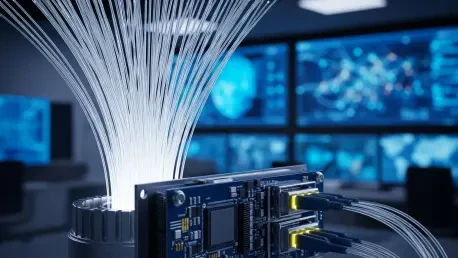

The industrial landscape has shifted from a series of disconnected mechanical processes into a hyper-connected nervous system where every sensor, actuator, and robotic arm demands constant, high-speed communication without the slightest delay or interruption. As manufacturers and energy providers struggle with the sheer volume of data generated by private 5G and fiber-optic backbones, traditional human-centric management has become a bottleneck that threatens to stifle the productivity gains promised by the Fourth Industrial Revolution. DANI AI, a sophisticated autonomous networking framework, has emerged as the solution to this complexity by providing a self-healing and self-optimizing layer that operates at speeds impossible for manual administrators. Instead of reacting to network congestion or link failures after the fact, this technology utilizes deep reinforcement learning to anticipate traffic surges and reconfigure bandwidth allocations dynamically to maintain peak performance and ensure that mission-critical data always reaches its destination.
The Architecture of Intelligence: Transforming Static Infrastructure
The fundamental breakthrough of DANI AI lies in its ability to abstract the physical hardware layer and create a programmable, intent-based networking environment that prioritizes mission-critical tasks over routine data transfers. By implementing a decentralized control plane, the system avoids the single-point-of-failure risks associated with traditional centralized controllers, allowing local network nodes to make autonomous decisions based on immediate environmental feedback. This architectural shift is particularly evident in high-density environments like modern automotive assembly plants, where thousands of autonomous mobile robots share the same wireless spectrum. DANI AI manages these interactions by creating virtual network slices that guarantee low-latency connections for safety-critical navigation systems while simultaneously managing high-bandwidth video streams for inspection cameras. This granular control ensures that the industrial backbone remains robust even during periods of unexpected equipment malfunctions.
Scalability in modern operations requires more than just adding more hardware; it demands a system that can absorb new devices into the network fabric without requiring manual provisioning or extensive downtime for testing. DANI AI facilitates this through an automated discovery and configuration protocol that identifies new hardware capabilities and integrates them into the existing topology using pre-defined operational constraints. This plug-and-play capability allows industrial operators to expand their facilities or upgrade specific production lines with minimal friction, as the AI automatically calculates the optimal routing paths and security policies for the new equipment. Moreover, the integration of edge computing resources within the DANI AI framework allows for data processing to occur closer to the source, reducing the burden on the core network and improving the responsiveness of real-time control loops. By eliminating the need for constant human intervention, organizations can focus talent on higher-level process optimization.
Operational Resilience: Ensuring Security and Strategic Success
One of the most significant impacts of DANI AI is its transition from a reactive maintenance model to a purely predictive one, where the network identifies subtle degradation in signal quality or hardware performance before a failure occurs. Traditional monitoring tools often rely on threshold-based alerts that only trigger after a problem has caused a noticeable dip in performance, but DANI AI utilizes pattern recognition to detect anomalies that are invisible to the naked eye. For example, in large-scale utility grids, the system can identify minute fluctuations in latency that might indicate a fraying fiber optic cable or a failing transceiver long before the link drops entirely. By proactively rerouting traffic and flagging the component for replacement during scheduled downtime, the AI prevents the catastrophic outages that cost millions in lost production time. This level of foresight is achieved through continuous learning from historical performance data, allowing the network to become more efficient over time.
Beyond physical reliability, the security of industrial networks has become a paramount concern as the convergence of information technology and operational technology creates a larger attack surface for malicious actors. DANI AI addresses this challenge by embedding security protocols directly into the networking fabric, utilizing behavioral analysis to identify and quarantine suspicious traffic patterns in milliseconds. Instead of relying on static firewall rules that can be bypassed by sophisticated zero-day exploits, the AI monitors the digital fingerprints of every device and application on the network, instantly cutting off any entity that deviates from its expected behavior. In a scenario where a compromised sensor attempts to communicate with a sensitive database, DANI AI can isolate the offending device into a secure sandbox while alerting security teams with a forensic report. This autonomous response capability is essential in environments where manual intervention would be too slow to stop the spread of a threat.
The adoption of DANI AI marked a definitive turning point in the management of industrial infrastructure, as organizations moved away from rigid legacy systems toward flexible architectures that prioritized operational continuity. Successful implementations demonstrated that the transition was not merely a technical upgrade but a strategic shift that required the alignment of network policies with broader business objectives. Leaders who invested early in data cleaning and standardization efforts reaped the greatest rewards, as the accuracy of the AI predictive models depended heavily on the quality of the initial training data. It became clear that the most effective way to deploy these systems involved a phased approach, where autonomous functions were introduced in non-critical segments before being scaled across the entire production environment. Organizations that integrated their cross-functional teams during the deployment phase avoided the silos that often hindered progress or created unnecessary friction.