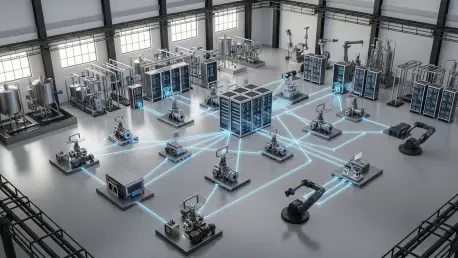

The massive scale of modern industrial complexes often creates a digital fragmentation that prevents facility managers from achieving true operational efficiency across diverse hardware systems. While the early iterations of the Matter protocol focused on making consumer smart homes more intuitive, the arrival of version 1.6 shifts the focus toward the rigorous demands of professional environments and massive logistics hubs. This update establishes a unified framework where diverse equipment from different manufacturers communicates seamlessly over Ethernet, Wi-Fi, and Thread. By focusing on the application and link layers, the standard ensures that industrial sensors and heavy machinery can exist on a shared IPv6-based network. This movement toward what experts call Professional IoT signifies a departure from simple residential connectivity, prioritizing the complex needs of large-scale facilities. Organizations now have a roadmap for integrating thousands of nodes without facing the traditional barriers of vendor lock-in or incompatible communication stacks.
Streamlining Industrial Deployment and Network Governance
Mastering Hardware Installation With NFC Commissioning
One of the most significant breakthroughs in the recent specification is the introduction of comprehensive offline commissioning capabilities through Near-Field Communication. In many industrial construction projects, hardware such as smart lighting and climate sensors is often installed months before the permanent power grid or Wi-Fi network becomes active. Matter 1.6 addresses this logistical timing conflict by allowing field technicians to configure and program unpowered devices using ruggedized mobile terminals. By leveraging the NFC Transport Layer, essential security certificates and network credentials can be stored directly into a device’s non-volatile memory before the unit ever receives electricity. This approach removes the dependency on an active internet connection during the physical mounting phase, ensuring that the installation crew remains productive regardless of the site’s infrastructure status. This specific functionality transforms how large-scale sensor networks are initially managed on the ground.
This streamlined capability fundamentally alters the post-installation phase of any large-scale facility setup by enabling automated device discovery. Once the main breakers are flipped and the site is fully energized, these pre-configured devices automatically seek out the central network and authenticate themselves using the previously loaded credentials. This process eliminates the tedious and expensive requirement for technicians to revisit every individual sensor or light fixture for manual pairing after the infrastructure is live. By reducing the total labor hours required for final site configuration, the protocol makes the deployment of massive IoT arrays much more cost-effective for developers. Furthermore, the reduction in human interaction with live circuits during the commissioning phase enhances overall site safety. The ability to verify the status of thousands of nodes simultaneously via a central dashboard ensures that the transition from a cold site to an operational one is nearly instantaneous.
Standardizing Protocol Interoperability for Large Facilities
Standardization at the application layer remains a critical component for ensuring that diverse industrial hardware can function reliably within a unified network environment. Matter 1.6 provides a rigorous set of definitions that allow different hardware types to understand common commands, regardless of whether they communicate via high-bandwidth Ethernet or low-power Thread. This uniformity is essential for manufacturing plants where high-speed robotics must coexist with battery-operated environmental sensors without creating network congestion. The protocol’s reliance on IPv6 ensures that every device has a unique address, simplifying the routing of safety data across sprawling industrial campuses. By removing the need for proprietary gateways that translate between different languages, the system reduces the complexity of the hardware stack. Consequently, facility managers can select the best hardware for a specific task based on performance specifications rather than being forced into a single ecosystem.
Integration across multiple transport mediums allows for a more resilient network topology that can withstand the physical challenges of industrial settings. In environments with heavy electromagnetic interference, the ability to switch between wired Ethernet for critical backbone systems and wireless Thread for agile sensor deployment is invaluable. Matter 1.6 ensures that these different physical layers appear as a single cohesive fabric to the management software, providing a unified view of all operational assets. This interoperability extends to the power management profiles of these devices, allowing for better monitoring of energy consumption across different departments. As networks scale toward the edge, the protocol maintains low latency for time-sensitive operations, such as emergency shut-off sequences or pressure alerts. The robustness of this communication framework ensures that data integrity is maintained even when the network expands to include tens of thousands of individual points.
Advancing Operational Intelligence and Advanced Security
Simplified Administration Through the Joint Fabric Model
Managing complex industrial networks often requires that different departments, such as IT and facility management, maintain simultaneous access to the same hardware. Matter 1.6 introduces the Joint Fabric model to streamline this collaborative process, moving away from the limitations of isolated management systems. This specific structure utilizes a centralized datastore and an Anchor Certificate Authority, which allows multiple authorized controllers to govern a single network ecosystem concurrently. Because the setup only requires a single instance of a device’s memory, the system remains highly efficient even when it is integrated into multiple independent monitoring platforms. This eliminates the redundancy of having separate networks for security and lighting, which often led to increased hardware costs and maintenance overhead. The industry expects the adoption of these shared fabrics to grow significantly from 2026 to 2030 as more facilities upgrade their internal systems.
This centralized governance model is particularly beneficial during the transition between the initial construction phases and the long-term operational reality of a site. Contractors can build and test a comprehensive sensor network using their own proprietary commissioning tools and then hand over administrative control to the client’s IT team with minimal friction. This process no longer requires specialized software or complex integration layers to transfer the digital keys of the building to the final owners. Such a seamless transfer of ownership ensures that the end-users have full cryptographic control over their infrastructure immediately upon project completion. By bypassing the traditional hurdles associated with proprietary lock-in, the Joint Fabric model protects the long-term investment of the facility owner. It provides a future-proof foundation where administrative permissions can be revoked or granted as personnel and operational requirements change over several years of the building’s life.
Safety Intelligence and Enterprise Implementation
Advanced environmental controls are now more sophisticated through the introduction of a feature known as Thermostat Suggestions within the version 1.6 update. Instead of forcing a local device to blindly obey every external command, central management platforms now submit time-bound suggestions that the local hardware evaluates against its own real-time data. For example, if a floor manager has set a specific temperature range to ensure the stability of chemical processes, the local thermostat can reject a conflicting command from an external utility provider. This creates a more intelligent feedback loop where local safety parameters take precedence over broad efficiency goals if those goals compromise the integrity of the operation. The system provides clear feedback to administrators, detailing the exact logic behind why an automated instruction was or was not executed. Beyond climate control, critical safety components can report an unmounted state if they are removed from their mounting brackets.
Early adopters of the Matter 1.6 specification successfully moved beyond the pilot phase and into full-scale production environments by focusing on these strategic pillars. They focused on optimizing their internal security protocols to align with the decentralized trust model while ensuring their staff was trained on the new NFC commissioning workflows. Decision-makers investigated the specific hardware requirements of their facility to ensure that every new purchase met the rigorous certification standards. This proactive stance allowed organizations to bypass the complexities of vendor-specific ecosystems and established a foundation for continuous operational improvement. Moving forward, the industry turned toward developing custom data analytics tools that leveraged the standardized information coming from the unified network. The shift to this standardized environment was not merely a technical upgrade but a fundamental change in how industrial facilities were managed and secured. Facility managers utilized these new capabilities to reduce downtime and improve safety profiles.