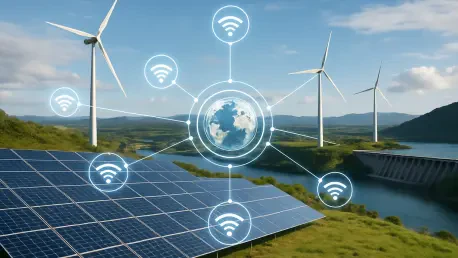

Utility operators are deploying IoT sensors to monitor load in real-time, allowing them to integrate renewable capacity with greater confidence and precision. The global energy transition represents a fundamental shift from centralized fossil-fuel power generation to a decentralized landscape dominated by renewable sources like wind and solar. This evolution introduces significant complexity to power grids, as renewable output fluctuates based on weather conditions and electricity now flows bi-directionally between the utility and residential consumers. To manage this volatility and the surging demand from electric vehicles and heat pumps, the power industry is increasingly relying on the Internet of Things (IoT) to provide real-time visibility and operational control. By embedding intelligence into every node of the distribution network, stakeholders can now mitigate the inherent instability of green energy while maintaining a steady supply for an increasingly electrified society as demand scales upward without any interruption.
Bridging the Gap: Data-Driven Grid Management
Enhancing Network Stability: Real-Time Metrics
Traditional networks were not designed for the modern demands of local balancing and two-way exports that define current energy markets. IoT technology addresses these gaps through the deployment of sensors and smart meters that monitor load, detect faults, and relay metrics in real-time. This infrastructure allows operators to integrate new capacity more confidently and facilitates remote maintenance for renewable assets located in harsh or remote environments. Furthermore, the industry’s expansion is reflected in a massive global labor boom, with millions of new clean energy jobs appearing in markets ranging from the United States and the United Kingdom to Brazil. By utilizing high-frequency data streams, engineers can pinpoint exact locations of voltage drops or surges before they escalate into regional outages. This granular level of oversight ensures that the existing copper and steel infrastructure can handle the higher currents required by rapid industrial decarbonization without requiring immediate and costly physical overhauls.
Operational Efficiency: Labor Market Expansion
The shift toward a digitally enabled grid is not merely a hardware upgrade but a socio-economic catalyst driving significant changes in the global workforce. As organizations implement wide-scale sensor arrays across vast geographic regions, the need for specialized technicians and data scientists has reached unprecedented levels. This transition fosters a collaborative ecosystem where hardware reliability and software intelligence converge to maximize the lifespan of renewable assets. For instance, sensors installed on offshore wind turbines or remote solar farms now provide diagnostic data that prevents catastrophic failures through early detection of mechanical wear. Such predictive capabilities reduce the frequency of hazardous manual inspections while simultaneously creating high-value roles in remote monitoring centers. Consequently, the reliance on IoT has created a feedback loop where improved asset performance attracts more investment, which in turn fuels further employment growth across both the technology and energy sectors.
Strategic Intelligence: Transforming Raw Data
Digital Twins: Rise of Predictive Analytics
The consensus among industry leaders is that raw data alone is insufficient; it must be converted into actionable intelligence to be truly valuable. This is achieved through advanced analytics, operational dashboards, and digital twins—virtual replicas of physical assets that assist in predictive planning. For example, the use of machine learning to predict substation usage enables utility companies to model network behavior at a granular level, leading to faster and cheaper connections for low-carbon technologies. These virtual models allow engineers to simulate various stress tests, such as extreme weather events or sudden spikes in local consumption, without risking the actual physical equipment. By running thousands of simulations daily, grid operators can proactively reinforce vulnerable points in the system. This methodology significantly reduces the time required to approve new connection requests for large-scale battery storage units and commercial electric vehicle charging hubs, accelerating the pace of infrastructure modernization.
Consumer Integration: Demand-Side Revolution
Demand-side flexibility is becoming a critical tool in the effort to balance supply and demand in a world powered by intermittent resources. Connected devices like home batteries and smart chargers can automatically shift consumption patterns to protect the grid during periods of peak strain, effectively turning consumers into active participants. This level of connectivity allows for a more fluid interaction between the residential sector and the broader energy market, where appliance usage is optimized based on real-time price signals or grid health indicators. Furthermore, the continued proliferation of connected devices will require a heightened focus on cybersecurity and data interoperability across all platforms. As every new sensor broadens the potential attack surface for cyber threats, robust governance and procurement standards will be as vital as the hardware itself. Establishing a secure communication layer ensures that the integration of private assets into the public grid does not compromise the overall security of the nation’s critical energy infrastructure.
Future Resilience: Secure System Implementation
Stakeholders prioritized the establishment of rigorous data standards to ensure that diverse IoT ecosystems functioned as a unified whole. Leading organizations implemented end-to-end encryption and zero-trust architectures to defend the increasingly complex web of connected energy assets. Moving forward, the focus remained on harmonizing these technological gains with international policy frameworks that encouraged cross-border data sharing and collective defense strategies. Investing in workforce training became a non-negotiable priority to ensure that the human element effectively managed the sophisticated digital tools at their disposal. Successful operators recognized that the foundation of a clean energy future rested on the transparency and security of their communication networks. By treating data as a core utility asset, the industry paved the way for a more flexible and reliable power system. Future efforts focused on the deployment of edge computing to further reduce latency in grid response and security.