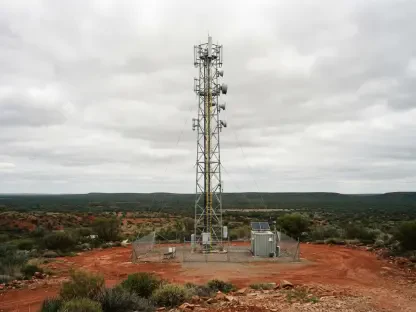

The historical barrier between terrestrial cellular networks and space-based infrastructure is beginning to dissolve as AST SpaceMobile develops the first orbital broadband system for standard smartphones. This monumental shift represents more than just a marginal improvement in signal reach; it is a fundamental reimagining of how mobile devices interact with the sky. For decades, geographical limitations and the high cost of physical infrastructure left vast “dead zones” across national parks, rural highways, and mountainous terrains where traditional cell towers were simply unfeasible. By positioning satellites as orbital cell sites, the industry is moving toward a reality where connectivity is no longer tied to the presence of a ground-based station. This approach effectively bypasses the logistical nightmares of laying fiber through protected wilderness or erecting towers in low-density rural areas, ensuring that the standard device in a user’s pocket remains functional regardless of their physical location on the globe.
The Strategic Framework: Forging Industry Alliances
The commercial viability of this space-based network rests upon a foundation of deep strategic integration with existing telecommunications giants. AT&T was among the first to recognize the potential of this technology, entering into a definitive commercial agreement that features a revenue-sharing model extending through at least 2030. This partnership recently gained significant momentum with the inclusion of Verizon, which joined the initiative to consolidate AST SpaceMobile’s position as the primary satellite partner for the nation’s leading wireless providers. These alliances are not merely symbolic; they provide the massive capital requirements and the vast subscriber bases necessary to justify the deployment of a global satellite constellation. By working with these established carriers rather than competing against them, the project avoids the pitfalls of building a new consumer brand from scratch and instead focuses on enhancing service quality for hundreds of millions of existing mobile users.
Beyond the financial backing of major carriers, the technical implementation of this network involves a complex ecosystem of global infrastructure providers. Ericsson has taken a central role by providing the core network technology and automation tools required to manage high-speed transitions between terrestrial signals and orbital nodes. Simultaneously, Nokia contributes the essential radio access technology and mobility software that allow satellites to communicate with unmodified handsets designed for ground networks. This collaborative effort ensures that the satellite service does not function as a cumbersome, standalone product but as an invisible, integrated layer of the current mobile ecosystem. The involvement of these technology leaders highlights a shift in industry thinking, where space is treated as an extension of the existing 4G and 5G network architecture rather than a separate, specialized niche for satellite phones or emergency beacons.
Technical Innovations: Achieving Seamless Network Transitions
A significant breakthrough in this technological evolution occurred in October 2026, when a field demonstration in Granite Falls, Washington, successfully showcased the industry’s first seamless handoff between a ground site and a satellite. During this test, a conventional smartphone maintained an active data session while transitioning from a terrestrial cell site to a BlueBird satellite without any measurable interruption. This achievement addressed one of the most persistent engineering hurdles in mobile communication: maintaining session continuity while moving between wildly different network types. In the past, switching from a land-based network to a satellite would have caused dropped calls or required a manual reconnection. The success of this demonstration proved that space-based connectivity can function in real-time, offering a reliable experience that is indistinguishable from traditional service for the end-user.
The difficulty of coordinating this transition cannot be overstated, as engineers have frequently compared the process to a vehicle merging from a standstill onto a highway where traffic is moving at the speed of an aircraft. To solve this, advanced network automation protocols were implemented to handle the high latency and Doppler shift inherent in satellite communication. By reducing the transition window to a matter of milliseconds, the system ensures that the switch is completely imperceptible to the user. This technical blueprint provides a vital foundation for emergency responders and civilian consumers who require constant, uninterrupted communication in remote or volatile environments. The ability to maintain an active connection while traveling across diverse terrains signifies a major step toward eliminating the concept of a “no-service” area, fundamentally changing how mobile devices are utilized in professional and recreational contexts.
BlueBird Deployment: Scaling the Satellite Constellation
The realization of consistent nationwide coverage is inextricably linked to the aggressive deployment of the BlueBird satellite constellation. While the complexities of space logistics have necessitated adjustments to the initial roadmap, the path forward is clearly defined. By late 2026, the activation of initial services is expected to provide intermittent coverage across the United States and several international markets. During this phase, users will experience connectivity during specific windows when a satellite is positioned directly overhead. Although this does not yet constitute a continuous service, it marks the first time that standard smartphones will have a reliable path to orbital broadband without any hardware modifications. This initial deployment serves as a live testing ground to refine the system before moving into more intensive phases of the network rollout.
As the constellation expands toward the milestone of 25 satellites in early 2027, the focus will shift toward rigorous beta trials conducted by AT&T and Verizon. These trials are designed to evaluate network performance under heavy traffic loads and in diverse weather conditions, ensuring the system can handle the demands of a modern mobile population. The ultimate objective is to reach a 45-satellite threshold by mid-2027, which is the critical mass required for consistent, nationwide availability. Beyond 2028, the company intends to launch more than 100 satellites to support high-bandwidth applications on a global scale. To support this growth, development of the “Blacklift” launch vehicle is currently underway. Expected to be operational by late 2028, this dedicated rocket system is engineered to carry multiple BlueBird satellites per mission, significantly lowering the long-term costs of constellation maintenance and deployment.
Enhanced Capabilities: Moving Beyond Text Services
One of the primary factors distinguishing this initiative from other satellite-to-cell projects is the focus on providing a full broadband experience rather than just emergency text messaging. While some competitors have focused on low-bandwidth SMS features for SOS situations, BlueBird satellites are engineered to support high-quality voice calls and data-intensive mobile applications. This capability ensures that users can browse the internet, use social media, and access cloud-based work tools in locations where there was previously no signal at all. By offering a comprehensive suite of cellular services, the network aims to provide a premium experience that matches the functionality of urban 4G and 5G networks. This approach addresses a significant market gap, as modern mobile users increasingly depend on data-rich communication for nearly every aspect of their daily lives.
This commitment to high-speed data transfer has profound implications for industries that operate in isolated environments, such as agriculture, logistics, and public safety. For a farmer in a remote area or a logistics manager tracking assets across vast rural corridors, the ability to stream video or transfer large data files via satellite can drastically improve operational efficiency. In the public safety sector, first responders can maintain high-speed communication during search and rescue operations in deep wilderness or after natural disasters have crippled local ground infrastructure. By ensuring that the satellite connection is indistinguishable from a standard signal, the technology transforms the smartphone from a local communication device into a truly global tool. This broadband-first strategy positions the “cell tower in the sky” as a vital piece of infrastructure for the modern digital economy.
Market Dynamics: Navigating the Competitive Landscape
The direct-to-device satellite market has quickly become one of the most competitive segments of the telecommunications industry. T-Mobile and SpaceX’s Starlink collaboration set an early benchmark by launching satellite-based messaging services in 2025, which forced other major carriers to accelerate their own orbital strategies. Currently, many consumers find themselves navigating a fragmented landscape where they might use secondary eSIM configurations to access satellite features from rival networks when their primary provider lacks coverage. This competitive pressure has served as a catalyst for innovation, driving AST SpaceMobile and its partners to focus on a more integrated and user-friendly solution. The race for dominance in the sky is no longer just about being the first to launch, but about providing the most seamless and robust service to the end-user.
In response to this fragmented market, the strategy adopted by AT&T and Verizon focuses on delivering a “native” experience that requires no additional subscriptions or complex setups. The goal is for the mobile device to automatically detect when a ground signal has been lost and switch to satellite coverage instantly without any intervention from the user. This friction-free model is designed to provide a significant competitive advantage over services that require specialized apps or secondary billing cycles. By embedding the satellite layer directly into the primary carrier’s network, these companies are betting that simplicity and reliability will be the deciding factors for consumers. This approach not only enhances customer loyalty but also positions the participating carriers as the only providers capable of offering truly universal, uninterrupted service across the entire geography of the country.
Global Infrastructure: Addressing Socio-Economic Progress
The expansion of space-based cellular networks offers a transformative solution to the long-standing problem of the digital divide. For rural and underserved communities, where the high cost of laying fiber-optic cable made traditional broadband expansion economically impossible, this technology provides the first reliable path to high-speed connectivity. This shift empowers local economies by enabling remote work, digital education, and modern agricultural techniques in areas previously isolated from the global market. The strategic deployment of orbital assets ensures that the benefits of the digital revolution are not restricted to urban centers, but are instead distributed more equitably across all geographic regions. This democratization of access represents a major leap forward in the quest for universal connectivity as a standard human utility.
The project successfully proved that integrating satellite and terrestrial assets was the most effective way to build a resilient global infrastructure. Technical challenges regarding network capacity and traffic management were addressed through continuous software updates and the launch of more advanced satellite generations. Organizations involved in the rollout prioritized the development of standardized protocols that allowed different hardware vendors to work together seamlessly in the orbital environment. This collaborative mindset transformed the industry from a collection of isolated networks into a unified, global communications web. By focusing on the practical needs of the mobile user and the operational requirements of emergency services, the initiative established a new baseline for what a cellular network could achieve, making the concept of a “mobile dead zone” a historical relic.