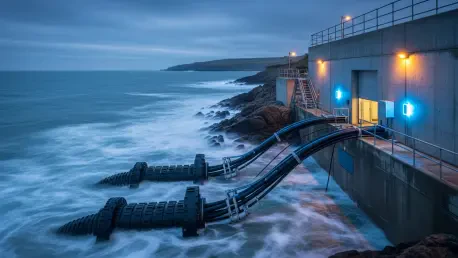

The silent network of undersea fiber-optic cables facilitates nearly every aspect of contemporary British life, from the instantaneous settlement of trillion-dollar financial markets to the seamless operation of critical national emergency services. These submerged conduits carry over 99% of all international internet traffic, effectively acting as the invisible nervous system of the global economy. For the United Kingdom, this reliance is particularly acute, as more than £1.4 trillion in financial transactions are processed through these links every single day, keeping stock exchanges and banking systems functional. However, the physical environment where this technology resides is increasingly fraught with danger. Historically, the primary concerns for cable operators were accidental—a ship’s anchor dragging across the seabed or a deep-sea trawler snagging a line. Today, the focus has shifted toward more deliberate and sophisticated threats. Geopolitical shifts have forced the British government to reclassify subsea infrastructure as a top-tier national security priority, responding to increased naval activity from hostile state actors near critical landing points. The vulnerability of these networks is no longer just a technical concern for telecommunications companies; it has become a central pillar of national defense and economic survival.
Assessing the Evolving Global Threat Landscape
Geopolitical Chokepoints: The Geography of Risk
The concentration of global data traffic into a handful of narrow maritime corridors creates a precarious situation for international connectivity. Regions such as the Strait of Dover, the Red Sea, and the Gulf of Oman serve as massive funnels for fiber-optic cables, meaning that a significant portion of the world’s information passes through very confined geographic spaces. This density makes the network highly susceptible to localized incidents that could have global repercussions. For instance, a single natural disaster, such as an underwater landslide, or a targeted military strike within one of these chokepoints could simultaneously sever multiple primary links. This would lead to immediate bandwidth congestion and potentially isolate entire regions from the global internet backbone, forcing traffic onto longer, less efficient routes that may not have the capacity to handle the overflow.
True resilience requires a departure from these crowded corridors toward a strategy of geographic diversification. By establishing more terrestrial routes and exploring alternative maritime paths that bypass traditional chokepoints, the UK can reduce the risk of a single point of failure. This shift involves not only technical engineering but also diplomatic negotiations to secure safe passage for cables through diverse jurisdictions. Building on this necessity, industry leaders are looking toward 2026 and 2027 as critical years for the commissioning of new routes that prioritize distance from high-tension areas. The goal is to move away from the “hub and spoke” model that currently favors a few vulnerable nodes and toward a more decentralized mesh network that can survive the loss of any single geographic cluster without causing a systemic breakdown in national communication.
Maintenance Vulnerabilities: The Recoverability Crisis
The physical security of subsea cables is only half of the equation; the ability to repair them quickly is equally vital to national resilience. Currently, the world faces a significant shortage of specialized cable-repair vessels, with a small fleet of aging ships tasked with maintaining hundreds of thousands of miles of underwater fiber. When a cable is severed, these vessels must be dispatched to the site, a process that can take days or even weeks depending on the ship’s current location and the weather conditions at sea. This “anxiety regarding recoverability” is a major strategic weakness, as the window of vulnerability during an outage provides ample time for economic damage to accumulate. If a repair ship is unable to reach a site due to mechanical failure or logistical delays, the impact on essential services can escalate from a temporary nuisance to a full-scale crisis.
This maintenance challenge is further exacerbated by political friction in sensitive regions where hostile actors may deny repair crews access to territorial waters. In high-tension zones, a technical fault can be leveraged as a form of “gray zone” warfare, where the delay of a repair ship serves as a silent blockade of information. To mitigate this, there is an urgent need for the UK to invest in its domestic repair fleet and foster international agreements that guarantee the safe and rapid passage of maintenance vessels. Developing autonomous underwater vehicles for initial damage assessment and minor repairs could also provide a bridge while larger ships are en route. Ensuring that the logistics of recovery are as robust as the cables themselves is the only way to prevent a technical malfunction from becoming a permanent economic scar.
Hidden Weaknesses in the UK’s Digital Network
The Illusion of Diversity: Mapping Physical Vulnerabilities
There is a pervasive belief within the telecommunications industry that the UK’s network is inherently resilient due to the large number of cables landing on its shores. While the nation boasts approximately 64 cable landing stations, many of these connections suffer from an “illusion of diversity” that masks significant physical risks. Service providers often market redundant routes to corporate clients, yet investigations frequently reveal that these supposedly separate paths eventually converge at the same physical fiber locations or pass through the same narrow trenches on the seabed. This means that while a company might believe it has purchased two independent connections, both could be taken out by the same anchor strike or specialized sabotage operation. This lack of true physical separation creates a fragile infrastructure where the failure of a single node can have a cascading effect.
To uncover these hidden weaknesses, more rigorous auditing of the actual physical paths of fiber-optic cables is required. Relying on logical redundancy—where data is rerouted through different software protocols—is insufficient if the underlying hardware is concentrated in a single location. Organizations must demand more transparency from their carriers regarding the exact geographic coordinates of their primary and backup lines. This transparency would allow for a more accurate assessment of risk and the identification of “single points of failure” that are currently hidden behind complex service agreements. By moving toward a model where diversity is measured by physical distance rather than just network topology, the UK can begin to build a foundation that is truly capable of withstanding physical interference or environmental disasters.
Economic Risks: The Impact of Systemic Failure
The consequences of a prolonged outage in the UK’s subsea infrastructure would extend far beyond the frustration of slow internet speeds or interrupted streaming services. Modern socio-economic stability is entirely dependent on the high-speed, low-latency transmission of data that these cables provide. A significant disruption could freeze financial payment systems, making it impossible for consumers to use credit cards or for banks to settle accounts, which would lead to an immediate paralysis of retail commerce. Furthermore, critical energy grids and healthcare logistics increasingly rely on real-time data from subsea links to manage supply chains and monitor infrastructure. If these links were severed, the resulting chaos would compromise the nation’s ability to respond to emergencies and maintain basic public services, potentially leading to a systemic collapse.
Latency-sensitive industries, such as high-frequency trading and automated financial markets, are particularly at risk from any degradation in cable performance. Even if a complete outage is avoided, the increased latency caused by rerouting traffic through suboptimal paths could make certain commercial operations untenable, leading to massive financial losses in a matter of seconds. This economic vulnerability serves as a potent lever for hostile actors who may seek to destabilize the UK without engaging in traditional kinetic warfare. Protecting this infrastructure is therefore not just about maintaining connectivity, but about safeguarding the very mechanisms that allow the British economy to function. The potential for a domino effect, where a single break leads to widespread commercial and social disruption, underscores the need for a resilience strategy that treats digital connectivity with the same urgency as the food or water supply.
Strategic Steps Toward Long-Term Resilience
Hardwired for Chaos: Rethinking Infrastructure Design
Creating a resilient digital future requires a fundamental shift in how the UK approaches the design and deployment of its subsea networks. Experts are increasingly advocating for a “hardwired for chaos” strategy, which prioritizes the survival of the network over the immediate cost-saving measures that have dominated the industry for decades. This approach involves deep collaboration between the public and private sectors to invest in geographically distinct routes that are intentionally designed to be redundant at every level. By decentralizing traffic and establishing new links that traverse different geopolitical regions, the UK can reduce its reliance on the small number of underwater corridors that are currently most vulnerable. This strategy also includes the development of more “dark fiber” capacity—cables that are laid but not immediately used—to provide instant failover options during a crisis.
Building this level of resilience also requires a significant expansion of the domestic repair fleet and the modernization of cable-laying technology. Government-backed initiatives must incentivize telecommunications companies to prioritize security features, such as deeper burial of cables or the use of advanced sensors that can detect tampering in real-time. By moving toward a more proactive stance, the UK can ensure that its infrastructure is not just reacting to threats but is built to withstand them from the outset. This forward-looking design philosophy acknowledges that the digital environment is inherently unstable and that the only way to maintain national security is to build systems that are robust enough to continue operating even when under direct pressure or in the face of catastrophic failure.
Corporate Readiness: Moving Beyond Theoretical Planning
While government-level strategies are essential, the resilience of the UK’s digital economy also depends on the actions taken by individual businesses and organizations. Many companies have disaster recovery plans that exist only on paper and have never been tested against a large-scale network disruption. To truly prepare for a crisis, businesses must conduct thorough vulnerability assessments that look beyond their immediate service providers to the underlying infrastructure those providers use. This includes diversifying their connectivity across truly separate physical paths and ensuring that their failover systems can handle the switch to backup lines without a significant loss in performance. Practical testing, such as simulating an outage during off-peak hours, is an essential practice for ensuring that an organization remains operational when a real-world disruption occurs.
Furthermore, corporate leaders must scrutinize their carrier infrastructure with the same rigor they apply to their cybersecurity protocols. This means asking difficult questions about the physical security of landing stations and the geographic diversity of the fiber routes they depend on. Moving from theoretical planning to practical application involves a cultural shift within organizations, where digital resilience is seen as a core business function rather than a secondary technical concern. As the threats to subsea infrastructure continue to evolve through 2026 and 2027, the companies that have invested in verified redundancy and robust contingency plans will be the ones that survive the inevitable instability of the modern world. Resilience is not a one-time achievement but an ongoing process of assessment, testing, and adaptation.
Strengthening National Connectivity Through Action
The United Kingdom recognized that the historical approach to subsea infrastructure was no longer sufficient in an era of heightened geopolitical tension. Stakeholders moved to adopt more rigorous auditing of physical paths, ensuring that the marketing of redundant routes matched the reality of the fiber on the ocean floor. They identified that the cost of building deep-sea redundancy was far lower than the price of a systemic economic collapse. As businesses implemented more aggressive testing of their failover systems and diversified their providers, the overall posture of the nation’s digital borders became significantly more robust. Government agencies also fostered stronger public-private partnerships, which accelerated the deployment of new, geographically diverse cable routes and expanded the domestic repair fleet to reduce recovery times. These collective efforts ensured that the UK remained a global leader in digital commerce, capable of maintaining essential services even in the face of sophisticated external threats. The shift toward a proactive resilience strategy proved to be a decisive factor in safeguarding the national economy against the unpredictable challenges of the digital age.