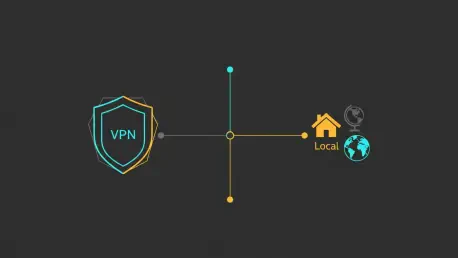

In the current digital landscape of 2026, the demand for privacy often clashes with the requirements of modern network utility and high-speed communication. Traditional Virtual Private Networks operate on a binary principle, either encrypting every packet of data or offering no protection, which leads to performance bottlenecks and connectivity failures. Split tunneling has emerged as a sophisticated solution to this dilemma, allowing users to move away from the restrictive all-or-nothing approach by bifurcating their internet traffic into two distinct streams. One stream is funneled through a secure VPN tunnel to protect sensitive information, while the other maintains a direct connection to the internet via a local service provider. This strategic separation ensures that while confidential activities remain hidden, essential local services can still function without the interference of a remote server or foreign IP address that might disrupt regional access to certain tools.
The Mechanics: Selective Data Routing
Primary Implementation Strategies: Whitelisting and Blacklisting
Whitelisting serves as the primary method for users who prioritize privacy as their default state, ensuring that the vast majority of their digital footprint remains under the protection of heavy encryption. In this configuration, the VPN software is programmed to route all outgoing and incoming data through the secure tunnel by default, with only specific exceptions manually granted to trusted applications or websites. This approach is particularly effective for individuals who handle sensitive corporate data or participate in activities that require a masked identity, as it eliminates the risk of accidentally exposing private information through an unsecured connection. By carving out a list of approved exceptions, such as a local banking application that requires a regional IP address or a high-definition video conferencing tool that demands maximum bandwidth, users can maintain their security posture without sacrificing the functionality of specific apps that are known to be safe.
In contrast to the conservative nature of whitelisting, the blacklisting strategy adopts a more surgical approach to data security, which is ideal for users who only require protection for a handful of specific tasks. Under this model, the general internet traffic of a device travels over the standard local connection, while only those applications explicitly added to the blacklist are directed through the VPN. This is a highly efficient way to manage resources, as it prevents the unnecessary encryption of non-sensitive data, such as background system updates or public weather feeds, which often clog secure tunnels and reduce overall network speeds. For a casual user who only cares about encrypting their web browser or a specific messaging app, blacklisting provides a low-overhead solution that keeps the rest of the system running at peak performance. This flexibility allows for a customized networking environment where the user remains in complete control over which parts of their digital life are shielded.
Hardware and Software Integration: Application and Router Levels
Most contemporary interactions with split tunneling occur at the application level, where intuitive software interfaces allow users to toggle specific programs in and out of the secure tunnel with ease. On platforms like Windows and Android, VPN clients often present a simple checklist of installed applications, making it incredibly straightforward to manage complex routing rules without needing any advanced technical knowledge. This granularity is essential for modern multitasking, as it allows a professional to participate in an encrypted research session in one browser window while simultaneously streaming music on a local platform that might otherwise block VPN-associated IP addresses. The ability to switch these settings on the fly provides a level of convenience that has made split tunneling a standard feature for personal cybersecurity. However, this method is limited to the specific device where the software is installed, necessitating a different approach for households with diverse hardware.
To address the limitations of individual device software, advanced users often implement split tunneling directly at the router level, which serves as a centralized hub for managing the data of every connected device in a building. This hardware-centric approach is particularly powerful because it can apply routing rules to devices that do not natively support VPN software, such as smart televisions, gaming consoles, and various Internet of Things appliances. By configuring the router to distinguish between different types of traffic or different destination addresses, a household can ensure that all laptops and smartphones are automatically encrypted while media players maintain a direct line to local streaming servers for buffer-free 4K playback. While setting up these configurations often requires more sophisticated networking expertise, the results offer a seamless and automated environment where security and utility are balanced without constant manual intervention, creating a unified home ecosystem.
Strategic Advantages: Improving Connectivity and Performance
Resolving Local Network Conflicts: Hardware and Service Integration
One of the most persistent frustrations when using a full-system VPN is the sudden loss of access to Local Area Network resources, which effectively isolates a device from its physical environment. Because a standard VPN routes all traffic to a distant server, the local computer often loses the ability to recognize or communicate with other devices on the same Wi-Fi network, such as wireless printers, file storage servers, or smart home controllers. Split tunneling resolves this isolation by allowing local traffic to bypass the encrypted tunnel, ensuring that the device remains part of the local ecosystem even while browsing the public web securely. This means that a user can finish a private research project over a secure connection and immediately send the document to a nearby printer without the need to disconnect from the VPN. Maintaining this local visibility is crucial for productivity in home offices where integrated hardware is essential, and it prevents the constant toggling of security settings.
Beyond the immediate utility of local hardware, split tunneling also facilitates smoother integration with services that rely on accurate geographic data provided by local internet service providers. Many web platforms, including food delivery services, ride-sharing apps, and local news outlets, use the user’s IP address to provide relevant regional information and ensure the functionality of location-based features. When a VPN is fully active, these services may fail to load correctly or provide data for a completely different city or country, causing significant user frustration. By permitting these specific applications to connect directly to the internet, split tunneling allows the user to benefit from localized intelligence while keeping the rest of their browsing data private. This ensures that the user does not have to sacrifice convenience for security, allowing for a more natural and integrated digital experience where the VPN operates silently in the background without breaking essential daily services.
Performance Optimization: Latency and Geographic Precision
Performance optimization remains a primary driver for the adoption of split tunneling, particularly when dealing with high-bandwidth and latency-sensitive activities like competitive gaming or ultra-high-definition streaming. Routing heavy traffic through an encrypted tunnel adds layers of overhead, including the time required for data encryption and the additional distance the packets must travel to reach a remote VPN server. By excluding these data-heavy streams from the VPN, users can drastically reduce ping times and eliminate the stuttering or buffering that often plagues secured connections. Furthermore, many modern streaming services use sophisticated geofencing technologies that actively block known VPN IP ranges to enforce regional licensing agreements. Split tunneling allows a user to keep their financial transactions and private communications encrypted while their media player connects directly to local servers, ensuring uninterrupted access to content and maintaining highest possible video quality.
The strategic use of split tunneling also helps in managing the overall data load on the secure server, which can lead to a more consistent connection for the traffic that truly requires protection. When a user forces all of their background system data, including large file downloads or automated cloud backups, through a single VPN tunnel, they often experience a noticeable decrease in speed due to server congestion. By selectively routing only the most sensitive data through the encrypted path, the user reduces the strain on the VPN connection, resulting in a snappier and more responsive experience for secure browsing. This specialized management of bandwidth ensures that critical tasks, such as online banking or secure messaging, receive the priority they deserve without being slowed down by non-essential traffic. Consequently, split tunneling has become an essential tool for power users who demand both a high level of security and the maximum possible throughput from their internet connection.
Security Considerations: Navigating Risks and Limitations
Mitigating Emerging Vulnerabilities: Preventing Potential Data Leaks
While the benefits of selective routing are significant, they are accompanied by specific security risks that require careful management to prevent the accidental exposure of private data. By intentionally leaving a portion of traffic unencrypted, users are essentially creating two separate paths into their device, which can lead to situations where sensitive information leaks through the unsecured channel. One of the most common issues is the DNS leak, where a request for a website address is sent through the local service provider instead of the secure VPN tunnel, providing the ISP with a clear record of the user’s browsing history even if the content itself is protected. Additionally, the real IP address of the user remains visible to any service that is excluded from the tunnel, which can be exploited by advertisers to track physical locations. To minimize these vulnerabilities, security professionals recommend that users utilize split tunneling for non-sensitive tasks and avoid its use on untrusted public networks.
Furthermore, the complexity of split tunneling configurations can sometimes lead to a false sense of security if the user does not regularly audit their routing rules to ensure they remain effective. Software updates to the operating system or the VPN client itself can occasionally reset these settings or change how certain applications are identified, potentially causing a sensitive program to bypass the secure tunnel without the user’s knowledge. It is also important to recognize that split tunneling bypasses the secondary security features often bundled with high-end VPN services, such as malware blocking and ad-filtering, for any traffic that connects directly to the internet. This means that a browser window excluded from the tunnel for the sake of speed is more vulnerable to web-based threats than one that remains protected. Maintaining a secure environment therefore requires a proactive approach, including the use of leak-test tools and a strict adherence to best practices for data classification.
Platform Support: Current Standards and Industry Trends
The effectiveness and availability of split tunneling are heavily dependent on the underlying operating system, with significant differences existing between major platforms. Windows and Android have long been the leaders in this area, offering robust support for per-app traffic routing that allows developers to create highly customizable VPN clients. In contrast, Apple has traditionally maintained a more restrictive stance on network traffic management within macOS and iOS, prioritizing a locked-down security model that makes implementing third-party split tunneling much more technically challenging. While newer iterations of these operating systems have begun to introduce more flexible networking APIs, the experience for Apple users often remains less intuitive than that of their counterparts. As the market for connected devices continues to expand, the pressure on software developers to provide consistent split tunneling features is increasing, as users demand the ability to manage their data with precision.
The adoption of split tunneling represented a significant shift in how personal cybersecurity was managed, moving away from a rigid defensive posture toward a more nuanced and adaptable framework. It was found that by categorizing data based on sensitivity and performance requirements, individuals achieved a more stable and efficient online experience. Experts recommended that a thorough audit of all application settings was necessary to ensure that no critical data was inadvertently exposed through the local connection. It was also noted that the most successful implementations involved a combination of router-level rules for general household devices and app-level controls for personal workstations. Looking forward, the focus shifted toward more automated, dynamic routing systems that could adjust encryption levels based on the perceived threat of a network. These advancements ensured that the balance between total privacy and maximum network utility remained a practical reality for the modern, hyper-connected user.