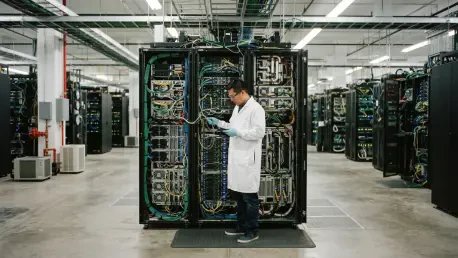

The global race for computational supremacy has transformed supercomputing from a mere scientific endeavor into a high-stakes geopolitical contest where architectural philosophy determines national prestige. As of 2026, high-performance computing (HPC) has firmly entered the exascale era, a milestone where systems perform over one quintillion calculations per second. This shift marks a transition from simply building larger clusters toward designing specialized hardware that can handle the intense heat and data throughput of modern workloads.
Leading the charge is China’s LineShine, currently the world’s most powerful system, followed closely by the United States’ elite trio: El Capitan, Frontier, and Aurora. Meanwhile, Europe has established its presence through Germany’s JUPITER Booster and France’s KAIROS, each representing a distinct vision of how modern infrastructure should be built. The current landscape highlights a pivot from raw clock speeds toward architectural efficiency, forcing developers to choose between the bespoke control of custom silicon and the raw power of off-the-shelf accelerators.
Evolution of High-Performance Computing Architecture
The journey toward exascale performance has been defined by the need to overcome the “power wall,” where increasing the number of traditional processors no longer yields proportional performance gains due to electricity and cooling constraints. In this era, the TOP500 list is dominated by the Exascale Five, a group of machines that have redefined the boundaries of human engineering. These systems are no longer just collections of servers; they are integrated ecosystems where the interconnect, storage, and processing units must function as a single organism to prevent data bottlenecks.
Technological significance has shifted from the total number of cores to how those cores communicate. While the industry previously relied on standardized hardware, the emergence of systems like LineShine at the National Supercomputing Center in Shenzhen demonstrates a return to vertically integrated, custom silicon. This move toward specialized architecture reflects a broader trend of sovereign computing, where nations develop their own intellectual property to ensure long-term stability and performance in an increasingly volatile global market.
Performance and Technical Design Benchmarks
Architectural Approaches to Raw Computational Speed
The primary divide in modern supercomputing lies in how a system achieves its peak performance. LineShine utilizes the LX2 custom processor, a 304-core powerhouse that allows the system to reach a benchmark score of 2.198 exaflops without relying on any external hardware. This monolithic design simplifies the internal data path but requires immense engineering effort to develop. It stands as a testament to the viability of general-purpose custom cores when scaled to extreme levels.
Conversely, the hybrid systems dominating the American landscape, such as El Capitan and Frontier, combine traditional CPUs with powerful AMD accelerators. This approach leverages the high-bandwidth memory of discrete cards to push through the exascale threshold. A third path is seen in Germany’s JUPITER Booster, which implements Nvidia Grace Hopper Superchips. This model offers a highly integrated hybrid design, fusing the CPU and GPU onto a single module to reduce the communication lag that often plagues discrete component designs.
Mixed-Precision Performance for AI Applications
While custom cores excel at the linear algebra required for traditional scientific simulations, the rise of artificial intelligence has shifted the benchmark for success toward mixed-precision computing. In this arena, hybrid designs like El Capitan hold a significant advantage. The specialized cores within AMD and Nvidia accelerators are specifically tuned for the low-precision math that drives deep learning, allowing them to outperform general-purpose custom processors in AI-heavy workloads.
This performance gap is further widened by the software ecosystems surrounding the hardware. While the LineShine system relies on the proprietary LingQi interconnect to maintain data flow between its thousands of cores, many hybrid systems have standardized on HPE Slingshot-11. This networking technology provides a predictable environment for developers, making it easier to scale diverse workloads across massive clusters compared to more niche solutions like the Japanese Tofu Interconnect D.
Energy Efficiency and Sustainable Computing
As power grids become increasingly strained, the sustainability of these massive installations has become a critical metric. Currently, France’s KAIROS system holds the top spot for energy efficiency on the Green500, proving that a well-optimized hybrid architecture can lead in gigaflops per watt. The thermal design of a system is inextricably linked to its hardware choice; custom chips like the LX2 aim for high density, which can create extreme cooling challenges.
In contrast, discrete accelerators are notoriously power-hungry but allow for more distributed heat management. These operational costs are a primary concern for major research centers, where the long-term sustainability of running an exascale machine depends on balancing peak performance with manageable energy draw. This tension defines the current architectural debate, as researchers weigh the benefits of raw speed against the realities of the electricity bill.
Implementation Challenges and Market Stagnation
The path to exascale performance is fraught with manufacturing barriers that vary wildly depending on the chosen architecture. Developing bespoke silicon like the LX2 requires a sophisticated domestic semiconductor pipeline and years of research to ensure the 304-core architecture remains stable. On the other hand, systems that rely on thousands of AMD or Nvidia units face logistical hurdles, from supply chain volatility to the physical complexity of integrating disparate components into a unified fabric.
These challenges have led to a noticeable period of market consolidation. In the latest TOP500 update, only 27 new systems joined the list, the lowest influx in history. This trend suggests that organizations are focusing on refining existing hardware rather than chasing frequent upgrades. Furthermore, scaling these systems revealed the limitations of interconnect technologies. Proprietary solutions often struggled to compete with industry-standard networking, illustrating why many nations gravitated toward proven solutions to avoid proprietary bottlenecks.
Strategic Recommendations for HPC Development
The performance gap between China’s custom-built LineShine and the United States’ hybrid systems indicates that there is no longer a single path to supercomputing excellence. For institutions focused on traditional scientific research involving complex simulations, the LX2’s custom core density provides a streamlined, efficient path to high-throughput results. However, for organizations prioritizing generative AI and machine learning, the hybrid accelerator model remains the superior choice due to its specialized mixed-precision capabilities.
Strategic investments have moved toward stabilizing interconnects and optimizing thermal management rather than simply adding more cores to the rack. Decision-makers are prioritizing long-term energy sustainability, as the cost of operation has become as significant as the initial price of the hardware. The maturation of the HPC market suggests that future infrastructure projects should rely on a workload-first philosophy, ensuring that the chosen architecture truly matches the specific research goals of the facility. Ultimately, the stability of the global rankings proves that the most successful systems are those that achieve a balance between raw power, energy efficiency, and software accessibility.