
CBRE Group’s strategic acquisition of Onnec Group signals a pivotal shift as real estate giants transition into technical service providers to support hyperscale AI development. This move comes at a time when the global data center landscape is undergoing a radical metamorphosis, primarily fueled by the relentless requirements of high-performance computing. By committing to a deal valued at approximately $1 billion, the company is effectively bridging the gap between physical real estate management and the highly specialized world of IT infrastructure. As hyperscalers and generative intelligence firms race to secure capacity, the bottleneck has shifted from merely finding floor space to ensuring that the underlying technical systems are capable of supporting unprecedented power and cooling loads. The integration of Onnec reflects a broader industry recognition that success in the current digital era requires a holistic approach that covers everything from land acquisition to complex fiber networking.
Evaluating the Financial Structure and Projections
The acquisition is structured to balance immediate capital outlay with long-term performance incentives, featuring an initial cash payment of $610 million. To ensure that the original leadership remains aligned with the parent company’s growth objectives, an additional earnout provision worth up to $400 million has been established, contingent upon Onnec meeting specific growth thresholds over the coming months. Financial projections for the newly integrated entity are robust, with expectations that Onnec will contribute nearly $500 million in revenue by 2027. This financial trajectory is supported by core earnings that are projected to exceed $67 million, suggesting a healthy margin for technical services in a high-demand market. Such a valuation highlights the premium that major real estate firms are now willing to pay for specialized knowledge that cannot be easily replicated or built from the ground up in a short timeframe.
This strategic investment highlights a shift in how market analysts value service-oriented companies within the broader infrastructure sector. Initially, the purchase price represents a multiple of roughly nine times the projected earnings, but this could rise significantly if all performance-based targets are achieved. The willingness to offer such a premium indicates that the underlying value lies in the specialized technical talent and the established client relationships with global hyperscalers. In an environment where interest rates and capital costs remain significant factors, investing in high-margin technical services provides a more resilient revenue stream compared to traditional property brokerage. This financial strategy allows for a more diversified portfolio that can withstand fluctuations in the commercial real estate market while riding the wave of the ongoing technological revolution. The fiscal discipline shown in the earnout structure ensures that the acquisition remains a value-additive move for shareholders.
Expanding Global Footprints and Service Capabilities
By bringing Onnec’s expertise into its portfolio, the organization is significantly expanding its Critical Infrastructure Services across the United Kingdom, continental Europe, and the Asia-Pacific region. Onnec brings a workforce of approximately 800 highly trained professionals who specialize in network architecture and fiber optic deployments, which are essential for the modern data center. This geographic and professional expansion allows for a much more consistent service delivery model on a global scale. Previously, developers often had to rely on a fragmented network of local contractors, which could lead to inconsistent standards and project management headaches. Now, with a unified team, it is possible to maintain the same rigorous technical specifications whether a project is located in London or Tokyo. This scale is particularly attractive to global cloud providers who prioritize speed-to-market and reliability above all other factors in their expansion plans.
One of the most significant advantages of this expanded capability is the elimination of the common “handoff problem” that often occurs during complex construction projects. Traditionally, there has been a gap between the teams responsible for building the physical shell of a data center and the IT teams tasked with installing the networking equipment. This communication breakdown frequently leads to costly delays and installation errors that are difficult to rectify once the facility is live. By offering a “cradle-to-grave” service model, the integrated team can oversee the entire lifecycle of a facility, from the initial architectural planning to the final commissioning of the IT infrastructure. This seamless transition ensures that the physical environment is perfectly optimized for the specific technical requirements of the hardware it will house. This approach not only reduces the risk of project overruns but also provides a single point of accountability for the client.
Supporting High-Density Connectivity for AI Workloads
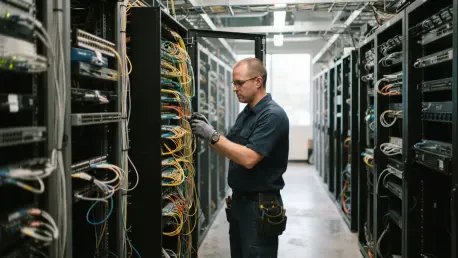
The rapid rise of generative intelligence has fundamentally altered the physical requirements of data center interiors, necessitating a much higher density of connectivity than traditional compute clusters. Artificial intelligence workloads rely heavily on powerful GPU clusters that require massive amounts of data throughput between individual servers. This shift means that the amount of fiber optic cabling required per rack has multiplied, making the role of the infrastructure installer more critical than ever before. If the cabling is not managed with extreme precision, it can impede airflow and lead to overheating in these high-density environments. The specialized skills that the new acquisition brings to the table are specifically designed to address these challenges, ensuring that the back-end networks for AI accelerators are installed with the density and accuracy required to maintain peak performance without compromising cooling efficiency.
In addition to connectivity, the physical infrastructure must now accommodate advanced liquid cooling systems to manage the intense heat generated by modern processors. These systems require a sophisticated integration of mechanical and electrical engineering that goes beyond the scope of traditional facilities management. The technical teams are now tasked with designing and maintaining environments where liquid and electricity coexist in close proximity, requiring a higher standard of safety and operational expertise. By internalizing these capabilities, the company can offer a comprehensive solution that ensures the physical plant is ready to support the next generation of hardware as soon as it arrives. This proactive management of the critical path—the sequence of events required to get a facility fully operational—is becoming the primary differentiator in a market where every day of delay results in significant lost revenue for the hyperscale tenant.
Developing a Resilient Global Infrastructure Strategy
This acquisition is a cornerstone of a broader roadmap to build a dominant global infrastructure services business, with a total revenue target of nearly $7 billion by 2027. Within this framework, critical infrastructure services are expected to contribute approximately $4.5 billion, while the remaining $2.5 billion will come from project management and advisory roles. This strategic pivot is intended to create a more resilient business model that is less dependent on the cyclical nature of traditional real estate transactions. By focusing on recurring technical services, the organization can secure long-term contracts that provide steady cash flow regardless of the broader economic climate. This shift from being a transaction-oriented firm to a service-oriented partner is essential for maintaining growth in an era where digital infrastructure has become as vital as any traditional utility or transportation network.
The strategy also emphasizes the importance of data-driven decision-making in the management of global assets. By having direct oversight of both the real estate and the technical infrastructure, the company can gather unique insights into how facilities are performing in real-time. This information can then be used to advise clients on everything from site selection to energy efficiency improvements. Furthermore, the ability to offer a standardized global platform makes it easier for multinational corporations to manage their digital footprints across different jurisdictions. As the demand for data sovereignty and localized processing grows, having a partner that can navigate both the local regulatory environment and the technical complexities of deployment is a significant competitive advantage. This holistic perspective ensures that the company remains at the center of the digital economy, providing the foundational services that enable modern technology to function.
Navigating Market Consolidation and Supply Risks
The merger signals a period of rapid consolidation within the data center services sector as large-scale providers look to dominate the global market. While this integration offers significant efficiencies for hyperscalers who want a single point of contact, it also raises questions about supplier concentration in the industry. As a few major players begin to control a larger share of the technical service market, it becomes increasingly important for infrastructure buyers to monitor price competition and service quality. However, the current bottleneck is not capital but rather the availability of specialized technical talent. By securing a large, experienced workforce, the organization has effectively built a moat around its business, making it difficult for smaller competitors to keep pace with the technical demands of the largest technology firms. This consolidation is likely to continue as the complexity of facilities increases.
The successful integration of Onnec Group established a new benchmark for how real estate enterprises managed technical complexity during a period of intense innovation. Stakeholders realized that the previous model of separating property management from IT installation created unnecessary friction that slowed down global deployment schedules. Consequently, investors prioritized firms that demonstrated end-to-end oversight of the data center lifecycle to mitigate operational risks. This strategic alignment provided a blueprint for future infrastructure developments where physical and digital layers were designed in tandem from the very beginning. Leaders in the sector recognized that specialized talent in fiber optics and network architecture was the most valuable asset in an increasingly automated world. By securing this expertise early, companies ensured they remained competitive in a market where execution speed was the primary differentiator for all major hyperscale projects.