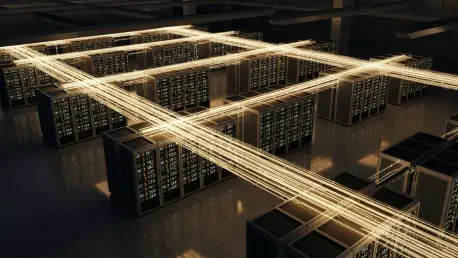

The global landscape of digital infrastructure is undergoing a radical transformation as specialized AI-focused providers like CoreWeave and Lambda Labs displace traditional architectural norms with high-density GPU environments. These neoclouds have rendered the old model of handling millions of tiny, sporadic connections, frequently termed mice flows, largely obsolete in favor of massive, synchronized data streams. Instead of the chaotic, high-entropy noise typical of standard web traffic, modern data centers are witnessing the rise of elephant flows, where sustained transfers regularly reach speeds between 100 Gbps and 1 Tbps. This shift is not merely a quantitative increase in bandwidth; it represents a fundamental change in the behavioral physics of information movement within the fabric. As compute clusters become more concentrated, the focus has pivoted toward optimizing storage-to-GPU connections that must remain perfectly stable under the immense pressure of coordinated model training.
The Emergence: Specialized Networking for Low-Entropy Traffic
The fundamental nature of network activity within these specialized facilities has transitioned from a random distribution of requests to a highly coordinated and predictable pattern. Engineers frequently describe this new reality as low-entropy traffic because the data movements are less erratic and more synchronized across the entire cluster. In a traditional enterprise environment, a network might manage thousands of disparate tasks simultaneously, but an AI neocloud often focuses the entire capacity of a network segment on a single training job. This concentration of resources means that any minor bottleneck in the backend fabric can lead to massive performance degradation across the entire GPU fleet. Consequently, the industry is moving away from generic load-balancing techniques toward sophisticated traffic engineering that prioritizes flow consistency. Maintaining a steady state for these massive transfers has become the primary metric for success in the current era of generative modeling.
Infrastructure measurements from leading storage providers indicate that these sustained elephant flows are no longer outliers but the primary operational standard for high-performance computing. Rather than seeing a high volume of unique IP addresses and short-lived sessions, network monitors now observe a smaller set of high-bandwidth endpoints that stay active for days or even weeks. This architectural consolidation occurs primarily between massive NVMe storage arrays and the GPU-dense compute nodes that ingest the data. To accommodate this, data center operators are forced to rethink their physical topology, often shortening the physical distance between storage and compute to minimize latency and signal degradation. The goal is to create a seamless pipeline where the network becomes a transparent extension of the system memory. By focusing on the quality and synchronization of these flows, neoclouds are achieving a level of efficiency that traditional hyperscale providers are currently rushing to replicate.
Protocol Evolution: Optimizing Training and Inference Pathways
The operational demands of artificial intelligence are split into two distinct phases, each placing unique pressures on the underlying network architecture. During the training phase, the network must support long-term, persistent flows that move massive datasets from enterprise sources to specialized data centers for processing. This stage is characterized by intense GPU-to-GPU communication where model states are constantly exchanged across the backend fabric. These training jobs are not measured in seconds or minutes but in weeks of continuous high-throughput activity. If the network fails to maintain the integrity of these elephant flows, the entire training process can stall, leading to millions of dollars in lost compute time. This has necessitated the implementation of advanced congestion control mechanisms that can distinguish between a temporary spike and a sustained data movement, ensuring that the critical training traffic is never throttled by less important administrative tasks.
In contrast to the heavy lifting of training, the inference phase requires a more agile and responsive network configuration that can handle bursty, request-driven traffic. As models respond to real-world user queries, the duration of individual flows is shorter, yet the collective volume remains exceptionally high. To maximize efficiency, operators are increasingly turning to the QUIC transport protocol, which now accounts for approximately 53% of total flows in these advanced environments. QUIC is favored because it allows for the aggregation of multiple data streams over a single connection, effectively bundling smaller requests into a more manageable and efficient format. This shift toward stream aggregation helps maintain high bandwidth utilization even when the workload is fragmented. By leveraging modern protocols like QUIC and RoCE, neoclouds can bridge the gap between the raw power needed for training and the rapid-fire responsiveness required for global inference services.
Strategic Geography: Power and Proximity in Global Markets
The rapid expansion of AI infrastructure is redrawing the map of global data center investment, pushing development far beyond the traditional hubs like Northern Virginia. Because high-density GPU racks require unprecedented levels of power and specialized liquid cooling systems, providers are seeking out locations where energy is both abundant and affordable. This has led to a surge in GPU cluster deployments in diverse international markets, including Finland and Brazil, where local infrastructure can support the unique cooling demands of modern AI hardware. This geographic diversification is not just about finding space; it is about placing compute resources closer to regional data sources and power grids that can sustain a massive carbon-neutral footprint. As the demand for localized AI processing grows, these diverse regions are becoming critical nodes in a global network designed to support the next generation of autonomous agents and large-scale language models.
As AI agents begin to interact with one another across different systems, the complexity of data center networking will only continue to intensify. These inter-agent communications create a secondary layer of traffic that extends beyond the internal data center fabric and onto the Wide Area Network links. This evolution is forcing engineers to adopt technologies like RDMA over Converged Ethernet to manage the migration of specialized backend tasks into the broader network. The result is a more disaggregated and resilient architecture that can handle synchronized bursts of data without compromising the performance of other cloud services. By prioritizing advanced congestion management and performance stability, the industry is setting a new standard for how global internet traffic is handled. This transition toward high-capacity, low-latency networking ensures that the digital backbone is ready to support the increasingly interconnected and autonomous nature of modern software ecosystems.
Future Infrastructure Strategies
The transition toward AI-optimized networking required a complete reassessment of how infrastructure was deployed and managed by technical teams. It became evident that traditional Ethernet configurations were insufficient for the demands of high-density GPU clusters, leading to the widespread adoption of specialized protocols that minimized overhead. Engineers focused on reducing network hops and implementing flat, non-blocking topologies that ensured every GPU had equal access to the storage fabric. This shift was not merely about purchasing faster hardware but about reconfiguring the entire logical flow of information to prevent synchronization bottlenecks. Teams that successfully integrated these changes saw a significant reduction in tail latency and an increase in overall cluster utilization. These lessons were then applied to a broader range of high-performance computing tasks, creating a new blueprint for scalable cloud architecture that prioritized flow quality over connection quantity.
To stay competitive in this rapidly evolving environment, organizations moved toward a more modular and disaggregated infrastructure strategy. They invested in programmable networking hardware that allowed for real-time adjustments to traffic priorities based on the specific requirements of the AI workload being executed. This flexibility enabled providers to switch between high-throughput training modes and low-latency inference modes without physical reconfigurations. Furthermore, the focus on geographic diversity helped mitigate the risks associated with power grid instability and regional data sovereignty laws. By distributing GPU resources across a wider array of international locations, providers were able to offer more resilient and compliant services to a global customer base. The successful implementation of these strategies turned the initial challenges of AI traffic into a robust foundation for the future of digital services, proving that a proactive approach to network design was the key to long-term operational success.