
The silent hum of a modern data center masks a volatile reality where a single cabinet now pulls more electricity than an entire city block of suburban homes used to consume. This shift represents the definitive end of the manual era in facilities management. For decades, the industry relied on human intuition, paper floor plans, and the occasional spreadsheet to track the health of a server room. However, as power densities reach levels that were once theoretically impossible, the margin for error has narrowed to a razor-thin line. The traditional “walk-through” inspection is no longer a safety measure; it is a relic of a simpler technological age that cannot keep pace with the thermodynamic demands of modern hardware.
Digital twins have moved from being an experimental concept to the central nervous system of infrastructure strategy. These virtual replicas do not just sit in a database; they breathe with the facility, reflecting every temperature spike and voltage fluctuation in real time. The necessity for this technology is fueled by the realization that managing a high-density environment without a digital counterpart is essentially operating blind. To maintain uptime in an environment where a single cooling failure can result in millions of dollars in damage within seconds, engineers have turned to these sophisticated simulations to act as a buffer between innovation and disaster.
The End of Human-Only Oversight in the Age of 150kW Racks
The era of managing data centers with spreadsheets and manual floor walks has officially hit a wall. In today’s high-density environments, a single rack of hardware focused on generative artificial intelligence can spike past 150 kW in power demand. This is not merely an incremental increase; it is a total transformation of the physical requirements of the data center. Because these racks generate heat at a rate that traditional air-cooling methods cannot dissipate, engineers must now manage complex liquid-cooling loops and specialized heat exchangers. In this high-stakes environment, “trial and error” is no longer a viable strategy; it is a recipe for a catastrophic failure that could cripple an enterprise’s digital presence.
Digital twins have emerged as the essential virtual sandbox where engineers can stress-test these extreme loads before a single cable is plugged into a live environment. By modeling the thermal output of a 150 kW rack within a virtual replica, facility managers can determine exactly how the surrounding infrastructure will react. This foresight allows for the precision placement of cooling resources and the balancing of electrical loads across the floor. Without this simulation capability, the risk of creating a localized “hot spot” that triggers a cascading server failure is simply too high for modern business standards to tolerate.
Navigating the Complexity: AI-Driven Hardware and Configuration Sprawl
The urgency behind the adoption of digital twins is fueled by two converging forces that have complicated the life of the network administrator. On one hand, the explosive power demands of GPU clusters require a physical infrastructure that is more rigid and demanding than ever before. On the other hand, the logical layer of the network has become a tangled web of “configuration sprawl.” As enterprises integrate multi-cloud strategies, software-defined wide area networks, and various vendor-specific cloud overlays, the sheer number of moving parts has exceeded the capacity of human operators to map accurately by hand.
This background of escalating physical density and logical intricacy makes digital twins a foundational requirement rather than a luxury. When a network encompasses thousands of virtual routers and firewalls, a single change to a security policy can have ripples that are impossible to predict without a comprehensive model. Digital twins provide the visibility needed to navigate this configuration sprawl, ensuring that a change in the logical layer does not inadvertently create a bottleneck in the physical hardware. This holistic view ensures operational stability in an increasingly volatile technological landscape where the smallest misconfiguration can lead to wide-scale outages.
Operationalizing Living Models: Across Networks and Facilities
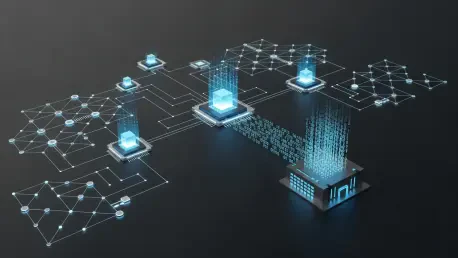
Digital twins differ from static blueprints by maintaining continuous synchronization with the live environment, acting as a dynamic replica of both physical and logical assets. In the networking realm, these models synthesize configuration data from every router, switch, and firewall to verify the “blast radius” of a planned update. This involves more than just a visual map; it is a mathematical verification process. By using the twin to run simulations, teams can ensure that a new routing protocol or a firmware patch will behave as expected across the entire stack, preventing the unforeseen outages that often plague large-scale deployments.
On the facility side, the use of computational fluid dynamics (CFD) and electrical simulations allows engineers to visualize air movement and power distribution with staggering accuracy. Instead of guessing how a new row of servers will affect the airflow in a cold aisle, managers can see a color-coded map of wind speeds and temperature gradients within the virtual model. This capability allows for the pinpointing of potential hot spots or containment failures long before they impact production hardware. The ability to operationalize these living models means that the physical facility is no longer a mystery but a predictable, programmable environment.
Leveraging Ground Truth DatEradicating Shadow Infrastructure and Outages
Industry analysis indicates that the shift toward digital twins is delivering more than just simulation; it is providing a definitive “ground truth” for enterprise operations. Research from leading analysts like Gartner suggests that organizations using these virtual models can reduce unplanned outages by as much as 70% by pre-validating changes. This is achieved because the digital twin serves as a single source of truth that bridges the gap between the facilities team and the IT department. When everyone is looking at the same real-time model, the communication silos that typically lead to operational errors begin to dissolve.
Furthermore, the visibility provided by these twins often exposes “ghost” infrastructure that has been hiding in plain sight. This includes un-decommissioned devices and active circuits that no longer serve a purpose but continue to consume power and pose significant security risks. Documentation decay is a chronic problem in traditional infrastructure management, where records often reflect a state of the network that existed years ago. By replacing these error-prone manual records with a living model, the digital twin becomes the primary, real-time documentation of the entire stack. This eliminates the guesswork and allows teams to reclaim wasted space and power, significantly improving the overall efficiency of the data center.
Building a Roadmap: Augmented Operations and Agentic Autonomy
Transitioning to a digital twin framework requires a shift from manual intervention to a model of augmented operations. The first step involves integrating natural language reasoning into the management stack. This allows engineers to query complex infrastructure data in plain English to identify policy conflicts without writing custom scripts. For instance, an operator might ask the system to identify all paths that bypass a specific firewall, and the digital twin would provide an immediate, verified answer. This accessibility democratizes the data, allowing even junior staff to make informed decisions based on the current state of the infrastructure.
Following this, organizations are moving toward “agentic operations,” where AI agents use the digital twin to diagnose root causes and run diagnostic path traces autonomously. In this stage, the human operator shifts from being a “doer” to an “overseer.” When an anomaly is detected, the AI agent can simulate various fixes in the virtual environment to find the one with the lowest risk and highest efficacy. This strategy reduces the cognitive load on staff and accelerates recovery times, establishing a scalable foundation for the next generation of autonomous data center management. This evolution ensures that the infrastructure can finally keep pace with the software that runs upon it.
The adoption of digital twins was recognized as a pivotal moment that reshaped the industry’s approach to risk and scalability. Organizations that prioritized these virtual models found they could successfully navigate the extreme thermal demands of generative AI hardware without the frequent outages that hampered their competitors. The integration of real-time telemetry and mathematical verification replaced the antiquated reliance on static spreadsheets, which ultimately saved millions in operational overhead. Leaders in the field moved toward implementing energy-grid telemetry to further synchronize their data centers with local power supplies, ensuring that infrastructure stayed resilient even during regional energy fluctuations. The focus then shifted to cross-training staff, as the role of the infrastructure manager became less about physical maintenance and more about the oversight of sophisticated AI agents operating within the twin. This cultural and technical transformation solidified the digital twin as the essential prerequisite for any enterprise aiming to thrive in an era of unprecedented computational density. Total characters: 6634