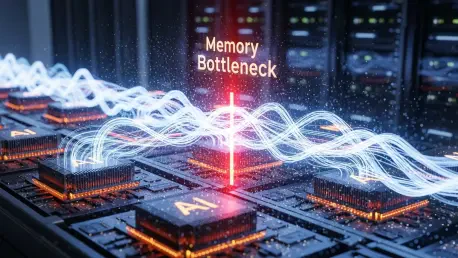

The silence within a modern high-density data center often masks a frustrating reality where the world’s most advanced trillion-transistor processors sit in expensive idle states, waiting for data to arrive from sluggish storage subsystems. For decades, the industry followed a predictable path where raw processing power served as the ultimate yardstick for progress. This era of compute-centricity assumed that as long as the logic gates grew faster and smaller, the system would perform better. However, the equilibrium has shifted. Today, even the most formidable graphics processing units are finding their potential capped not by their own internal clock speeds, but by the physical and electrical limits of the pipes that feed them.
Moving Beyond the Obsession with Raw Compute
The long-standing obsession with raw flops—floating-point operations per second—is finally hitting a wall as the energy cost of moving a single bit of data begins to eclipse the cost of the actual calculation. While chip designers successfully shrunk transistors to pack incredible amounts of logic into every square millimeter of silicon, the interconnects and memory buses have not kept pace. This divergence created a performance gap that now threatens to stall the progress of large-scale artificial intelligence. The industry is reaching a tipping point where the most sophisticated models are hitting a physical reality: the ability to move data efficiently is now more critical than the ability to process it at the core level.
This fundamental shift marks the transition into a memory-centric architecture where the memory bus, rather than the GPU core, defines the absolute ceiling of performance for the enterprise. In previous generations, adding more cores was the standard solution to a performance bottleneck, but in the current landscape, more cores often lead to more idle cycles if the data hunger of those cores remains unsatisfied. Consequently, the focus of architectural innovation moved toward reducing the distance between memory and logic, ensuring that the processing units spend less time waiting and more time executing the complex matrices required for modern machine learning.
The Physical Constraints of Scaling Trillion-Parameter Models
As artificial intelligence models scale toward trillions of parameters, the traditional bottleneck moved from the execution units of a chip to the extreme physical limits of the memory subsystem. In these massive workloads, moving data across the motherboard or even between layers of a chip became the dominant factor in both system latency and total power consumption. High-performance computing is no longer just a challenge of logic density; it is a challenge of thermodynamics and signal integrity. If data cannot reach the processor with sufficient velocity, the vast investment in silicon remains underutilized, turning a cutting-edge server into an expensive heater.
This friction is particularly visible in high-density data centers where available power and cooling capacity have become strictly finite resources. Every millijoule spent on moving a bit of information from a storage drive to a processor is energy that cannot be spent on the computation itself. In this constrained environment, the “performance per watt” metric has surpassed raw clock speeds as the most vital variable for long-term infrastructure sustainability. Organizations are discovering that the most efficient way to improve the bottom line is not necessarily to buy a faster processor, but to deploy a system that wastes less energy during the data transfer process.
A Taxonomy of Modern Memory and the Move Toward Heterogeneity
The industry is rapidly moving away from the “one-size-fits-all” server model that defined the last twenty years in favor of a specialized hierarchy of memory technologies. This shift acknowledges that different AI tasks require different types of speed and volume. Static RAM (SRAM), for instance, provides the ultra-low latency required for on-chip cache and rapid token generation during the “decode” phase of a language model. However, its high cost and physical footprint limit its capacity, making it a precious resource that must be managed with extreme precision to avoid spilling over into slower memory tiers.
High Bandwidth Memory (HBM) utilizes vertical stacking to provide the massive throughput necessary for “prefill” tasks, where large volumes of data are fed into the system in parallel to prime the model for an answer. Meanwhile, Low Power DDR (LPDDR) is migrating from the world of mobile devices into the server room, offering a superior balance of efficiency and density for inference tasks. This evolution suggests that the future of the data center is inherently heterogeneous, utilizing a “right memory for the right workload” approach. By matching the specific throughput and latency requirements of a task to the appropriate memory technology, architects are finally addressing the systemic inefficiencies that plagued earlier AI deployments.
Strategic Shifts and Expert Insights on the Memory-First Paradigm
The technical leadership at AMD argues that memory architecture is now a first-order constraint on system performance, prompting a significant strategic push for LPDDR5X integration in server environments. By operating at significantly lower voltages than standard DDR5, these modules allow data center operators to realize massive energy savings at the rack scale. This is not merely a marginal improvement; it represents a fundamental change in how resources are allocated within the power budget of a facility. When thousands of servers are running simultaneously, the cumulative reduction in heat and power draw from the memory subsystem translates into millions of dollars in operational savings.
Industry analysts, including Matt Kimball of Moor Insights & Strategy, observe that monolithic memory architectures are becoming obsolete because the different phases of AI inference place distinct demands on bandwidth and latency. The previous approach of using generic DDR modules for every task resulted in a significant waste of power and a failure to hit peak performance targets. This specialized, memory-first approach allows operators to allocate more of their fixed power budget to actual computation rather than wasting it on the energy overhead of inefficient data movement. The conversation shifted from how many teraflops a system can produce to how many tokens it can generate per watt of total system power.
Frameworks for Balancing Efficiency with Enterprise Reliability
Adopting high-efficiency memory like LPDDR5X in an enterprise setting requires a strategic approach to overcome traditional serviceability hurdles that once kept mobile memory out of the server room. Historically, the “soldered” nature of low-power memory prevented the modular replacement and easy upgrades required for high-reliability data centers. To bridge this gap, organizations are looking toward new form factors like SOCAMM (Small Outline Compression Attached Memory Module), which provides the power efficiency of LPDDR while maintaining the modular design necessary for maintenance. This innovation allows data center managers to swap modules or upgrade capacity without having to replace an entire motherboard, preserving the flexibility that enterprise environments demand.
Implementing this transition involved a three-part framework that prioritized workload-specific memory stacks while utilizing modular form factors to maintain Reliability, Availability, and Serviceability (RAS). By shifting procurement metrics from initial hardware cost to long-term Total Cost of Ownership (TCO) driven by power efficiency, procurement officers began to see the value in these specialized architectures. The industry successfully integrated these new standards by focusing on the specific bottlenecks of inference, ensuring that the infrastructure could handle the next generation of generative models without requiring an impossible expansion of the electrical grid.
The industry moved decisively toward these memory-centric solutions once the limitations of compute-heavy designs became undeniable. Analysts recognized that the most sustainable path forward involved a total rethinking of the data path, ensuring that the memory hierarchy evolved as quickly as the processors themselves. Strategic investments were diverted into heterogeneous architectures that prioritized data movement as the primary design constraint. By solving the serviceability challenges of LPDDR and SOCAMM, the enterprise sector stabilized the operational costs of AI, allowing for a more predictable scaling of services. The next phase of development focused on integrated cooling and optical interconnects to further reduce the energy footprint of the memory bus. Future considerations now center on the total lifecycle management of these specialized modules to minimize electronic waste while maintaining the rapid pace of hardware turnover.