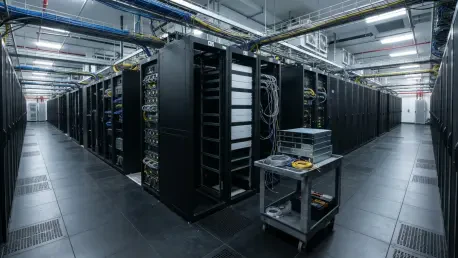

Technological sophistication within the contemporary server farm has reached a point where the most significant obstacle to profitability is no longer the speed of the processor but the systemic waste of already purchased power and floor space. While massive investments are funneled into new hardware to support the burgeoning demands of artificial intelligence and high-speed analytics, a silent crisis of inefficiency persists within the racks. A staggering amount of capacity, often referred to as ghost or zombie servers, sits idle, drawing current and occupying valuable square footage without providing any measurable output. This gap between theoretical potential and actual utility creates a financial drain that no longer fits into the modern lean operational model.
Infrastructure leaders find themselves at a crossroads where the solution is no longer to simply build more, but to recover what is already owned. The path to reclaiming this lost capacity is not found in a single hardware purchase but in a fundamental shift in how resources are perceived and managed. By moving away from a philosophy of expansion and toward a disciplined strategy of reclamation, organizations can unlock hidden value that fuels innovation without the need for additional capital expenditure. The objective is to turn these stagnant assets into high-performance drivers of business growth that can sustain a long-term trajectory from 2026 toward 2030.
Beyond the Ghost Servers: The Hidden Cost of Idle Infrastructure
The modern data center exists in a state of constant tension between the desperate search for more power and the reality of widespread waste. Even as facilities struggle to find the electrical headroom for next-generation chips, a significant percentage of existing capacity remains completely dormant. This idle infrastructure represents a massive purchased capacity that has already been paid for but provides zero return on investment. The cost of this waste is compounded by the high prices of energy and the environmental pressures to reduce the carbon footprint of digital operations. Simply leaving these servers on just in case is a luxury that few budgets can continue to sustain in the face of rising operational costs.
This scenario creates a financial paradox where companies pay for the highest grade of infrastructure only to use a fraction of its power. The hidden cost is not just the electricity consumed by idle silicon, but the missed opportunity to deploy new, more profitable workloads in that same space. When a rack is occupied by a server doing nothing, it prevents the installation of a server that could be running revenue-generating AI models or processing critical customer data. To remain competitive in the current landscape, the focus must shift from the acquisition of new hardware toward the ruthless optimization of every existing watt and rack unit within the facility.
The Visibility Gap: The Crisis of Fragmented Data
The inability to reclaim underused resources often stems from a fundamental lack of transparency across the organization. Data centers frequently suffer from deep organizational silos where different teams maintain their own isolated views of the infrastructure. For instance, the facilities management team might monitor the cooling and power distribution, while the IT platform team tracks central processing unit and memory usage. Because these systems rarely share data in a meaningful way, it becomes impossible to see the bottlenecks that prevent full utilization. A platform manager might see plenty of available memory for a new application, yet the facilities manager knows that the specific row where that server sits has already reached its thermal limit.
This fragmentation leads to a situation where decision-makers are operating in the dark, unable to distinguish between a hardware limitation and a software configuration issue. Without a unified, workload-centric view of the entire stack, capital remains trapped in pockets of the data center that are deemed unusable by one team but viewed as empty by another. Reclaiming this capacity requires breaking down these traditional barriers and implementing integrated telemetry that provides a single source of truth. Only when the relationship between power, cooling, and compute is fully understood can an organization begin to move workloads with the precision necessary to maximize efficiency.
Categorizing the Unused: Waste vs. Strategic Reserve
Effective reclamation requires a nuanced understanding that not all idle capacity is inherently bad. Before any resources are reallocated, operators must accurately categorize what is recoverable waste and what is a necessary buffer. Overprovisioned resources represent a common form of waste where applications are granted far more memory or compute power than they ever actually use. This behavior is often driven by developer caution, where excessive margins are requested to prevent performance issues during rare peak periods. While this provides a safety net, it results in a massive amount of silent capacity that never serves a functional purpose.
In contrast, strategic reserves are essential components of a resilient infrastructure. These are the assets intentionally left idle to handle disaster recovery, failover events, or essential maintenance cycles. Attempting to reclaim this type of capacity without a sophisticated failover strategy can jeopardize the reliability of the entire system. Therefore, the goal of a modern reclamation program is to isolate recoverable resources—those that can be returned to the general pool without increasing the operational risk to the business. By differentiating between fragmented allocations and intentional buffers, managers can focus their optimization efforts where they will have the most significant financial impact.
Expert Perspectives: Modernization and Facility Lanes
Industry veterans suggest that the most cost-effective way to grow is to look inward at existing facilities rather than outward at new construction. Analyst Bruce Bateman has frequently pointed out that the decision to modernize a facility must be driven by actual demand rather than the allure of new technology. He warns of a ripple effect where the installation of high-density hardware in an aging facility triggers an expensive chain reaction of electrical and cooling upgrades. If a project to reclaim space for AI training requires a complete overhaul of the building’s power grid, the business case for that reclamation often falls apart.
Finding the right lane for a facility is a strategic necessity that prevents these costly missteps. If a specific data center site cannot support the massive power draw required for training large language models, it may still be perfectly suited for AI inference. Because inference—the process of using a trained model to answer queries—requires less power and benefits from proximity to the end-user, it offers a lucrative path for repurposing older infrastructure. Additionally, research into automated resource sharing, such as the GPU sharing models pioneered by companies like Google, demonstrates that throughput can be increased by as much as 50 percent without adding new hardware. These expert insights prove that intelligence in workload placement is often more valuable than the raw size of the facility.
Practical Frameworks: Rightsizing and Optimization
The technical process of reclaiming capacity is a continuous cycle of adjustment rather than a single event. One of the most effective frameworks involves the implementation of rightsizing through dynamic autoscaling. By allowing infrastructure to breathe with the actual demand of the application, resources can be added or removed in real-time. This ensures that the system is never paying for idle silicon during low-traffic periods. However, this requires an application architecture that supports horizontal scaling, where workloads can be distributed across multiple smaller instances rather than a single massive server that is difficult to optimize.
Intelligent workload consolidation provides another powerful tool for optimization. By using advanced scheduling software, operators can group multiple underutilized workloads onto a smaller number of physical hosts. This consolidation frees up entire servers or even full racks, which can then be powered down to save energy or repurposed for high-priority projects. Every such initiative should be supported by power telemetry and predictive automation, allowing the system to anticipate when and where capacity will be needed. Ultimately, every reclamation project must be supported by a rigorous economic evaluation where the cost of software tools or hardware retrofits is measured against the significant savings of delaying a new data center build.
The strategy for managing digital infrastructure underwent a fundamental transformation as organizations prioritized the reclamation