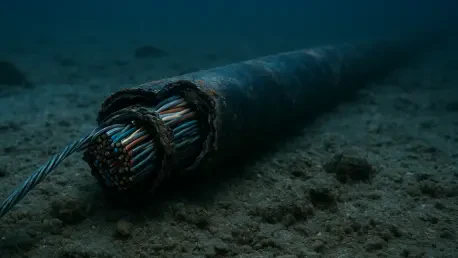

A global cable war represents a form of mutually assured disruption where the attacker inevitably inflicts damage upon its own economic systems. While the modern consumer perceives the internet as an ethereal, weightless cloud, the reality is a grittier, physical network of fiber-optic strands spanning the dark depths of the world’s oceans. These thin glass fibers carry the lifeblood of 21st-century civilization, yet they remain largely unprotected from the calculated maneuvers of hostile state actors. Recent escalations in the Arctic have demonstrated that the ocean floor is no longer a silent void but a primary theater for hybrid warfare. Intelligence reports from 2024 highlighted how Russia’s Main Directorate for Deep Sea Research, or GUGI, conducted sophisticated simulations near Norway’s Svalbard archipelago to map and potentially sever these critical links. Today, the persistence of these “underwater war games” forces a reckoning with the fact that a few coordinated strikes could effectively blind the West, decapitating communication and control systems before a single shot is fired on land. The vulnerability of this subsea infrastructure is not merely a technical oversight but a systemic risk that threatens the very stability of global governance and the daily survival of urban populations.
Technical Fragility: The Role of DNS
The Mechanism: Network Decay
The Domain Name System, or DNS, functions as the invisible architecture that allows the global community to navigate the digital landscape by translating human-readable names into machine-accessible numerical addresses. This system is often described as the “glue” that binds disparate networks into a cohesive global internet. If subsea cables were systematically severed, the immediate result would not be a total blackout but a terrifyingly slow “dimming out” of connectivity. Because the DNS relies on a process called caching—storing localized copies of address information for a set period—many services would initially appear to function normally. However, as these caches expire and local servers find themselves unable to reach the authoritative root servers across the ocean, the digital world would begin to fragment. Websites would stop resolving, databases would lose synchronization, and the interconnectedness we take for granted would erode into isolated, non-functional islands of data. This decay is particularly insidious because it creates a false sense of security in the opening hours of a crisis, delaying the necessary emergency responses until the infrastructure is already beyond immediate repair. The psychological impact of a fading internet, where services vanish one by one, would likely be more destabilizing than a sudden, clean break in communication.
Urban Impact: Physical Infrastructure Failures
The consequences of network decay extend far beyond the inability to access social media or stream content, as they strike at the heart of municipal management and physical security. Modern urban centers are governed by Industrial Control Systems (ICS) and Internet of Things (IoT) sensors that synchronize everything from traffic flow to the pressure in water mains. These systems are not closed loops; they frequently rely on cloud-based synchronization and remote monitoring that traverse international data links. When the underlying connectivity fails, the synchronization of traffic lights collapses, leading to gridlock that prevents emergency vehicles from reaching their destinations. Similarly, electricity grids that balance load through real-time data exchanges would face instability, potentially triggering regional blackouts as automated systems lose their ability to communicate across borders. The loss of control over water circulation and waste management systems would follow, turning a digital disruption into a public health catastrophe. This transition from a virtual failure to a physical collapse illustrates why subsea cables are the ultimate high-value target for those looking to destabilize a nation from within without traditional military invasion. In an era where cities are designed for maximum connectivity, the absence of that connection renders the physical environment nearly uninhabitable.
Economic Impact: Paralysis and Collapse
Global Finance: The Threat of Liquidity Crises
The global financial system is perhaps the most vulnerable beneficiary of subsea fiber-optic technology, with more than 99% of international data traffic moving through these underwater corridors. Every single day, an estimated $10 trillion in financial transactions, settlements, and currency exchanges are processed across these links, anchoring an economy that is fundamentally dependent on the U.S. dollar and American clearinghouses. If these cables were targeted, the result would be an immediate and total freeze of the international banking apparatus. National economies dependent on trade would find themselves unable to verify letters of credit or execute cross-border payments, leading to a rapid disappearance of liquidity. For the average citizen, this would manifest as the sudden failure of credit and debit cards, the inability to withdraw cash from ATMs, and the freezing of personal savings accounts. As the mechanisms of daily commerce vanish, the resulting psychological blow would likely trigger widespread social unrest and panic. The interdependence of modern markets means that no nation is an island; a disruption in the North Atlantic would be felt in every market from Tokyo to Johannesburg, creating a cascading economic failure that exceeds any recession in recorded history. The damage would be so complete that it would take years, if not decades, to rebuild the trust necessary for a global credit-based economy.
Essential Services: Education and Emergency Logistics
Beyond the high-stakes world of finance, the severing of subsea links would essentially dismantle the delivery of modern healthcare, education, and emergency logistics. Today, medical records are increasingly stored in cloud-based repositories that might reside thousands of miles from the hospital where a patient is being treated. A surgeon’s access to critical diagnostic images or a pharmacist’s ability to verify life-saving prescriptions would be compromised if the connection to these remote servers is cut. Similarly, the education sector has integrated cloud-based learning management systems and digital research archives so deeply that their absence would bring academic progress to a standstill. Perhaps more critically, the coordination of emergency services and military logistics relies on the same commercial infrastructure for redundant communication. Without these lines, the ability to organize large-scale disaster relief or move military assets in response to an attack would be severely hampered. The globalized nature of data routing ensures that even domestic military communications often pass through international commercial cables, creating a scenario where a strategic strike on a civilian asset directly degrades a nation’s ability to defend itself and care for its population during a crisis. This vulnerability highlights a dangerous lack of separation between the tools of convenience and the tools of national survival.
Resilience and Weakness: Misconceptions
Satellite Technology: The Myth of a Seamless Backup
A common argument in defense of digital resilience suggests that satellite constellations like Starlink or Kuiper could provide a fail-safe backup if the ocean floor were to become a graveyard for fiber optics. However, this perspective ignores the fundamental physical and technical limitations of orbital networks. Satellite systems are not independent entities; they are deeply reliant on terrestrial ground stations and command-and-control centers that are themselves connected to the global network via the same vulnerable subsea cables. Furthermore, the sheer volume of data carried by a single subsea fiber-optic pair—often measured in hundreds of terabits per second—dwarfs the current total capacity of entire satellite constellations. Attempting to reroute even a fraction of global internet traffic through space would result in massive congestion and system-wide failure. Additionally, in the event of a high-intensity conflict, space-based assets are just as vulnerable as those on the sea floor. The demonstration of anti-satellite (ASAT) capabilities by major powers suggests that a “cable war” would almost certainly be accompanied by a “space war.” The resulting debris fields from destroyed satellites could render low-Earth orbit unusable for generations, leaving the world without even the limited fallback of satellite communication. Relying on satellites as a primary backup is a strategic gamble that fails to account for the integrated nature of modern information warfare.
Structural Fragility: The Cost of Efficiency
The extreme vulnerability of the modern internet is not an accident of engineering but a deliberate byproduct of an industry that has prioritized cost-efficiency and speed over physical security and redundancy. For decades, the race to build a faster and cheaper network has led to a concentration of data traffic into a few high-capacity corridors that are well-mapped and easily targeted. Corporations and consumers have generally been unwilling to pay the high price premiums required to fund truly redundant, multi-point resilient systems that do not rely on these centralized hubs. This has created a “superficial veneer of resilience” where a network may have multiple logical paths for data but only one or two physical routes across the ocean floor. While the technology to build decentralized and hardened subsea networks exists, the market’s drive for efficiency has ensured that these solutions remain largely unimplemented. This structural fragility means that a sophisticated adversary does not need to cut thousands of cables to achieve a total shutdown; they only need to target a few strategic “choke points” where dozens of lines converge near the coastline. Until global infrastructure policy shifts from a focus on quarterly profits to long-term national security, the physical backbone of our civilization will remain an inviting target for sabotage. The price of our digital convenience may ultimately be measured in the loss of sovereign control over our most critical data pathways.
A Future Defined by Infrastructure Resilience
The analysis conducted throughout this study has demonstrated that the physical integrity of subsea cables is no longer a niche concern for telecommunications engineers but a cornerstone of global stability. As explored, the potential for a “dimming out” of the DNS, the subsequent paralysis of international finance, and the collapse of urban management systems indicate that a war on the ocean floor is a war against the functionality of modern life. In conclusion, the international community has historically treated these cables as private commercial assets rather than critical sovereign infrastructure, a mistake that must be rectified through immediate investment in dark fiber redundancy and localized data sovereign centers. Governments and private entities were found to be lagging in the implementation of “self-healing” network protocols and physical protective measures for landing stations. Moving forward, the development of regional “intra-nets” that can maintain essential municipal functions during a global outage should be a top priority for national security planners. The findings suggested that while the threat of mutually assured disruption might deter some actors, the lack of physical protection makes the cost of sabotage dangerously low. Strengthening these links through international treaties and robust maritime patrolling was identified as the only viable path to securing the digital foundations of the next decade. Ensuring the survival of the internet requires moving beyond the illusion of the cloud and protecting the very real glass fibers buried beneath the waves.