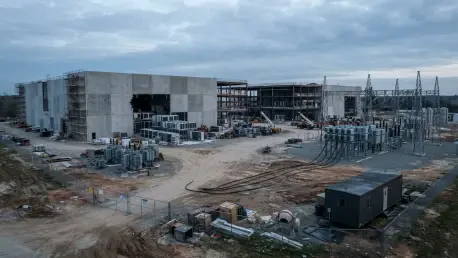

The scarcity of available electrical power is joining high interest rates as a primary constraint that is slowing the construction of massive new data center projects. This convergence of physical and financial limitations marks a departure from the unbridled expansion that characterized the early stages of the generative intelligence revolution. As the industry matures, the initial surge of speculative capital is being replaced by a more cautious environment where lenders demand transparency and immediate utility. Industry leaders have begun highlighting the emergence of “stranded compute,” a term describing partially completed facilities that lack the funding to reach operational status. In these instances, high-performance hardware sits in a state of suspended animation, unable to generate the necessary cash flow to satisfy the debt incurred during their inception. This shift suggests that the era of growth at any cost has ended, forcing builders to reconcile their technical ambitions with the harsh realities of a tightening credit market that no longer prioritizes potential over performance.
The Flight to Quality: Capital Markets and Risk Repricing
Recent market movements indicate a distinct bifurcation between companies with diversified revenue and those relying solely on speculative artificial intelligence applications. For example, ventures that successfully integrated satellite communications or global logistics into their business models have managed to secure substantial debt financing at competitive rates. These investment-grade entities possess the “substantial revenue” buffers that lenders now require before committing billions to high-performance computing clusters. This flight to quality reflects a broader realization that the intelligence boom is transitioning from a novelty to a fundamental utility that must be supported by traditional business fundamentals. Lenders are increasingly wary of pure-play developers whose balance sheets lack the depth to absorb delays in data center deployment. Consequently, the competition for capital has intensified, favoring established giants who can leverage their existing cash reserves and proven track records to maintain infrastructure momentum.
Despite the alarmist rhetoric regarding a total shutdown of funding, evidence suggests a sophisticated re-pricing of risk rather than a systemic collapse of the debt market. High-profile startups in the intelligence sector, such as Anthropic, continue to navigate complex financing rounds, including junior debt tranches that carry significantly higher yields than seen in previous cycles. A yield exceeding 10% on these instruments demonstrates that capital remains accessible for elite players, albeit at a premium that necessitates extreme operational efficiency. This pricing environment serves as a filter, separating the most viable architectural models from those that cannot sustain such high borrowing costs. The market is effectively demanding that these organizations prove their worth through immediate, verifiable cash flow projections. This rigorous vetting process ensures that only projects with the highest probability of commercial success receive the necessary backing to move from design to deployment, stabilizing the broader ecosystem against speculative bubbles.
Identifying Vulnerabilities: Ecosystem Risks and Supplier Resilience
The risks inherent in this new financial paradigm are becoming increasingly visible among specialized data center operators who lack significant non-AI revenue streams. Applied Digital serves as a pertinent example, as it manages a precarious balance between substantial debt obligations and relatively thin cash reserves. When a significant portion of an organization’s revenue is tied to volatile sectors like cryptocurrency hosting, the market naturally questions its ability to service billions in long-term debt. Even with decades-long contracts in place, the perceived instability of the tenant base can cause a sharp decline in investor confidence and stock valuation. This skepticism highlights a critical vulnerability for builders who rely on a narrow set of customers within a rapidly evolving industry. Without a diversified buffer, these companies remain highly susceptible to fluctuations in interest rates and shifts in market sentiment. The focus has moved beyond the sheer volume of contracted revenue toward the actual liquidity and creditworthiness of the counterparties involved.
While builders struggle with liquidity, the “picks and shovels” suppliers that provide the underlying networking fabric tell a more resilient story. Companies leading the charge in optical networking and high-speed switches, such as Arista Networks and Marvell Technology, continue to report robust demand from large-scale hyperscalers. These major cloud providers possess the massive capital reserves required to sustain infrastructure investment even during periods of financial turbulence. However, even these industry stalwarts are beginning to voice caution regarding the “timely basis” of equipment deployment. The primary bottleneck is shifting from silicon availability to the physical limitations of the grid, specifically the scarcity of electrical power and specialized cooling infrastructure. Networking leaders are now closely monitoring how quickly their customers can actually turn on the hardware they purchase. If infrastructure bottlenecks persist, even the strongest suppliers may face a period of cooling demand as their clients wait for power capacity to catch up with their computing power.
The Strategic Outlook: Consolidation and Operational Sustainability
The industry is currently transitioning into a consolidation phase that will likely redefine the hierarchy of global computing power. Stronger buyers and better-capitalized builders are positioned to absorb the assets of smaller players who find themselves unable to secure necessary financing. This trend toward consolidation is not necessarily a sign of failure but rather a move toward a more stable and disciplined growth trajectory. The health of the entire sector will soon be judged by the upcoming earnings reports and capital expenditure guidance from the major networking and chip manufacturing giants. These metrics will serve as a bellwether for the remaining months of 2026, indicating whether the build-out phase is merely pausing or undergoing a structural shift. Analysts are paying particular attention to free cash flow yields and the ability of smaller operators to refinance their existing obligations without entering a spiral of high-interest debt. This environment prioritizes those who can achieve the highest “compute-per-watt” efficiency while maintaining a lean financial structure.
The era of unconstrained expansion required a fundamental shift in how organizations approached data center construction and financing. To navigate the complexities of 2026 and beyond, stakeholders recognized that financial stability had to match technical innovation. Successful firms established robust partnerships with regional utility providers to secure power rights years in advance, effectively de-risking their projects for wary lenders. They also prioritized the development of proprietary cooling technologies that reduced operational overhead, thereby improving the cash flow margins required to service high-interest debt. The market eventually rewarded those who moved away from speculative “pure-play” models toward integrated platforms with diverse revenue streams. By focusing on the cold realities of credit ratings and the physical constraints of the electrical grid, the industry moved toward a sustainable equilibrium. Moving forward, the most effective strategy involved rigorous stress-testing of debt-to-cash ratios and a commitment to transparency in reporting hardware utilization.