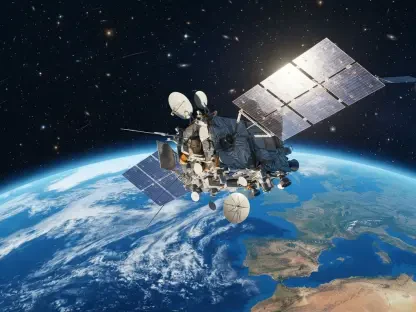

The integration of S, X, and Ka-band connectivity ensures that the new infrastructure remains compatible with a vast range of current and future satellite protocols. As the space industry moves beyond the simple mechanics of launching rockets, the focus has shifted toward the critical roots of the ecosystem: data accessibility and ground connectivity. At the center of this transformation is Global AKAR, a high-stakes partnership between the established satellite giant Eutelsat and the innovative French startup Skynopy. This initiative aims to build a software-defined ground infrastructure that bridges the gap between high-tech orbital data collection and the practical needs of terrestrial users. By treating the ground segment as a unified, intelligent network rather than a series of isolated hardware outposts, Global AKAR is setting the stage for a more connected and data-driven space economy. The name AKAR, meaning root in Malay, underscores the foundational role this project plays in supporting the modern NewSpace market as it expands into more complex orbital operations.
The Shift Toward Software-Defined Ground Segments
Modernizing Infrastructure: Virtualization and SDN
The core innovation of Global AKAR lies in its transition from hardware-centric operations to Software-Defined Networking. Historically, ground stations required specific physical modems and dedicated hardware for every satellite they communicated with, creating a rigid and expensive environment that limited growth. By utilizing Skynopy’s orchestration software and virtualized modem technology, the partnership allows existing antennas to be repurposed and shared across different missions dynamically. This flexibility enables operators to manage diverse constellations through a single interface, significantly lowering the barrier to entry for new satellite companies.
Furthermore, the move toward virtualization ensures that ground infrastructure can evolve alongside satellite technology without requiring constant physical upgrades. Software-defined systems allow for remote updates and configuration changes, meaning that ground stations can adapt to new communication protocols almost instantly. This agility is vital for the current LEO economy, where satellite missions are becoming increasingly diverse and complex. By decoupling the hardware from the software, the initiative allows for a much more efficient use of existing ground assets, turning static outposts into versatile nodes.
Performance Gains: Throughput and Latency
Beyond mere flexibility, the Global AKAR initiative is engineered to deliver unprecedented performance metrics that challenge current industry standards. While traditional systems often experience data delivery delays of an hour or more, this new infrastructure aims to reduce latency to less than three minutes. This leap in performance is critical for applications that rely on immediate information, such as tracking fast-moving orbital assets or responding to sudden environmental changes. By streamlining the path from the satellite to the user, the network ensures that orbital data remains relevant and actionable for those who need it most.
Additionally, the network is designed to support a throughput of up to 10 Gbps, which is a massive increase over the 1–2 Gbps typical of state-of-the-art systems used until recently. These improvements ensure that the ground segment can keep pace with the massive volumes of data generated by modern Earth observation and in-orbit computing satellites. This high-capacity data backbone allows for the seamless transfer of high-resolution imagery and complex datasets without the risk of creating a bottleneck in the overall space data pipeline. It effectively creates a high-speed highway between space and Earth.
Industrial Impact and the Future of Space Services
Real-Time Solutions: Commercial and Security Applications
The implementation of this global data backbone has profound implications for industries that rely on timely information, such as disaster response, maritime tracking, and national security. By providing near-real-time data processing and high-capacity secure links, Global AKAR allows Earth observation companies to deliver insights when they are most valuable. In emergency scenarios, where every minute counts, having a ground network that can deliver high-resolution imagery almost instantly can drastically improve the effectiveness of humanitarian efforts and resource allocation on a global scale.
This infrastructure also supports the rising demand for in-orbit services, where satellites perform complex computing tasks in space and require reliable connections to transfer results back to Earth. As orbital edge computing becomes more prevalent, the ground segment must be able to handle specialized data packets and bursty traffic patterns. The secure architecture of Global AKAR ensures that sensitive information, whether commercial or governmental, is handled with the highest degree of integrity across all nodes, making it a cornerstone for both civil and defense applications that require absolute reliability.
Service Scaling: The Ground-Station-as-a-Service Model
The partnership successfully planned the deployment of over 100 operational antennas at strategic sites worldwide by 2029, leveraging Eutelsat’s extensive geographical footprint and regulatory expertise. This expansion facilitated a ground-station-as-a-service model, which removed the need for individual satellite operators to build and maintain their own costly infrastructure. By offering a shared, multi-band network operating across S, X, and Ka-bands, the initiative ensured compatibility with a wide range of protocols. This collaborative approach significantly reduced the capital barriers for new entrants in the space sector.
The project ultimately reinforced European technological sovereignty while establishing a new global standard for how orbital data was managed and delivered. It bridged the technical gap between legacy ground hardware and modern cloud-native software, providing a resilient foundation for the space economy. By streamlining the connection between space and Earth, the Global AKAR initiative provided the necessary infrastructure to handle the explosive growth of satellite constellations. This strategic move ensured that the ground segment remained an active and intelligent layer of the global aerospace ecosystem.