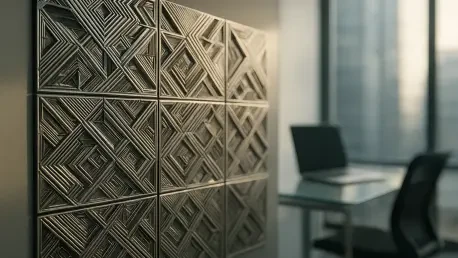

Because millimeter waves are highly susceptible to blockage by the human body, maintaining a stable connection in a crowded room has traditionally required expensive and power-hungry hardware solutions. As the wireless industry shifts toward the high-frequency spectrum of 6G, the fundamental physics of signal propagation presents a daunting obstacle. Unlike the lower frequencies used in previous generations, millimeter waves travel in tight, laser-like beams that are easily obstructed by everyday objects. A person walking through a room or even a heavy piece of furniture can effectively terminate a high-speed link, leading to frustrating dropouts and latency spikes. Researchers at the University of California San Diego have recently introduced a solution named FlowForm, which utilizes 3D-printed passive tiles to bypass these physical limitations. This technology promises to turn walls into smart mirrors that intelligently route data around obstacles in the workspace environment.
Metasurface Architecture: Turning Plastic Into Precision Electronics
The construction of FlowForm tiles represents a significant departure from the complex manufacturing processes typically associated with advanced telecommunications hardware. Each six-inch square tile is produced using standard 3D printing techniques and finished with a thin coating of specialized conductive paint. Despite their deceptively simple appearance, these tiles are sophisticated metasurfaces embedded with thousands of sub-wavelength elements. These microscopic structures are meticulously designed to manipulate incoming electromagnetic waves, allowing the tiles to reflect signals at specific angles rather than scattering them haphazardly like a typical wall surface. This precise control enables the system to steer wireless data streams with extreme accuracy, effectively creating a controlled pathway for signals to navigate around corners. The ability to manufacture such high-performance components using commodity materials marks a shift in how engineers approach the problem.
One of the most compelling aspects of the FlowForm system is its entirely passive nature, which eliminates the need for internal circuitry or a constant power source. Traditionally, extending the range of high-frequency networks required active relays or small cells that consume electricity and add significant complexity to a building’s infrastructure. A single active relay can easily cost thousands of dollars, making wide-scale deployment a financial burden for most property owners. In stark contrast, a FlowForm tile can be produced for approximately two dollars, allowing for the potential of blanketing entire rooms or office complexes with signal-enhancing surfaces for a fraction of the cost. This economic feasibility opens the door for a ubiquitous wireless environment where every surface contributes to connectivity rather than hindering it. By removing the energy requirements, the technology also offers a sustainable path forward for the 6G era, reducing the total carbon footprint.
Major-Minor Flow Topology: A New Standard for Signal Distribution
To manage the distribution of signals across a wide area, the research team implemented a hierarchical organization known as the major-minor flow topology. This design philosophy is inspired by the natural movement of water through a drainage basin, where large channels feed into smaller tributaries to ensure total coverage. In this wireless context, major flow tiles function as the communication backbone, acting as a chain of high-precision relays that shuttle signals over long distances and through structural bottlenecks. These tiles are optimized for narrow, high-gain reflections that preserve signal integrity across large spaces, ensuring that the initial data stream reaches the deepest recesses of an indoor environment without significant loss. By establishing these primary corridors of data, the system creates a reliable foundation upon which more localized distribution can occur. This structured approach prevents the signal from becoming incoherent as it bounces through multiple reflections.
Branching off from this central backbone are the minor flow tiles, which serve as the final distribution layer for end-user devices. Unlike their major flow counterparts, these tiles are designed to emit wider beams, effectively saturating specific zones with signal coverage from multiple angles simultaneously. This intentional redundancy is a critical feature of the system, as it ensures that a wireless device can maintain a stable connection even when a user is in motion. If a person moves or an object is shifted into the path of one reflection, the device can instantly pick up a signal from a different minor flow tile without the user experiencing any interruption in service. This multi-directional approach solves the persistent issue of dead zones that has plagued high-frequency wireless deployments in the past. By creating a dense web of potential connection points, FlowForm provides the resilience needed for demanding applications like augmented reality within modern workspaces.
System Integration: Performance and Compatibility in Real-World Scenarios
Empirical testing in various real-world indoor environments has demonstrated that the FlowForm system provides performance gains that rival far more expensive and power-hungry alternatives. Data collected from these trials indicated that the average data-carrying capacity of wireless links nearly doubled when the passive tiles were present. Furthermore, the total coverage area within challenging office layouts was more than doubled, transforming previously unreachable corners into high-speed zones. These metrics are particularly impressive because they were achieved without the use of complex coordination protocols or high-voltage power supplies that typically limit the scalability of 6G infrastructure. The technology offers a uniquely sustainable way to bring ultra-wideband connectivity into dense urban environments and industrial settings. By prioritizing structural physics over electronic amplification, the research team has found a way to maximize the utility of the available spectrum while keeping the operational overhead low.
Beyond its raw performance capabilities, FlowForm stands out for its seamless compatibility with existing wireless hardware and standards. Since the tiles act as natural reflectors, they do not require any software updates, specialized firmware, or changes to the internal architecture of routers and mobile devices. Modern 6G access points are already designed to scan their surroundings for the strongest available signal path, and FlowForm simply provides a vastly expanded menu of high-quality paths for them to utilize. This makes the system an invisible upgrade that can be integrated into the physical aesthetics of a building through wall panels, ceiling tiles, or even decorative art. The lack of electronic components also means there are no issues with electromagnetic interference or regulatory certifications that often delay the rollout of new radio hardware. This plug-and-play nature ensures that property managers can deploy signal-optimizing surfaces quickly and effectively to address gaps.
Smart Infrastructure: Architectural Solutions for Future Connectivity
The success of the FlowForm project suggests a broader trend where the design of internal spaces becomes inextricably linked with the performance of the digital networks they house. Future smart buildings may be designed from the ground up with wave-shaping materials integrated directly into the drywall, paint, and structural beams. This evolution would move the industry away from the current model of patching coverage holes with additional hardware and toward a more holistic vision of architectural wireless design. Engineers and architects could collaborate to create indoor environments that are inherently transparent to high-frequency signals, using passive elements to channel data like light through a prism. Such a shift would significantly reduce the density of active radio equipment required in public spaces, leading to cleaner aesthetic designs and lower overall energy consumption. The ability to use standard 3D printing for these components means that customized solutions can be tailored to any unique room geometry.
The development of FlowForm established a new precedent for how researchers addressed the fundamental physical barriers of the 6G era. By moving away from the paradigm of active, energy-intensive hardware, the industry proved that passive metasurfaces offered a viable and cost-effective method for eliminating signal blockages. Moving forward, organizations should prioritize the evaluation of their physical infrastructure as a core component of their digital strategy. Investing in signal-aware building materials provided a long-term solution that bypassed the obsolescence cycles of traditional electronic equipment. Stakeholders in the telecommunications and construction sectors observed that the integration of passive tiles offered an immediate boost to network reliability while maintaining strict energy efficiency standards. As high-frequency networks became the global standard, the adoption of these smart surfaces ensured that the promise of 6G was fulfilled.